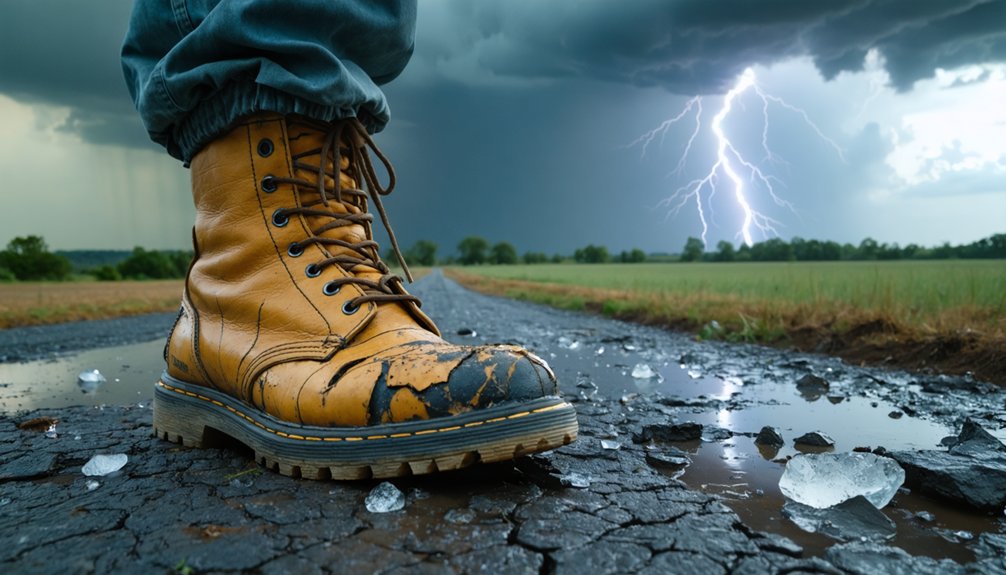
For storm chasing, you’ll need gear engineered to survive sustained punishment. Prioritize a waterproof jacket with at least a 20,000 mm hydrostatic head rating and fully taped seams. Pair it with quick-donning rain pants, Vibram-soled boots, and impact-rated eye protection. Don’t overlook satellite communication devices and high-capacity power banks for remote operations. The right combination of protective clothing and field equipment keeps you operational when conditions turn dangerous—and every gear choice covered ahead gets more specific from here.
Key Takeaways
- Waterproof jackets need a hydrostatic head rating of at least 20,000 mm with fully taped seams for reliable storm protection.
- Top jacket options include Arc’teryx Beta AR, Patagonia Torrentshell 3L, and Outdoor Research Foray II for proven performance.
- Rain pants with full-length side zips allow quick over-the-boot donning during rapidly changing storm conditions.
- Boots with Vibram soles and aggressive lug patterns provide essential grip and ankle support on wet, uneven terrain.
- Weatherproof gloves, polycarbonate helmets, and high-impact safety glasses protect against wind, debris, and hail during active chasing.
Waterproof Jacket Ratings That Actually Matter in a Storm
When you’re gearing up for storm chasing, not all waterproof ratings are created equal. You need a jacket with a hydrostatic head rating of at least 20,000 mm to handle prolonged storm exposure. Anything lower and you’re risking saturation during extended downpours.
Weatherproof fabric performance also depends heavily on seam sealing. Fully taped or welded seams outperform critically taped construction by eliminating the weak points where water intrudes. Don’t compromise here.
Seam sealing is non-negotiable. Fully taped or welded construction eliminates the weak points that let water win.
Breathability matters too. Target 15,000 g/m²/24h or higher to manage sweat during active chasing. Options like the Patagonia Torrentshell 3L, Sitka Dew Point, and Kuiu Chugach TR meet these benchmarks.
Add water-resistant zippers and adjustable closures, and you’ve got a shell that handles rapid, unpredictable weather shifts without trapping you.
Best Waterproof Jackets for Storm Chasing
Choosing the right jacket means narrowing a crowded field down to shells that actually deliver in sustained storm conditions. Weather resistant fabrics and smart layering techniques separate functional gear from marketing noise. You need proven construction, not promises.
Top-performing options include:
- Patagonia Torrentshell 3L – fully taped seams, packable, reliable in extended rain
- Sitka Dew Point – purpose-built for field use, high breathability, rugged construction
- Kuiu Chugach TR – aggressive weather protection with active-use breathability
- Arc’teryx Beta AR – 20,000 mm rating, Gore-Tex Pro, water-resistant zippers throughout
- Outdoor Research Foray II – storm-ready build with adjustable closures for rapid condition changes
Prioritize jackets rated at 20,000 mm hydrostatic head or higher with breathability exceeding 15,000 g/m²/24h.
Rain Pants Built to Handle Severe Weather and Rough Terrain
Full-length side zips let you pull pants over boots quickly when conditions shift.
Convertible zip-off designs add flexibility across variable chase-day temperatures without carrying extra gear.
Waterproof Boots With the Traction Storm Terrain Demands
When you’re orienteering flooded fields, muddy slopes, or debris-covered roads, high ankle support keeps your foot locked in place and reduces fatigue over long chase days. Boots like the Salomon Quest 4D 3 GTX and KEEN Targhee III Waterproof deliver structured ankle collars that stabilize uneven footing without sacrificing mobility.
You’ll also want slip-resistant outsoles with aggressive lug patterns, since wet grass, loose gravel, and storm-soaked pavement will test your grip at every step.
Ankle Support And Stability
Storm terrain doesn’t forgive weak ankle support—muddy ditches, hail-scattered gravel, and rain-slicked slopes all demand boots that keep you stable and dry under sustained pressure.
High-cut ankle stability designs reduce roll risk during unpredictable footing, and quality support footwear keeps you mobile when conditions shift fast.
- High ankle collars brace against lateral movement on uneven ground
- Stiff midsoles reduce fatigue during extended field positioning
- Padded ankle cuffs prevent pressure points during long wear
- Reinforced heel counters lock your foot in place on descents
- Lacing systems with locking zones let you customize tension by zone
Prioritize boots rated for multi-hour wear across variable terrain—your mobility during a chase depends entirely on how well your ankles hold up.
Slip-Resistant Sole Features
Traction fails before waterproofing does in most storm scenarios—mud, wet grass, flooded asphalt, and hail-covered gravel all destroy grip faster than they saturate leather or membrane layers.
You need a sole material like Vibram or a comparable high-density rubber compound that stays pliable across temperature extremes and resists compression under load. Soft rubber degrades grip; dense, purpose-built compounds don’t.
Your tread pattern matters equally—deep, multi-directional lugs channel water and debris away from contact points, maintaining ground adhesion when surface conditions shift without warning. Shallow or worn tread patterns collapse under wet terrain demands.
Boots like the Salomon Quest 4D 3 GTX and KEEN Targhee III Waterproof integrate both elements effectively. Don’t compromise here—lost footing near active storm debris carries consequences waterproofing ratings can’t offset.
Gloves, Helmets, and Eye Protection for Active Chasers
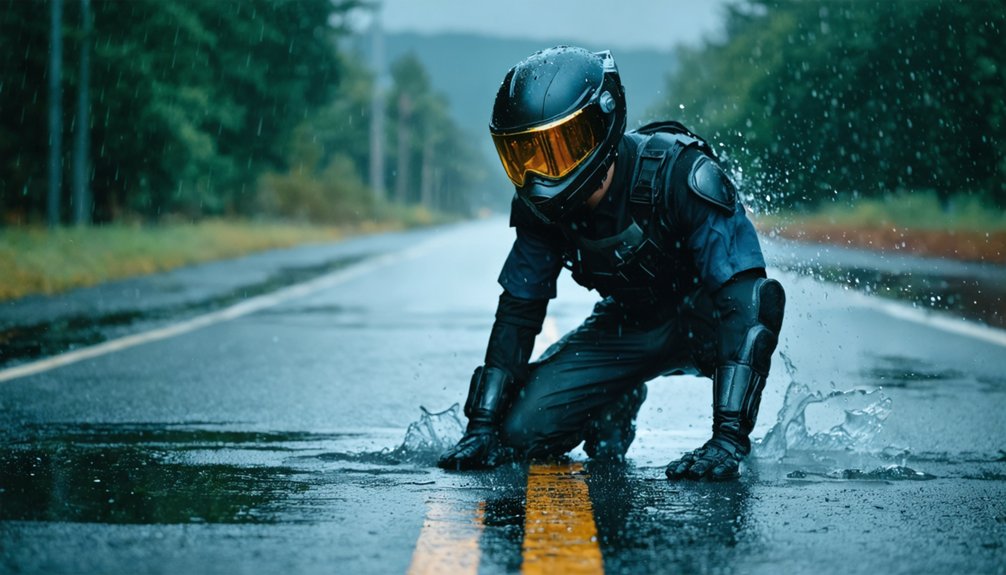
Protecting your hands, head, and eyes isn’t optional when you’re operating near hail cores, blowing debris, and post-storm cleanup zones. You need gear that performs under real field stress, not just light rain.
Gear failure in the field isn’t an inconvenience — it’s a liability. Perform under pressure or don’t go out.
- Choose weatherproof gloves with wind-blocking glove insulation and touchscreen-compatible fingertips for uninterrupted device operation.
- Select helmets featuring polycarbonate shells, EPS liners, and adequate helmet ventilation to prevent heat buildup during active pursuit.
- Wear high-impact safety glasses that block wind-driven particles and debris fragments.
- Use adjustable helmet straps to maintain secure fit during rapid movement or vehicle shift.
- Prioritize gloves with reinforced palm grip for handling equipment in wet, high-wind conditions.
Each piece serves a specific protective function. Stack these layers correctly, and you stay operational when conditions deteriorate fast.
Power and Communication Gear for Remote Storm Chasing
When you’re operating in remote areas with no cellular coverage, a satellite phone and GPS tracker aren’t optional—they’re your lifeline for real-time positioning and emergency contact.
You’ll also want a robust portable power setup, including high-capacity battery banks and a power inverter, to keep your phone, tablet, and camera running across multi-day chase trips.
Pair those with a surge-protected power strip for hotel recharging, and you’ve built a reliable power and communication system that won’t fail you when conditions turn severe.
Satellite Phones and GPS
Remote storm chasing takes you into areas where cellular networks don’t exist, and that’s where satellite phones and GPS trackers become non-negotiable tools rather than optional accessories. Reliable satellite communication and precise GPS navigation keep you operational when infrastructure fails completely.
- Satellite phones like Iridium or Globalstar models maintain two-way communication from any location globally.
- Dedicated GPS trackers provide real-time positioning independent of cellular signal.
- Emergency beacons transmit distress signals to rescue coordination centers automatically.
- Walkie-talkies extend local team communication across several miles without network dependency.
- Portable batteries keep satellite and GPS devices charged through extended multi-day deployments.
Don’t treat these tools as backups. In remote terrain during active storm conditions, they’re your primary lifeline for navigation, team coordination, and emergency response.
Portable Power Solutions
Every device you carry into the field—satellite phone, GPS tracker, camera, tablet—is useless the moment its battery dies, making portable power management one of the most critical logistical challenges in remote storm chasing.
You’ll want high-capacity portable charging batteries rated at 20,000 mAh or higher to keep multiple devices running simultaneously.
Power inverters plugged into your vehicle’s 12V outlet extend your operational window during long repositioning drives.
For multi-day deployments far from grid access, solar chargers provide passive recharging during daylight breaks between storm cycles.
Portable generators offer reliable backup when solar input is inconsistent due to heavy cloud cover.
Prioritize surge-protected power strips to protect sensitive electronics when recharging from hotel outlets or generator outputs between chase days.
Field Safety Gear Every Storm Chaser Should Have on Hand
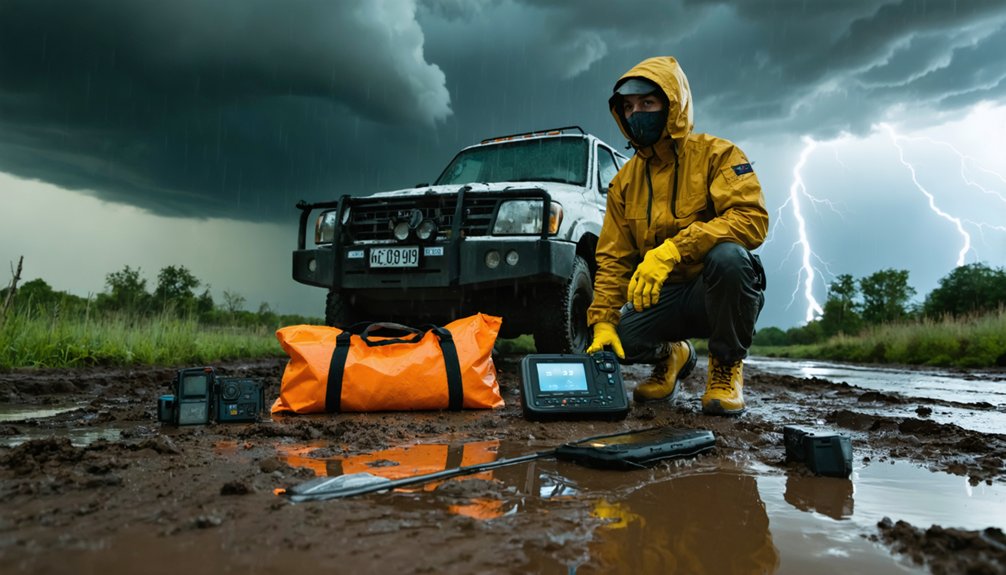
Storm chasing puts you in rapidly evolving, high-risk environments where the right field safety gear isn’t optional—it’s operational. Between wildlife encounters on remote access roads and rapidly shifting storm tracking techniques, you need gear that keeps you mission-ready.
- First aid kit: carry trauma-level supplies, not just bandages
- Flashlight or headlamp: essential for night operations and post-storm vehicle inspection
- Emergency beacon or walkie-talkie: backup communication when cellular networks fail
- Clear plastic film and tape: temporary window protection after debris impact
- AWD/4WD vehicle with mud tires: maintains access across flooded or damaged terrain
Each item directly supports field survivability. You’re not packing for comfort—you’re packing for continuity. Gaps in your safety loadout become liabilities the moment conditions deteriorate faster than your exit window allows.
Frequently Asked Questions
How Do You Dry Waterproof Gear Quickly Between Consecutive Storm-Chasing Days?
Like wringing out a storm cloud, you’ll need quick drying techniques fast: hang gear in ventilated spaces, use moisture wicking fabrics as base layers, and run a fan overnight to reclaim your freedom by dawn.
Can Waterproof Gear Ratings Decrease After Repeated Washing or Field Use?
Yes, waterproof material degradation is real—repeated washing and field use wear down DWR coatings, reducing washing impact on waterproofing over time. You’ll need to reapply DWR treatments regularly to maintain your gear’s rated performance.
What Layering Systems Work Best Underneath Waterproof Storm-Chasing Outerwear?
Can you afford to be cold and wet mid-chase? You’ll want moisture-wicking base layer moisture management paired with insulation compatibility—fleece or synthetic mid-layers trap heat without restricting movement, keeping you dry, warm, and field-ready.
How Should Waterproof Gear Be Stored During the Off-Season Chase Months?
Store your waterproof gear clean and fully dry before applying fresh DWR treatment. Use breathable bags for storage solutions, and schedule annual gear maintenance checks to keep seams, zippers, and membranes chase-ready.
Are There Specific Brands Offering Warranties for Storm-Damaged Waterproof Equipment?
Like a shield forged for battle, brand warranties from Patagonia and Sitka offer storm damage coverage you can count on. Check each brand’s policy directly, as coverage terms vary and you’ll want full protection clarity.
References
- https://www.reddit.com/r/stormchasing/comments/1o53b49/worn_gear_for_storm_chasing/
- https://www.stormtours.com/information/must-bring-items/
- https://www.facebook.com/groups/fansoftexasstormchasers/posts/2807461269441236/
- https://www.youtube.com/watch?v=Sr2lz72ZYwM
- https://stormtrack.org/threads/recommended-chaser-equipment-list.23013/
- https://crazystormchasers.com/best-rain-gear-waterproof-clothing-storm-chasers/
- https://crazystormchasers.com/weather-resistant-clothing-for-storm-chasing/
- https://crazystormchasers.com/thunderstorm-safety-gear-recommendations/
- https://store.sirui.com/blogs/guides/essential-equipment-for-storm-chasing-guide-for-2025
- https://www.outdoorlife.com/gear/best-hunting-rain-gear-2025/