Technology has fundamentally transformed how you compete in storm chasing contests. You’re now evaluated using GPS-logged intercepts, timestamped radar screenshots, and WSR-88D cross-referencing instead of subjective judging. Dual-polarization radar lets you confirm rotation velocity, hail size, and debris signatures with precision. Real-time data feeds shape your positioning decisions, while equipment disparities can give wealthier chasers a measurable edge. The full picture of how these factors reshape strategy, fairness, and safety goes much deeper.
Key Takeaways
- GPS and real-time radar access have transformed storm chasing contests from instinct-based pursuits into precise, data-driven competitive operations.
- Modern judging now relies on GPS-logged intercepts and timestamped radar data, replacing subjective scoring with measurable, verifiable metrics.
- Equipment cost disparities give wealthier chasers faster data and proprietary tools, creating competitive advantages that challenge fairness assumptions.
- Real-time data creates false confidence, encouraging riskier positioning and escalating dangerous behaviors during contests.
- Technology has fundamentally redefined contest participation requirements, demanding updated rules addressing safety risks and equipment inequality.
How Technology Rewrote the Rules of Storm Chasing Contests
As storm chasing evolved from instinct-based navigation into data-driven field operations, contests built around the activity had to adapt or risk becoming obsolete. You’re no longer competing with paper maps and visual cues alone. GPS, mobile Doppler feeds, and real-time radar access reshaped how scoring, positioning, and documentation get judged.
Contest organizers had to rewrite participation frameworks to account for dual-polarization radar data, mobile broadband, and high-definition video uploads from the field. These advancements forced direct conversations about storm chasing ethics, particularly around risk escalation in low-visibility or complex terrain scenarios.
Participant safety became a measurable variable, not an afterthought, requiring rule structures that balanced technological capability against responsible field behavior. Technology didn’t just improve performance—it fundamentally redefined what competitive storm chasing demands from you.
How Real-Time Radar and GPS Decide Contest Positioning
Before dual-polarization radar and GPS became standard chase tools, positioning near a tornadic storm relied heavily on visual cues, wind shifts, and instinct. Now, you’re operating with real-time Doppler feeds, mobile broadband, and precision GPS coordinates that transform your chase vehicle into a rolling data platform.
Storm chasing once meant reading the sky on instinct. Today, your vehicle is a rolling data platform.
Dual-polarization radar boosts data accuracy by distinguishing rain, hail, and tornadic debris signatures simultaneously. You’re no longer guessing rotation strength—you’re reading it directly from velocity scans.
GPS locks your position against storm trajectory, letting you intercept with calculated precision rather than reactive driving.
Drone surveillance adds another layer, pushing aerial visual data into your decision loop before you commit to a road.
Together, these tools don’t just improve your contest positioning—they redefine what accurate, strategic storm interception actually looks like.
How Storm Chasing Contests Are Scored and Judged Today
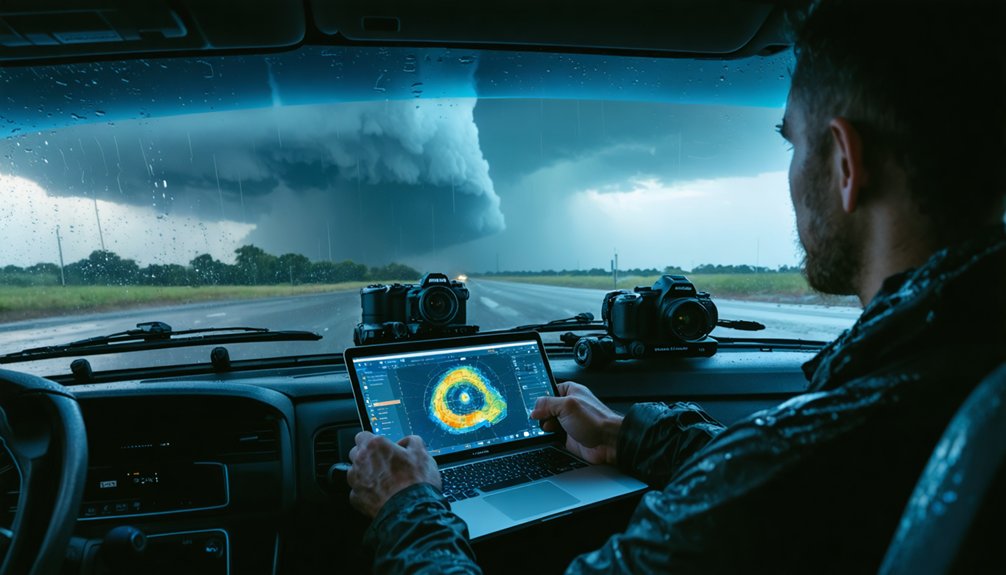
Scoring in modern storm chasing contests has shifted from subjective judging toward verifiable, data-backed metrics that reward precision over proximity. You’re evaluated on GPS-logged intercept coordinates, timestamped radar screenshots, and documented storm parameters like rotation velocity and hail size.
Historical precedents favored whoever got closest, but today’s systems cross-reference your position against WSR-88D data to confirm legitimate intercepts. Judges validate submissions using dual-polarization signatures and debris ball confirmation rather than relying solely on visual footage.
Ethical considerations shape scoring rules too — point deductions apply for reckless positioning or blocked road reports. You can’t fabricate a confirmed tornado intercept when radar archives exist.
This framework strips out guesswork, rewards disciplined positioning, and holds every competitor accountable to the same objective dataset.
Does Better Data Give Wealthier Chasers an Unfair Advantage?
The scoring framework that rewards GPS precision and radar-verified intercepts assumes equal access to the tools that make precision possible, but that assumption breaks down quickly when you examine equipment costs. Dual-polarization radar subscriptions, mobile broadband modems, and real-time data platforms carry recurring costs that create measurable financial disparity between chasers.
If you’re running a single smartphone against a team operating a vehicle-mounted radar unit with redundant LTE connections, you’re not competing on equal terrain. Equipment access directly shapes positioning accuracy, intercept timing, and scoring outcomes.
Wealthier chasers can afford faster data refresh rates, proprietary software, and backup systems that eliminate downtime. Contests haven’t structurally addressed this gap, which means the scoring system inadvertently rewards capital investment as much as it rewards skill.
When Contest Technology Pushes Chasers Into Dangerous Territory
Capital disparity isn’t the only consequence of technology-driven contest design—it’s also pushing chasers into terrain and conditions they’d otherwise avoid. When scoring algorithms reward proximity and rare storm types, you’re incentivized to chase after dark, navigate forested ridgelines, or enter hail cores where escape routes narrow fast.
Real-time radar and 4G LTE feeds create a false confidence—you can see the data, so you push further. That’s where ethical dilemmas surface: contest structures that prioritize documentation over survivability shift risk tolerance in measurable ways.
There’s also an environmental impact to consider—increased vehicle traffic through sensitive rural terrain during active weather events compounds ecological disruption. Technology didn’t create recklessness, but contest frameworks built around it can systematically reward decisions that compromise your safety and the surrounding environment.
Frequently Asked Questions
Can Amateur Chasers Compete Fairly Against Professionally Equipped Contest Teams?
You can compete, but equipment disparities create real challenges. Your amateur expertise in reading instinct-driven data matters, yet professionally equipped teams leverage dual-pol radar, mobile broadband, and GPS platforms that considerably outpace standard consumer-grade chase setups.
How Do Contest Organizers Verify the Accuracy of Submitted Storm Chasing Data?
Like town criers of old, organizers broadcast data authenticity standards clearly. They’ll cross-reference your GPS logs, radar timestamps, and photo metadata using verification methods powered by mobile broadband, Doppler records, and NOAA alert histories you’ve independently captured.
Are Storm Chasing Contests Officially Recognized or Sanctioned by Meteorological Organizations?
You won’t find formal meteorological accreditation or regulatory compliance frameworks governing storm chasing contests. Most operate independently, without official sanction from meteorological organizations, giving you the freedom to participate outside rigid institutional oversight.
How Has Drone Technology Influenced Data Collection in Storm Chasing Competitions?
Drones have revolutionized your data collection by capturing close-range atmospheric readings that enhance predictive modeling accuracy. You’re now integrating satellite imaging with drone feeds, giving competitions sharper, real-time storm insights previously unattainable through traditional ground-based instrumentation alone.
Do Storm Chasing Contests Require Participants to Meet Specific Technology Certification Standards?
Most contests don’t mandate formal technology certification, but you’ll often face equipment standards ensuring storm safety. Organizers expect you to operate calibrated, field-ready gear that delivers reliable, data-driven performance without restricting your operational freedom in dynamic chase environments.
References
- https://www.stormtours.com/information/storm-chasing-technology/
- https://theweatherprediction.com/technology_weather/storm_chase_technology.html
- https://stormtrack.org/threads/the-impact-of-social-media-on-storm-chasing.32536/
- https://en.wikipedia.org/wiki/Storm_chasing
- https://hull-repository.worktribe.com/preview/4415817/Hunter_ Nicolle – Storm Chasing in Contemporary American Society and Culture.pdf
- https://crazystormchasers.com/how-technology-transformed-storm-chasing/
- https://wickedwxlive.com/chasing-the-future-how-advancing-weather-technology-is-changing-storm-tracking/
- https://www.preventionweb.net/news/what-do-storm-chasers-really-do-two-tornado-scientists-take-us-inside-chase-and-tools-studying