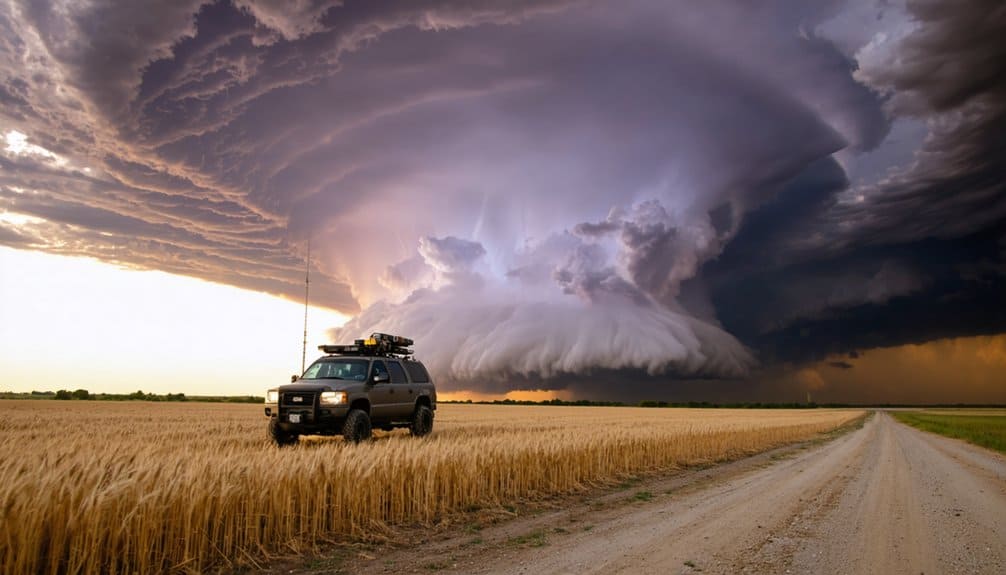
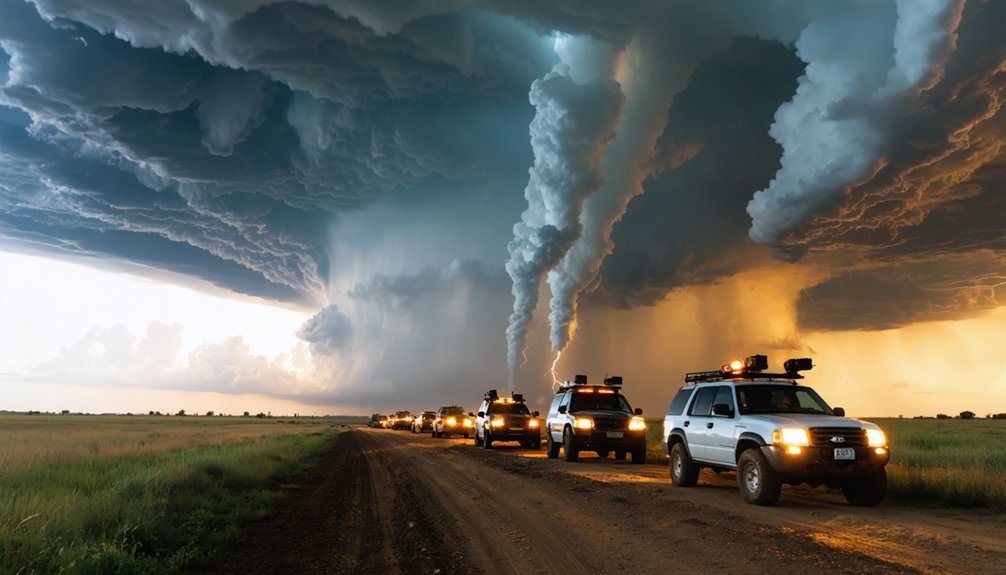
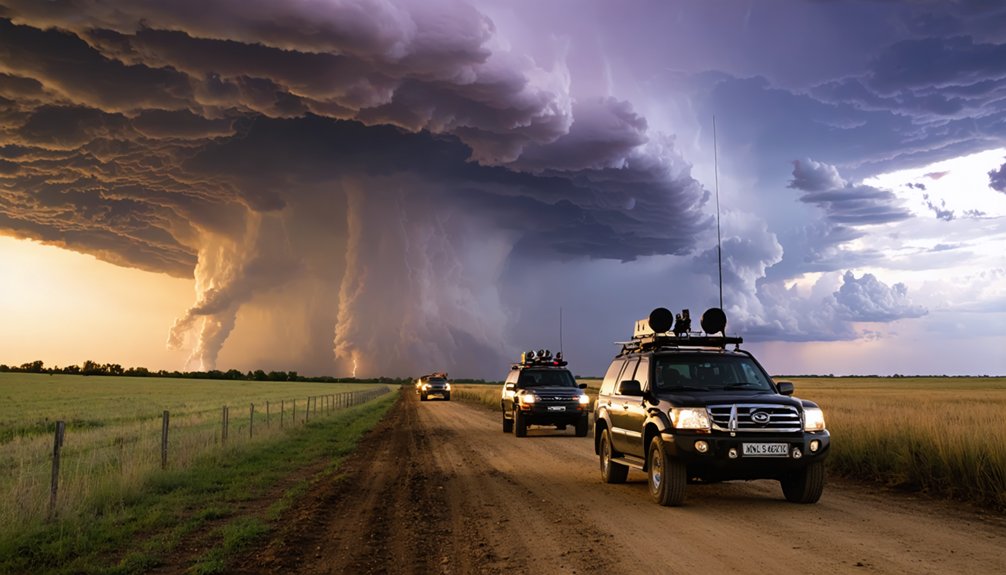
Extreme storm chasing experiences are unforgettable because your brain encodes them at a neurochemical level ordinary moments can’t match. Adrenaline, cortisol, and norepinephrine flood your system simultaneously, sharpening sensory integration and accelerating hippocampal memory consolidation. You’re processing rotating wall clouds, pressure shifts, and life-or-death decisions all at once — creating multiple neural retrieval pathways. Rare atmospheric events, near-miss moments, and social reinforcement compound this effect, making each chase deeply and permanently embedded in long-term memory. There’s far more science behind why these moments never fade.
Key Takeaways
- Adrenaline and cortisol released during storm chasing sharpen sensory processing and enhance hippocampal memory consolidation, creating vivid, long-lasting recollections.
- Near-miss encounters trigger intense emotional and physiological responses, burning critical details like escape decisions and wind direction into long-term memory.
- Simultaneous exposure to extreme multisensory stimuli—lightning, hail, wind, and rotating clouds—prevents sensory adaptation, deepening neural memory encoding.
- Rare events like wedge tornadoes signal the brain to prioritize and archive atmospheric details with exceptional precision due to perceived uniqueness.
- Social reinforcement through group debriefs, photographs, and community storytelling creates multiple retrieval pathways, preserving memories with greater accuracy and longevity.
Why Extreme Storms Overwhelm Every Sense at Once
When you stand within range of a supercell, your senses don’t process one dominant stimulus — they process several simultaneously and at high intensity. Rotating wall clouds, strobing lightning, and hail streaks deliver continuous visual data.
Infrasound from large tornadoes registers below conscious hearing yet triggers physiological unease. Wind pressure, temperature drops, and rain impact add tactile dimension.
This sensor overload isn’t accidental — it’s the physics of extreme atmospheric energy concentrating across a defined area.
The atmospheric spectacle compounds because storm structure evolves rapidly. Mesocyclones tighten, rain-free bases lower, and condensation funnels extend within minutes.
Your brain tracks constant change, which sustains heightened alertness rather than allowing sensory adaptation. That sustained multi-channel intensity is precisely why a single chase intercept encodes itself so deeply into long-term memory.
How Adrenaline Sharpens Every Moment of a Storm Chase
As a tornado tightens its condensation funnel within your field of view, your adrenal glands release epinephrine within seconds, triggering a measurable cascade of physiological changes. Your heart rate accelerates, pupils dilate, and glucose floods your bloodstream. These responses sharpen sensory integration, allowing your brain to process visual, auditory, and kinesthetic data simultaneously with unusual precision.
This heightened state compresses time perception, making each decision point feel distinctly separate and significant. You’re calculating storm motion, exit routes, and structural changes in real time.
That cognitive pressure builds emotional resilience by forcing rapid, high-stakes adaptation. Unpredictable storm behavior sustains arousal throughout the chase, preventing attention from dulling.
Each adrenaline-charged moment encodes deeply into memory, which is exactly why you’ll replay that intercept vividly for years.
Why Danger Makes Storm Chasing Memories Stick
When you operate under high stakes, your brain encodes the experience with greater intensity, making storm chasing memories far more durable than routine events.
Near-miss encounters amplify this effect, as the emotional charge from a close intercept creates persistent memory anchors that you’ll recall with precision for years.
Every calculated risk you take—judging escape routes, reading storm motion, evaluating distance—keeps your mind in a state of heightened engagement that intensifies the entire experience.
High Stakes Sharpen Memory
Danger doesn’t just make storm chasing exciting—it makes it unforgettable. High-stakes situations trigger stronger memory consolidation because emotional intensity signals the brain to prioritize encoding. When you’re calculating escape routes while a wedge tornado tightens its path, your nervous system isn’t just reacting—it’s recording.
Storm chasing produces sustained sensory overload: rotating walls, pressure drops, debris fields, and rapidly shifting wind all demand simultaneous processing. That cognitive load, combined with real risk, creates conditions where memory formation accelerates rather than fragments.
Near-miss moments are especially persistent. Research consistently links perceived threat to sharper, longer-lasting recall. Each decision point—distance judgment, storm motion analysis, exit timing—adds tension that deepens the imprint. You’re not just witnessing the storm; you’re actively navigating it, and that engagement makes forgetting nearly impossible.
Near Misses Leave Marks
A tornado that nearly cuts off your exit doesn’t just scare you—it rewires how your brain stores that moment. Near-miss events trigger elevated norepinephrine and cortisol release, encoding the experience with exceptional clarity and emotional resonance. Your brain treats high-threat moments as priority data worth preserving in detail.
The sensory overload you experience during a close intercept—roaring inflow, debris-filled air, rapidly shifting storm motion—compounds that encoding process. Every sensory channel fires simultaneously, giving your memory multiple retrieval pathways back to that moment.
Research on threat-based memory formation confirms that danger sharpens consolidation during sleep, making near-miss chases disproportionately vivid over time. You don’t just remember the storm. You remember exactly where you stood, what you decided, and what it cost you to stay free.
Risk Intensifies Every Moment
Near misses represent one end of a risk spectrum, but the broader dynamic of calculated danger shapes every moment of a chase—not just the close calls. Every decision you make—reading escape routes, judging storm motion, interpreting storm symbolism embedded in wall cloud rotation—carries measurable consequence. That weight doesn’t paralyze you; it sharpens you.
Research consistently links high-stakes environments to stronger memory encoding. When you operate under uncertainty, your brain elevates emotional intensity, tagging each moment as significant. That’s why you remember the exact position of a mesocyclone or the precise sound of inflow winds.
Risk converts routine observation into charged experience. You’re not passively watching weather unfold—you’re actively steering through it, and that engagement makes every intercept cognitively and emotionally irreversible.
Why Near-Miss Moments Stay With Storm Chasers for Life
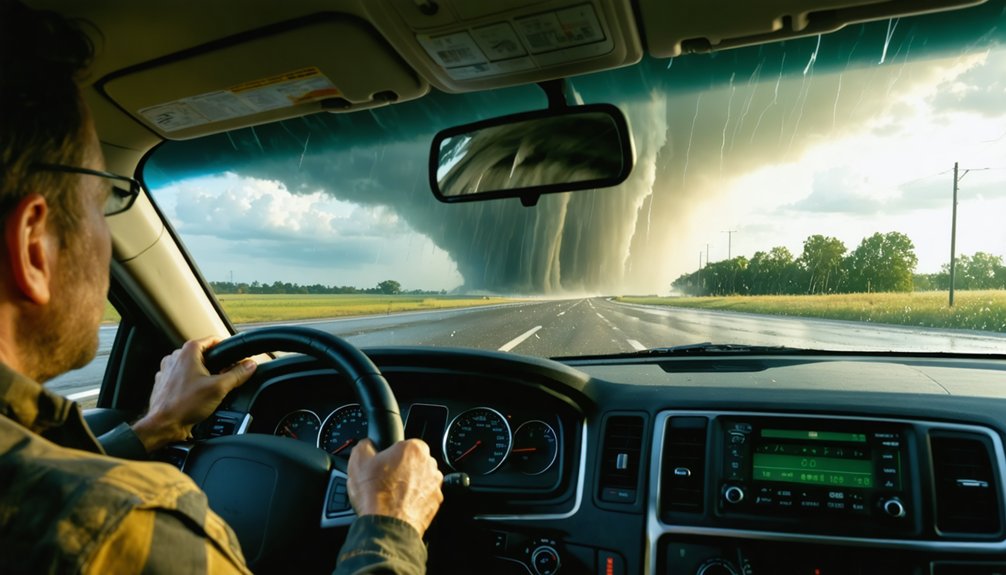
When you experience a near-miss during a chase, your brain encodes that moment with exceptional precision because elevated cortisol and norepinephrine levels directly enhance hippocampal consolidation of high-threat events.
Research on emotional memory confirms that survival-relevant stimuli receive prioritized neural storage, meaning the closer the danger, the stronger and more persistent the recall.
You’re not simply remembering the storm—you’re carrying a physiologically reinforced record that resurfaces with greater frequency and detail than ordinary experiences.
Danger Sharpens Memory
Storm chasing’s most persistent memories aren’t formed during calm intercepts — they’re burned in during near-misses. When danger spikes, your brain releases norepinephrine and cortisol, neurochemicals that signal the hippocampus to encode the experience with exceptional clarity. That’s not coincidence — it’s threat-response architecture.
Near-miss moments carry intense emotional resonance precisely because your survival system treats them as critical data. The closer the storm, the stronger the encoding. You’ll recall wind direction, vehicle position, and escape route decisions with surprising precision years later.
This also explains personal significance. A routine intercept fades. A moment where you misjudged a tornado’s forward speed doesn’t. High-stakes decisions activate deeper memory consolidation, transforming a single chase day into a reference point you’ll carry indefinitely.
Near-Misses Create Persistence
A single near-miss intercept can reshape how you chase for the rest of your life. When storm adrenaline peaks and sensory overload hits simultaneously, your brain encodes that moment with exceptional precision. Near-misses aren’t failures—they’re high-intensity data points your memory refuses to release.
Here’s why they persist:
- Emotional intensity elevates memory consolidation, making near-miss details sharper than routine intercepts.
- Unpredictability forces rapid decision-making, burning escape routes and storm motion into long-term recall.
- Physiological arousal during close encounters heightens sensory registration across sight, sound, and movement.
- Uncertainty resolution creates a narrative your mind replays repeatedly, reinforcing each detail with every retelling.
You don’t just remember the storm—you remember exactly how it felt to survive your own calculated risk.
The Role of Rare Weather Events in Creating Unforgettable Chases
Few experiences in storm chasing carry the same emotional weight as witnessing a rare atmospheric event. When you intercept a meteorological anomaly — a wedge tornado, a hailbow, or a photogenic supercell with textbook wall cloud structure — you’re observing conditions that statistically align once across hundreds of chase days. That scarcity compounds emotional intensity.
Rare events also carry storm symbolism that transforms a weather intercept into something personally significant. You’re not just documenting rotation — you’re witnessing atmospheric mechanics operating at an exceptional threshold. That distinction sharpens recall.
Research consistently shows that perceived uniqueness strengthens memory encoding. When you recognize that conditions won’t replicate easily, your brain prioritizes the experience. Every decision, visual detail, and sensory input gets archived with greater precision, making the chase genuinely unforgettable rather than just exciting.
Why a Lifelong Passion for Storms Makes Each Chase Unforgettable
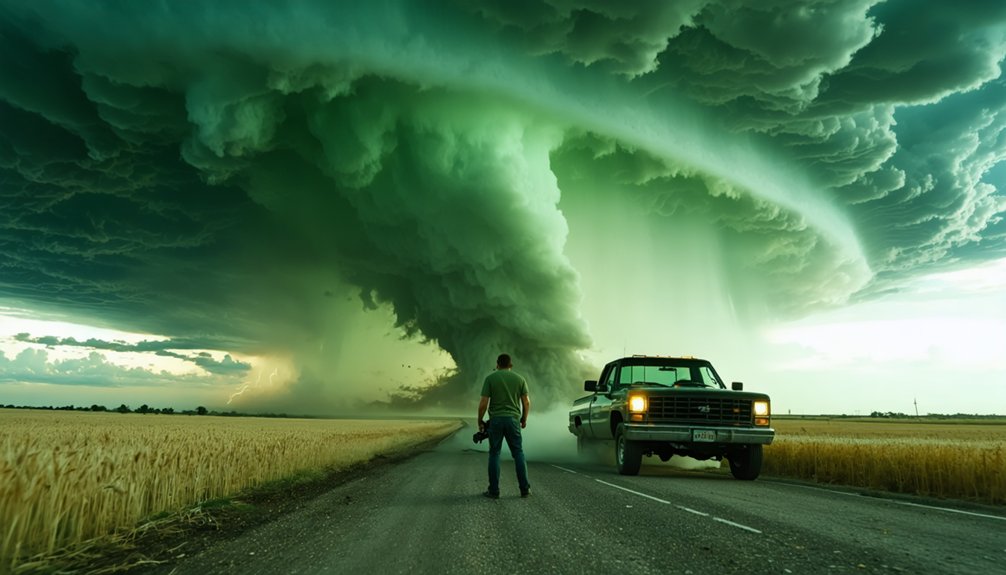
Rarity alone doesn’t fully explain why certain chases stay with you for decades. When storms carry personal storm symbolism rooted in childhood fascination, every intercept activates deeper cognitive pathways than novelty alone triggers.
Weather symbolism tied to identity amplifies emotional encoding, making each chase neurologically distinct:
- Childhood anchoring — Early storm exposure creates strong associative memory frameworks you continuously reinforce through chasing.
- Purpose-driven focus — Passion sharpens observational precision, increasing the density of meaningful data points per chase.
- Identity integration — Repeated engagement embeds storm chasing into your self-concept, making each event personally significant.
- Cumulative expertise — Growing technical knowledge lets you recognize rare meteorological signatures others miss, intensifying your emotional response.
Your passion transforms raw atmospheric data into profoundly personal experience, compounding memorability across every chase you complete.
Why Chasing With Others Makes the Memory Last Longer
Chasing alongside other experienced observers doesn’t just make the day more enjoyable — it structurally strengthens how your brain encodes and retrieves the event. Collective memory research shows that shared camaraderie during high-arousal events creates multiple retrieval pathways.
Chasing with others doesn’t just enrich the experience — it rewires how your brain stores it.
Each person anchors different sensory details — timing, position, storm behavior — and retelling reinforces your own recall through cross-referencing. When another chaser confirms what you witnessed, that validation consolidates the memory’s accuracy and emotional weight.
You’re not just storing a personal experience; you’re embedding it within a social framework that resists decay over time. Group debriefs after an intercept sharpen timeline accuracy and highlight details you’d otherwise miss.
The result is a memory that remains structurally intact longer, with more precision, than anything you’d retain chasing alone.
How Photos, Stories, and Community Keep Chase Memories Alive
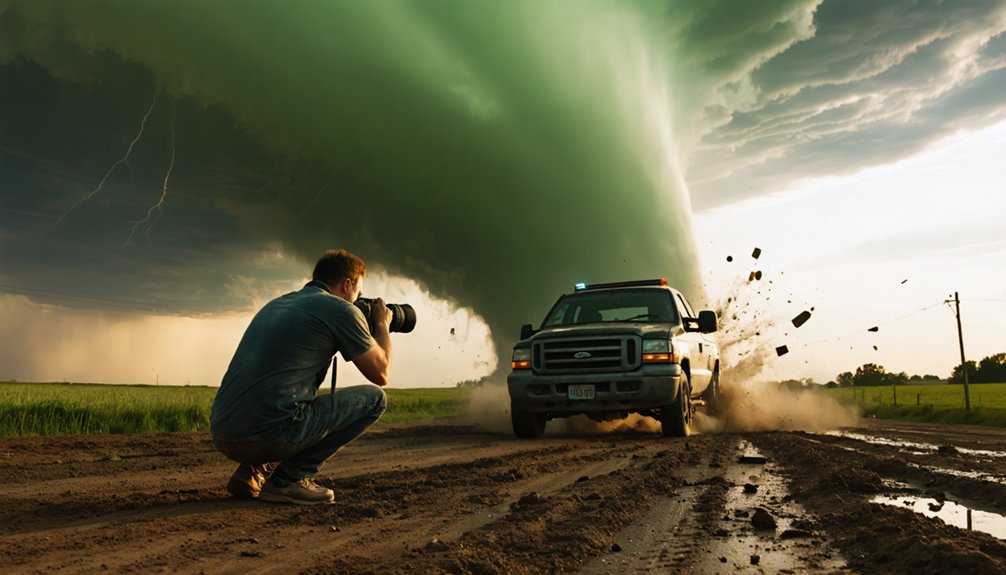
The artifacts you create during a chase — photographs, field notes, video footage — function as external memory storage that actively reshapes how you recall the event. Storm photography and community storytelling reinforce neural pathways tied to your field experience, making those moments structurally stronger over time.
Each review of your documentation does the following:
- Reactivates emotional intensity linked to the original sensory environment
- Sharpens spatial detail, including storm structure, positioning, and escape route decisions
- Validates your interpretation of rare atmospheric events through peer confirmation
- Embeds the experience into group narrative, extending its psychological lifespan beyond individual memory
When your chase community retells, analyzes, and archives these events collectively, you’re not just preserving a moment — you’re reinforcing your autonomy as an independent observer of extreme atmospheric science.
Frequently Asked Questions
Can Storm Chasing Experiences Trigger Long-Term Anxiety or Post-Traumatic Stress?
Yes, post-chase trauma can shatter your mental resilience entirely. Near-miss encounters trigger hypervigilance, intrusive memories, and acute stress responses. You’ll need structured anxiety management strategies—like cognitive behavioral therapy—to process and reintegrate these overwhelming high-stakes storm chasing experiences effectively.
How Do Storm Chasers Mentally Prepare Before Entering a Dangerous Storm Environment?
You mentally prepare by practicing storm visualization and conducting thorough risk assessment. You’re analyzing storm motion, mapping escape routes, and reviewing real-time data, keeping your mind sharp, calculated, and free to make critical decisions under pressure.
What Age Do Most Storm Chasers Begin Pursuing Extreme Weather in the Field?
Like storm cells converging at dusk, you’ll find most chasers start around 18–25, when weather forecasting curiosity peaks. You’re mastering safety protocols early, driven by data, freedom, and that undeniable pull toward nature’s most powerful, unrestricted forces.
Are Storm Chasing Memories Scientifically Different From Memories of Other Extreme Sports?
Yes, your storm chasing memories differ because they’re encoded through unmatched sensory overload—simultaneously visual, auditory, and kinesthetic. The emotional intensity from unpredictable, life-threatening conditions activates stronger amygdala responses than most extreme sports, making recall sharper and longer-lasting.
How Does Sleep and Rest After a Chase Affect Memory Consolidation?
While you think rest wastes time, sleep deprivation actually destroys memory retention. Your brain consolidates chase experiences during deep sleep cycles, actively transferring vivid storm memories into long-term storage—so you’ll remember every electrifying detail far more clearly.
References
- https://www.stormchasingusa.com/blog/my-10-most-memorable-storm-chasing-moments-ever/
- https://www.washingtonpost.com/weather/2021/05/24/storm-chasing-highlights-hail-tornado/
- https://www.severe-weather.eu/learnweather/storm-chaser-presentation/swe-calendar-2025-pursuit-of-power-storm-chaser-interview-rick-bekker-mk/
- https://crazystormchasers.com/what-motivates-storm-chasers-in-extreme-weather/
- https://stormchasing.com/reviews/
- https://crazystormchasers.com/what-drives-adrenaline-junkies-to-chase-tornadoes/
- https://www.weatheradar.com/article/into-the-vortex-the-high-stakes-world-of-storm-chasing-a14
- https://www.aip.org/inside-science/storm-chaser-firsthand-account
- https://www.stormplatform.nl/nieuws/stormchasen-een-fascinerende-maar-ook-gevaarlijke-hobby/
- https://www.reddit.com/r/tornado/comments/1uszmfv/has_anyone_here_ever_storm_chased_what_was_you/