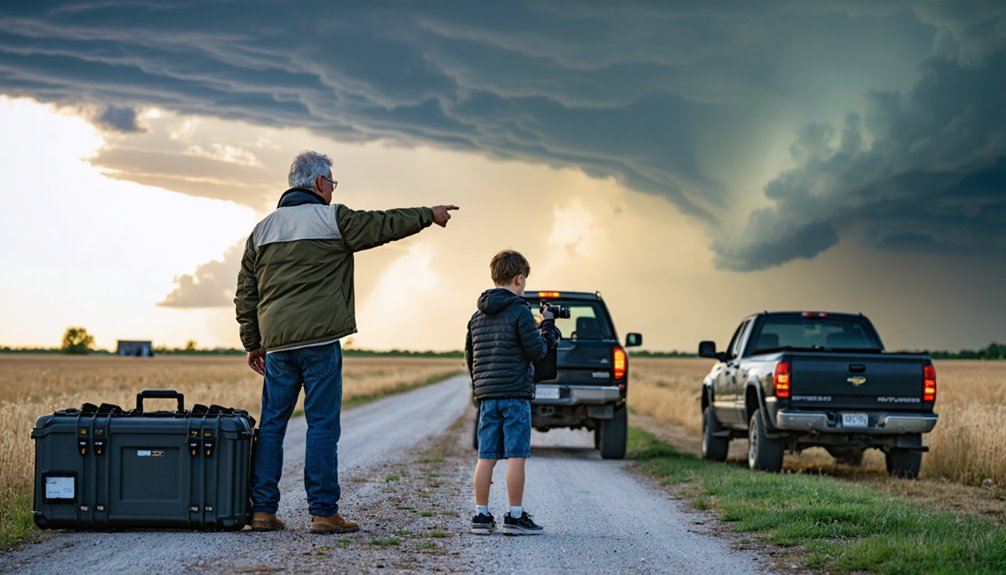
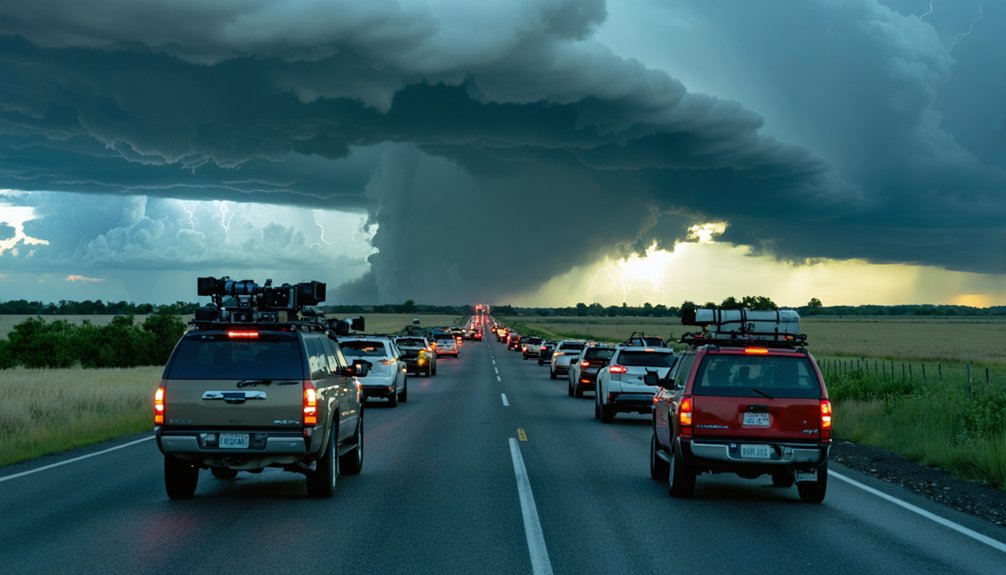
Safety measures in storm chasing contests keep you alive when conditions shift faster than you can react. You’re managing tornado standoff distances, escape route failures, lightning thresholds, and hydroplaning risks simultaneously. Without structured protocols, one missed cue collapses your entire decision window. Fatal scenarios aren’t rare—they’re predictable outcomes of undisciplined positioning. Systematic rules eliminate the highest-probability dangers before they materialize. The specific strategies that protect you most are worth understanding in detail.
Key Takeaways
- Minimum standoff distances from tornadoes reduce debris exposure and prevent rapid storm intensification from catching chasers off guard.
- Pre-planned escape routes eliminate dangerous decision-making delays when storm motion shifts unexpectedly during contests.
- Visibility failures from heavy rain and blowing dust collapse decision windows, increasing crash and entrapment risks significantly.
- Lightning within one mile, large hail, and wind shifts can incapacitate individuals or destroy vehicles instantly.
- Systematic safety rules eliminate high-probability fatal scenarios, expanding long-term operational capability for competitive storm chasers.
Storm Chasing Contest Rules That Cut Fatal Risk
Storm chasing contests introduce structured rule sets that directly cut fatal risk by enforcing minimum standoff distances from active tornadoes and storm cores. These rules give you a defined operational boundary, reducing your exposure to debris fields, violent wind shifts, and rapid intensification events that develop within minutes.
Effective storm safety protocols built into contest frameworks require you to maintain measurable distances rather than relying solely on personal judgment under pressure. That structured constraint functions as a risk management tool, removing decision variables when situational awareness degrades fastest.
You retain operational freedom within those boundaries while the rules systematically eliminate the highest-probability fatal scenarios. Contests that enforce standoff minimums, penalize reckless positioning, and reward disciplined navigation produce chasers who understand that structured limits expand long-term operational capability rather than restrict it.
Vehicle and Road Hazards Contest Chasers Face Most
Beyond tornado proximity, vehicle and road hazards generate a high proportion of chase-related injuries and fatalities that contest rules alone can’t eliminate. Standing water triggers hydroplaning; rising water can trap your vehicle within minutes. Wet roads extend braking distances considerably, and unpaved surfaces become impassable mud traps that eliminate your escape routes entirely.
You’ll also encounter unexpected hazards: road construction zones that narrow lanes and reduce visibility, and wild animal crossings that demand immediate braking in already compromised conditions. Heavy rain and blowing dust further degrade your situational awareness.
Driving near rotating wall clouds or penetrating a storm core sharply increases your loss-of-control risk. Maintaining reduced speeds, keeping headlights on, and enforcing seatbelt compliance aren’t optional—they’re measurable interventions that directly cut your crash probability.
Escape Route Strategies That Keep You Out of Danger
Before you position yourself near a severe storm, you should identify at least two independent paved escape routes that lead away from the storm’s projected motion vector.
Dead-end roads eliminate your options instantly, so you need to cross-reference your route against current radar data and mapped road networks before committing to a position.
When storm motion shifts unexpectedly, having pre-planned exits cuts your decision time and reduces the risk of entrapment.
Planning Multiple Exit Routes
When you’re positioning relative to a severe storm, two clear exit routes aren’t optional—they’re a baseline safety requirement. Storm motion vectors shift rapidly, and a single escape path can become blocked by debris, flooding, or emergency vehicles within minutes. You need to pre-identify both routes before committing to any observation point.
Map paved, well-documented roads that align with your projected weather pattern analysis. Unpaved routes introduce traction failure risks, particularly when wet, eliminating your mobility exactly when you need it most.
Avoid urban road networks where traffic density compounds decision-making pressure.
Maintain active communication protocols with your team throughout repositioning. Real-time location sharing and radio contact ensure someone always tracks your situation if conditions deteriorate faster than your radar data initially indicated.
Avoiding Dead-End Roads
Dead-end roads eliminate your margin entirely—once you’re committed to one, storm evolution dictates your outcome rather than your decision-making. Tornadoes and flash flooding can cut off a single-exit road in under two minutes, leaving no viable response.
Cross-reference GPS accuracy against current road signage before committing to any route. Digital maps frequently lag behind road closures, seasonal restrictions, or washed-out sections. What your device shows as passable may already be compromised.
Prioritize mapped, paved roads with confirmed multiple exit points. When GPS accuracy is questionable in rural terrain, road signage becomes your most reliable real-time data source. If neither confirms a through-route, don’t enter.
Your autonomy in a chase depends entirely on maintaining exit options before the storm removes them.
How Lightning and Wind Exposure Kills Contest Chasers
Lightning and wind are two of the most lethal hazards a contest chaser faces, and they don’t announce themselves with enough lead time to guarantee a safe response. Both threats operate faster than your reaction window allows if you’re poorly positioned.
Key lightning safety and wind hazard thresholds you must respect:
- Cloud-to-ground lightning within one mile demands immediate shelter inside a closed vehicle—not outside it.
- Rotating wall clouds generate unpredictable wind fields that can shift direction and intensity within seconds.
- Large hail driven by intense gusts can shatter glass and incapacitate you before you can reposition.
Staying near the storm core eliminates your margin for error. You control your proximity—use that autonomy to maintain standoff distances that keep both lightning exposure and destructive wind loads outside your risk envelope.
Team Roles That Prevent Deadly Decision Failures
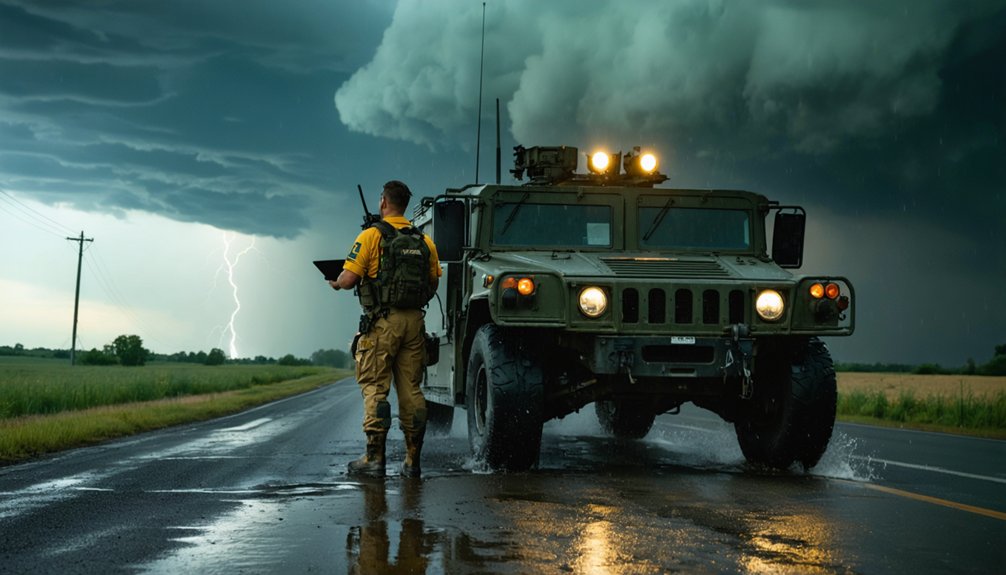
When you split driving and navigation into separate roles, you eliminate the task saturation that causes delayed reactions in fast-moving storm scenarios. Your dedicated driver maintains eyes on the road and hands on the wheel.
Meanwhile, your navigator monitors radar, tracks the storm’s motion vector, and communicates position updates. This division of cognitive load measurably improves situational awareness and keeps your team from making the split-second errors that turn survivable situations fatal.
Dedicated Driver Reduces Distraction
Storm chasing compresses multiple high-stakes tasks—radar interpretation, navigation, filming, and radio communication—into a single moving vehicle. Task saturation is one of the leading contributors to delayed or failed decisions in fast-evolving severe weather.
Assigning a dedicated driver is a proven distraction management strategy that keeps one person’s full attention on road conditions, traffic, and storm positioning.
A dedicated driver supports:
- Focus maintenance on vehicle speed, braking distance, and escape route availability
- Uninterrupted monitoring of rotating wall clouds, debris, and sudden visibility changes
- Faster reaction times when storm motion shifts unexpectedly
When you split roles deliberately, you reduce cognitive overload across the team. Every second your driver isn’t distracted by radar or radio is a second they’re keeping you alive.
Split Roles Improve Awareness
Splitting team roles across a chase vehicle isn’t just an organizational preference—it’s a direct countermeasure against the cognitive fragmentation that kills chasers. When you’re simultaneously driving, reading radar, filming, and managing communication protocols, your reaction time degrades sharply.
Assigning a dedicated navigator with strong weather literacy frees the driver to focus exclusively on road conditions, escape vectors, and traffic hazards. Research on task saturation confirms that divided attention increases error rates under high-stress, time-compressed scenarios—exactly what severe storm environments produce.
Your navigator tracks storm motion vectors, monitors spotter radio traffic, and flags developing hazards before they become threats. This clean division of cognitive labor keeps both roles sharp, your situational awareness intact, and your team’s decision-making capacity functioning when storm conditions deteriorate fastest.
Visibility Failures That End Storm Chasing Contests Badly
Heavy precipitation, blowing dust, and sudden darkness don’t just reduce comfort—they collapse the decision window that keeps a contest chase team safe. Aerial obstruction from dense rain cores masks rotation you need to see. Foggy conditions strip your ability to judge storm structure, road elevation, and water depth simultaneously.
When visibility fails, these hazards compound quickly:
- Radar fixation replaces real-world observation, delaying your reaction to immediate road threats
- Task saturation across driving, filming, and communication causes critical cues to get missed entirely
- Low-contrast environments at night or in heavy precipitation make debris, standing water, and stopped vehicles nearly invisible
You can’t chase what you can’t see safely. Recognizing visibility thresholds before they’re breached is what separates a completed contest run from a preventable disaster.
Frequently Asked Questions
What Insurance Coverage Do Storm Chasers Typically Need During Contests?
Like armor in battle, you’ll need all-encompassing auto, liability, and medical coverage. Your risk assessment and emergency preparedness demand policies covering storm damage, third-party injuries, and equipment loss during contests.
How Do Contest Organizers Verify Chasers Followed Safety Rules Afterward?
Organizers verify your compliance through GPS logs, timestamped footage, and reported standoff distances. You must submit documentation confirming you followed emergency protocols and used proper safety gear, with violations flagged against contest data records.
Are There Age Restrictions for Participating in Storm Chasing Contests?
Imagine storm walls swallowing unprepared chasers whole—age restrictions and participant eligibility vary by contest. You’ll find most organizers require you’re 18+, with minors needing guardian consent and verified storm spotter training credentials.
What Medical Training Should Storm Chasing Contest Participants Have Beforehand?
You should obtain first aid certification and basic emergency response training before participating. These skills let you manage trauma, treat hail injuries, and stabilize teammates until professional responders arrive during rapidly evolving, high-risk storm scenarios.
How Does Contest Scoring Balance Storm Proximity Against Safety Compliance?
Like a tightrope walk, contests reward your storm proximity only when you’ve met safety compliance thresholds. Scoring systems weigh risk assessment data against standoff distances, penalizing violations, so your emergency protocols directly protect both your points and your life.
References
- https://www.atms.unca.edu/cgodfrey/courses/swfex/pdf/ChasingSafety.pdf
- https://www.flame.org/~cdoswell/chasesums/Chase_safety.html
- https://www.youtube.com/watch?v=nxPSFg2R8YY
- https://en.wikipedia.org/wiki/Storm_chasing
- https://weather.cod.edu/oldchasing/Safety.pdf
- https://midweststormchasers.org/safety-tips/
- https://www.reddit.com/r/stormchasing/comments/k89wnc/safety_tips_for_storm_chasing/
- http://www.stormeyes.org/tornado/chasing/FAQ/
- https://www.tornadosimulator.net/storm-chasing-safety/
- https://www.livingskytours.com/storm-chasing-101/