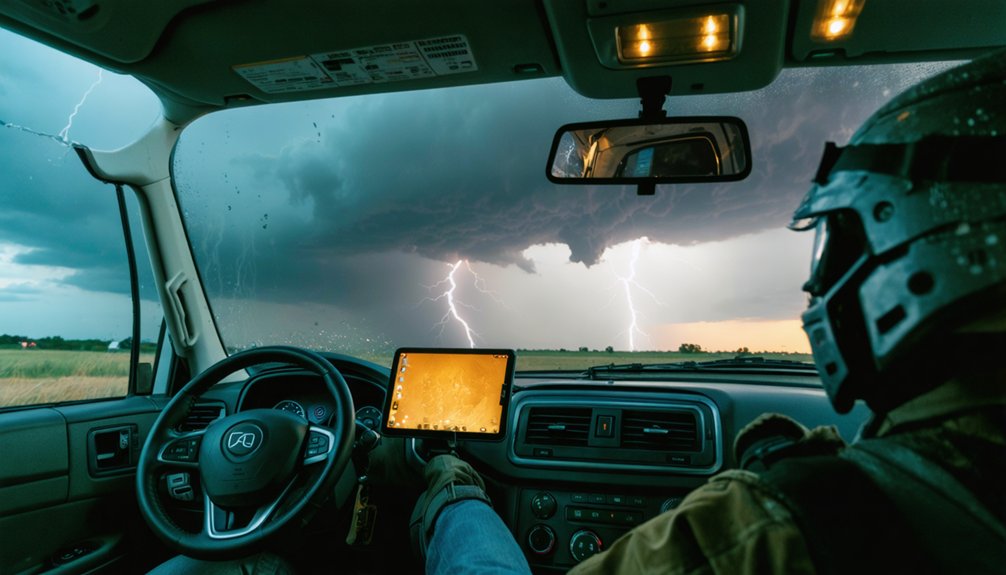
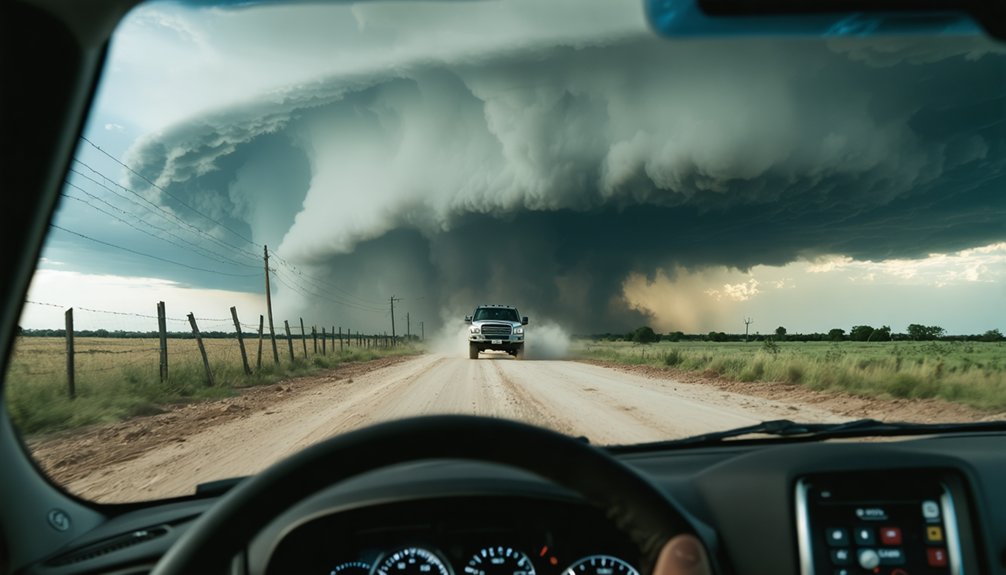
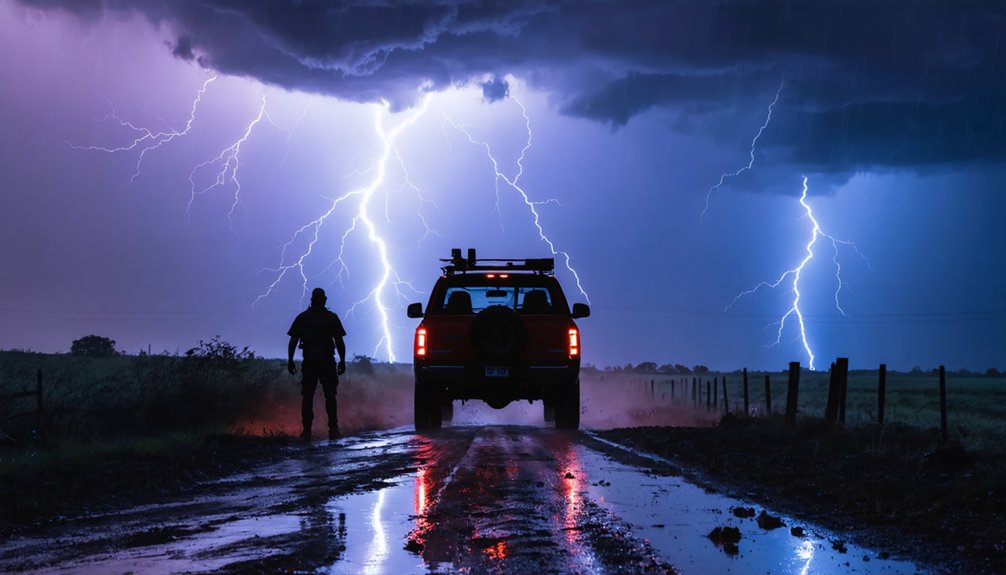
Successful storm chasing risk assessment starts with analyzing SPC outlooks, cross-referencing NWS mesoscale discussions, and independently evaluating CAPE, wind shear, and boundary triggers before you commit. You’ll need real-time radar data, calibrated instruments, and at least two escape routes plotted against storm motion vectors. Keep your vehicle prepped, your team roles clearly assigned, and your abort thresholds non-negotiable. Master these layered strategies, and you’ll find there’s considerably more precision and discipline behind every safe, successful chase decision.
Key Takeaways
- Analyze SPC Convective Outlooks and cross-reference NWS mesoscale discussions to assess forecast confidence, ingredient deficiencies, and target areas before deploying.
- Evaluate CAPE, wind shear, surface dewpoints, and boundary triggers independently to determine whether conditions sufficiently support tornadogenesis.
- Plot at least two escape routes using real-time storm motion vectors, avoiding flood-prone crossings and deteriorated terrain.
- Abort the chase immediately when escape routes close, visibility collapses, or storm motion exceeds your repositioning capability.
- Assign defined team roles, conduct pre-chase vehicle inspections, and calibrate all instruments weekly to ensure operational readiness.
Read the Storm Prediction Center Outlook Before You Leave
Before you commit to a chase day, pull up the Storm Prediction Center’s Convective Outlook and read the discussion section—not just the categorical risk graphic. The discussion reveals forecaster confidence levels, timing uncertainty, and ingredient deficiencies that the graphic won’t show you.
Cross-reference that outlook with NWS mesoscale discussions to sharpen your target area.
From there, layer in satellite imagery to assess moisture advection, boundary positioning, and convective initiation timing. Run lightning analysis against early convective development to identify which cells are organizing versus scattering.
Evaluate surface dewpoints, CAPE, wind shear, and boundary triggers like drylines and fronts independently—don’t let a single model output drive your decision. Ingredient-based forecasting gives you the analytical edge to commit confidently or hold back strategically.
Plan Storm Chasing Escape Routes Around Storm Motion
Before you commit to a chase, plot your escape routes against the storm’s expected motion vector, since a supercell moving at 35 knots northeast eliminates southward exits faster than most chasers anticipate.
You’ll need at least two viable corridors that run perpendicular or parallel to storm motion, keeping you ahead of the forward flank and well clear of the hook.
Exclude any route that crosses low-water bridges, unpaved roads, or flood-prone terrain, as compromised road conditions can neutralize an otherwise sound escape plan within minutes.
Understanding Storm Motion Vectors
Storm motion vectors determine where a supercell will be in 10, 20, or 30 minutes—and your escape routes must align with that trajectory before you commit to a position. Pull storm motion data from your radar software and calculate the vector’s speed and heading in real time.
If a cell is tracking northeast at 35 knots, your southern and southeastern corridors become your primary exits. Don’t guess—run the numbers.
Vector analysis also exposes deviant storm motion risk. Supercells frequently deviate 15–30 degrees right of the mean wind, tightening your margin faster than expected.
Cross-reference observed motion with model hodographs to catch that deviation early. If your exit corridor intersects the projected storm path, reposition immediately.
You control your freedom to retreat—protect it.
Identifying Viable Escape Routes
Every escape route you commit to must be built around storm motion vectors, not road familiarity or habit. Wind shear data directly influences how fast and unpredictably a storm can pivot, so your exit corridors must account for that variability before you’re in the field.
Identify at least two viable escape routes during pre-chase analysis. Cross-reference storm tracking data with road networks, eliminating options that include flood-prone crossings or unpaved segments that deteriorate under rainfall.
Align your exits perpendicular to or ahead of projected storm motion, never parallel to it.
If a deviant storm motion closes your primary route, your secondary must already be verified. The moment escape options narrow, abort. Your freedom to reposition is your most critical tactical asset.
Avoiding Hazardous Road Conditions
Flood-prone crossings and unpaved roads aren’t inconveniences—they’re route-killers that can trap you faster than the storm itself. Before committing to any chase corridor, audit every road segment against real-time flood gauges and soil saturation data.
Flooded roads deceive—six inches of moving water can disable your vehicle, and storm runoff accumulates faster than radar refresh cycles suggest.
Unpaved crossings compound the risk exponentially; wet clay surfaces eliminate traction precisely when you need emergency repositioning capability.
Cross-reference your escape vectors against terrain maps, identifying elevation drops that funnel water across your path. If your primary exit depends on a low-water crossing or a gravel stretch, it’s already a compromised route.
Eliminate it before the chase begins, not after the storm closes your options.
Evaluate Tornado Ingredients Before You Commit to a Chase
Before committing to a chase, you’ll need to evaluate four core tornadic ingredients: surface dewpoints, CAPE, wind shear, and triggering boundaries like drylines or fronts.
High dewpoints fuel instability, while strong directional and speed shear drives mesocyclone dynamics capable of sustaining a tornado vortex.
Don’t rely on a single model—cross-reference SPC Convective Outlooks with NWS mesoscale discussions to sharpen your target area.
Ingredient forecasting gives you analytical leverage. Check Doppler radar, satellite imagery, and local radiosondes together to assess storm formation timing and evolution.
If one ingredient is marginal, reconsider commitment. Weak shear undermines rotation; insufficient CAPE limits updraft intensity.
You’re making a risk-based decision, so treat every data gap as a liability before you ever leave the driveway.
Keep Your Storm Chasing Vehicle and Gear Ready
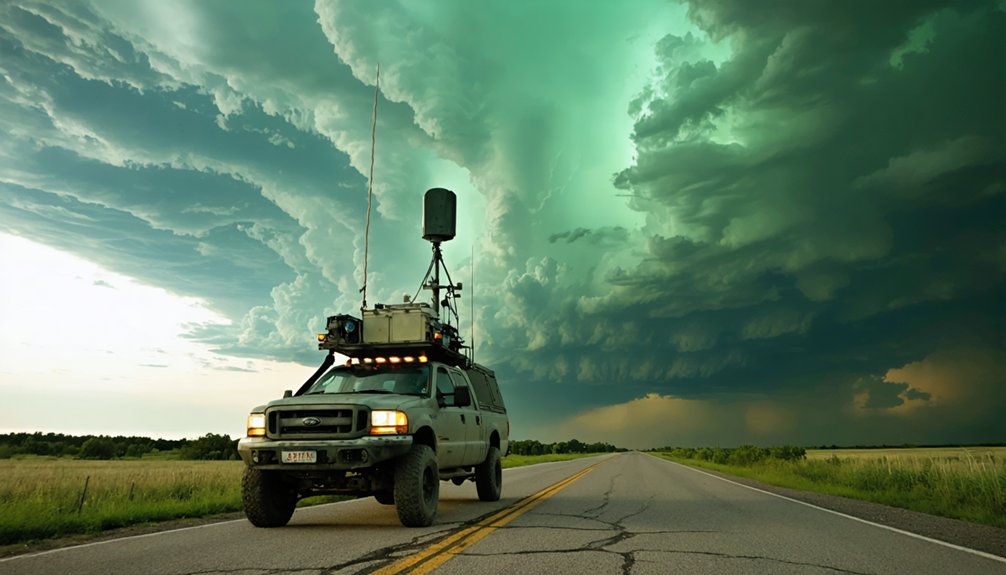
Before you commit to a chase day, inspect your tires, brakes, fluids, and fuel, since degraded tires are a leading mechanical risk on wet rural roads.
Stock your vehicle with emergency supplies sized for likely failure scenarios—blown tires, storm delays, and communication blackouts—so that a single equipment failure doesn’t force a dangerous abort.
Calibrate and test all chase instruments weekly, and verify that GPS, radar feeds, and HAM radio are fully operational before you enter the chase zone.
Pre-Chase Vehicle Inspection
A reliable vehicle is your most critical asset on a chase day, so you’ll want to complete a thorough pre-chase inspection before you commit to a target. Vehicle maintenance directly determines your operational range and emergency preparedness capacity when conditions deteriorate rapidly.
Systematically check tires for pressure and tread depth, since wet-road performance degrades sharply on worn rubber. Verify brake responsiveness, fluid levels, and fuel capacity before departure. A full tank eliminates range anxiety during repositioning sprints against fast-moving supercells.
Test all communication devices, confirm GPS functionality, and inventory emergency supplies including water, first aid, and recovery gear. Document any mechanical anomalies identified during inspection.
If critical systems aren’t performing within spec, scrub the chase—no target justifies compromising the mechanical foundation your escape strategy depends on entirely.
Essential Emergency Supply Stocking
Once your vehicle clears mechanical inspection, what you carry inside it determines your operational resilience when conditions deteriorate beyond your planned parameters. Your emergency kit should include first aid supplies, road flares, a fire extinguisher, non-perishable food, water reserves for 48 hours, and backup power banks calibrated for your devices.
Communication gear demands equal priority. Carry a HAM radio, a programmed weather alert receiver, and a push-to-talk backup unit for cellular dead zones. Test each device before departure, not during pursuit.
Map your supply placement for rapid access under stress. You shouldn’t be searching for a rain poncho mid-rotation. Every item earns its weight by addressing a specific failure scenario, keeping your team autonomous when infrastructure around you collapses.
Equipment Calibration And Testing
How often you calibrate your chase equipment directly determines whether your data holds up when storm-scale conditions push every sensor to its operational limits. Weekly sensor calibration and signal testing keep your instruments field-ready and your decisions grounded in accurate readings.
Run these checks before every deployment:
- Verify anemometer zero-point and span calibration against a known reference
- Confirm GPS unit accuracy within acceptable positional error thresholds
- Test HAM radio signal strength and push-to-talk response time
- Validate radar software data feeds and refresh intervals
- Cross-check barometric sensor readings against current NWS surface observations
Skipping these steps compounds risk exponentially once you’re operating under rapidly evolving mesoscale environments. Reliable gear isn’t optional—it’s your operational foundation. You own your preparedness, so defend it systematically.
Build Your Storm Chasing Team Roles Before Season Starts
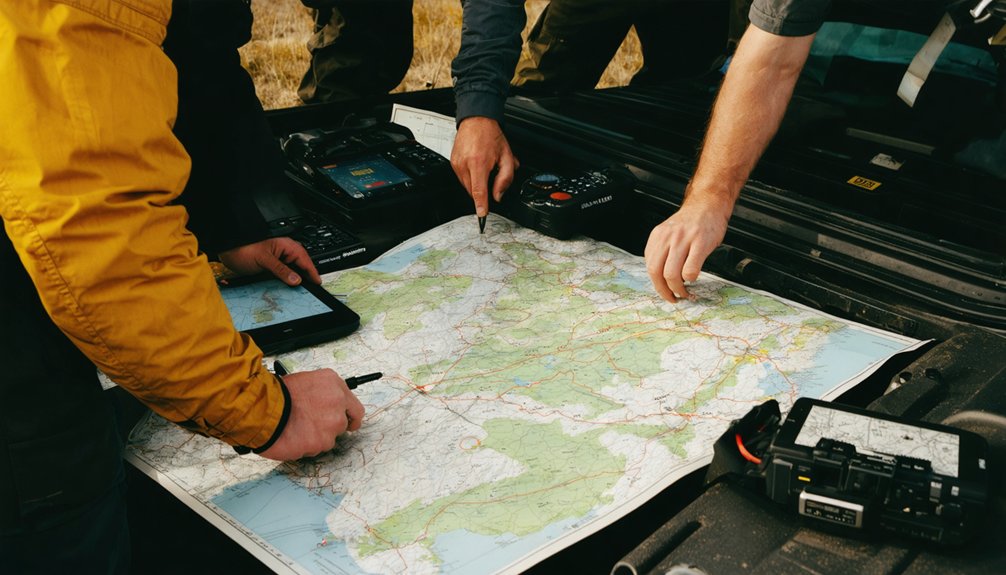
Building a structured team before storm season begins isn’t optional—it’s a core safety and operational requirement. Assign distinct roles—Driver, Navigator, Communicator, and Logger—before you deploy. Role clarity eliminates in-field confusion when conditions deteriorate rapidly and decisions carry real consequences.
Role clarity isn’t a luxury—it’s the difference between a coordinated team and dangerous in-field chaos.
Your Driver focuses exclusively on vehicle control and positioning.
Your Navigator monitors storm motion vectors, escape routes, and road conditions.
Your Communicator maintains team communication with NWS, spotter networks, and your trusted base contact via HAM radio or push-to-talk systems.
Your Logger documents coordinates, observations, and timestamps in real time.
Train every member in meteorology, navigation, and emergency response before season starts. Attend NWS spotter safety classes together.
A team that rehearses roles operates faster, reads threats more accurately, and exits danger more decisively than any solo chaser can.
Stay the Right Distance From a Live Tornado
A well-structured team gets you into position faster—but position itself demands its own discipline. Tornado safety isn’t instinct—it’s calculated storm proximity management backed by real-time data.
Maintain these distance and positioning standards:
- Stay 1–2 miles minimum from a confirmed tornado; extend that buffer in rain-wrapped conditions.
- Monitor hook echo geometry and low-level shear continuously—not periodically.
- Never position on the north side of a tornadic circulation; escape routes collapse fastest there.
- Avoid core punching; sacrificing visibility for a closer view kills margin.
- If storm motion outpaces your repositioning ability, abort immediately—no footage justifies a closed exit.
Your freedom to chase another day depends entirely on disciplined storm proximity decisions made before the situation forces your hand.
Know When to Abort a Storm Chase Immediately
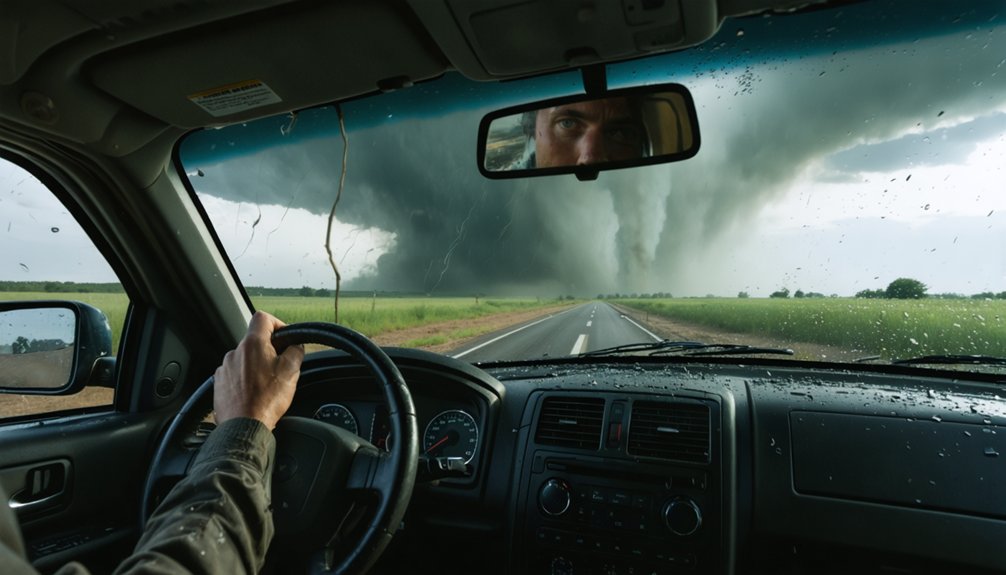
Disciplined abort decisions separate survivable chases from fatal ones. You must exit immediately when escape routes close, visibility collapses, or storm motion outpaces your repositioning capacity. Don’t negotiate with those thresholds—they’re non-negotiable triggers.
Additional hard abort criteria include nightfall reducing visual acquisition, flooded road crossings blocking corridors, radar or GPS signal loss, and sudden storm motion reversal. Each condition independently justifies full withdrawal.
During tornado aftermath assessment, resist re-entering damage corridors prematurely. Storm damage zones frequently harbor downed power lines, structurally compromised bridges, and debris-blocked escape paths that eliminate your exit options entirely.
Treat every abort as a tactical decision, not a failure. Your freedom to chase another day depends entirely on your willingness to disengage when field conditions exceed acceptable operational parameters.
Frequently Asked Questions
How Do I Share My GPS Location With Someone During a Chase?
Share your GPS sharing setup before departure — use apps like Garmin inReach or Google Maps location tracking to beam real-time coordinates to a trusted contact, ensuring they’ve got your route logged and can monitor your position continuously.
When Should I Submit Storm Reports to the National Weather Service?
Submit storm reports the moment you observe hail, tornadoes, funnels, or damage. Storm report timing aligns with weather warning procedures—you’re feeding real-time data that NWS needs to issue life-saving alerts instantly.
What Emergency Supplies Should I Stock in My Chase Vehicle?
Stock first aid kits, water, food, flashlights, and backup batteries. Include weather monitoring gear for continuous data collection. You’ll also want storm shelter planning maps, tire repair kits, and emergency blankets for unpredictable field scenarios.
How Often Should I Calibrate and Maintain My Chase Equipment?
Like a finely tuned engine, you should calibrate and maintain your chase equipment weekly. Consistent calibration frequency guarantees equipment durability, keeping your tools field-ready and your data reliable when it matters most.
What Communication Tools Work Best When Cellular Service Fails?
When cellular fails, you’ll want HAM radio or push-to-talk systems for real-time coordination. Supplement these with satellite communication devices for GPS tracking and emergency signaling, ensuring you maintain reliable data links regardless of network infrastructure collapse.
References
- https://crazystormchasers.com/essential-tips-for-storm-chasing-risk-assessment/
- https://crazystormchasers.com/expert-tips-for-effective-risk-assessment-in-storm-chasing/
- https://www.youtube.com/watch?v=fABwvj0rP_A
- https://crazystormchasers.com/best-practices-for-storm-chasing-safety-engagement/
- https://www.wiu.edu/SevereWeather/images/presentations/How_to_Effectively_Storm_Chase.pdf
- https://www.atms.unca.edu/cgodfrey/courses/swfex/pdf/ChasingSafety.pdf
- https://www.youtube.com/watch?v=6otZLjSZvPU
- https://www.youtube.com/watch?v=uCLaE6ELFik
- http://www.stormeyes.org/tornado/chasing/FAQ/
- https://crazystormchasers.com/storm-chasing-safety-rules/