Oklahoma records more tornadoes per square mile than any other U.S. state, making it your most productive storm chasing environment nationally. You’re working with flat, open terrain, a grid-style road network at one-mile intervals, and Interstate 35 and 40 as primary intercept corridors. Gulf moisture colliding with dry air fuels supercells from April through July, peaking in May. Add advanced radar coverage, mobile data infrastructure, and formal licensing laws, and you’ve got every advantage covered — keep going to discover exactly how deep Oklahoma‘s edge runs.
Key Takeaways
- Oklahoma leads the U.S. in supercell thunderstorms and tornadoes, with peak activity from April to July, especially in May.
- Flat, open terrain provides unobstructed sightlines, allowing chasers to visually track mesocyclones, wall clouds, and tornado rotation with ease.
- Interstates 35 and 40, combined with a grid road network, enable rapid repositioning and precise storm intercepts.
- Advanced radar coverage, mobile internet, and research institutions provide real-time data, making Oklahoma the most data-rich chasing environment globally.
- Oklahoma’s licensing system and strict traffic laws ensure professional and amateur chasers operate safely and efficiently.
Oklahoma’s Unmatched Tornado and Supercell Frequency
Oklahoma records the highest frequency of supercell thunderstorms and tornadoes in the United States, making it the undisputed epicenter of Tornado Alley activity. Western and central Oklahoma concentrate the most significant outbreak events annually, with most spring seasons delivering at least one or two days of major tornado activity.
You’re chasing in a region where isolated supercells and expansive outbreaks coexist across open landscapes that double as diverse wildlife habitats and culturally significant terrain surrounding historical cultural landmarks. The state’s nickname, “Hail Alley,” isn’t arbitrary — it reflects measurable storm density that no other state rivals.
If you’re serious about intercepting high-quality supercells, Oklahoma’s climatological data consistently positions it as the most statistically productive chasing environment in the country.
What Makes Oklahoma’s Terrain Perfect for Storm Chasing?
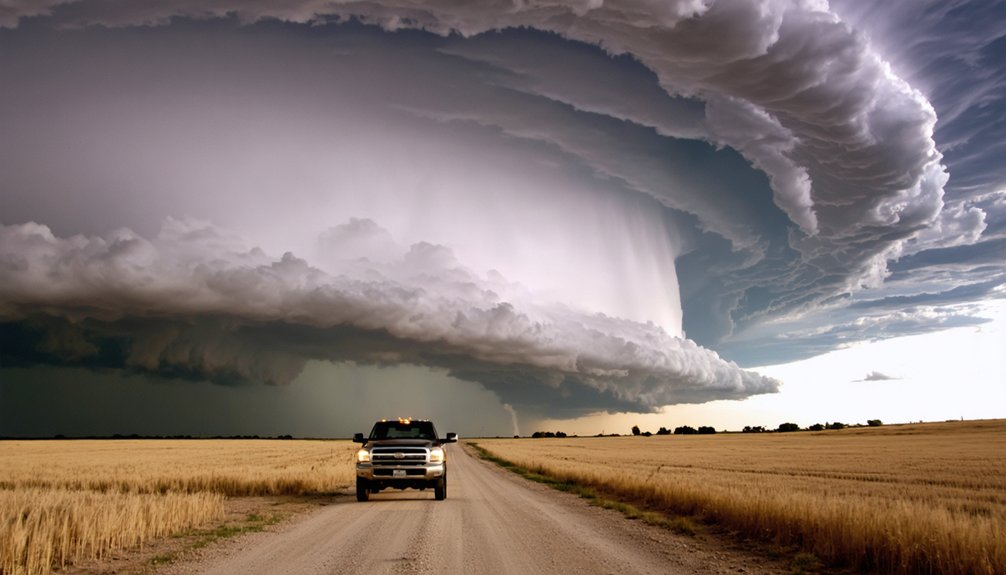
When you chase storms in Oklahoma, the flat, open terrain gives you unobstructed sightlines across vast rural landscapes, letting you visually track supercell formations and rotational features in real time.
You’ll find that Interstates 35 and 40 serve as critical intercept corridors, positioning you efficiently along storm tracks without sacrificing speed or visibility.
The road grid across western and central Oklahoma supports rapid repositioning, though you should account for coverage gaps in hilly sectors where navigation becomes particularly more difficult.
Flat Open Terrain Advantages
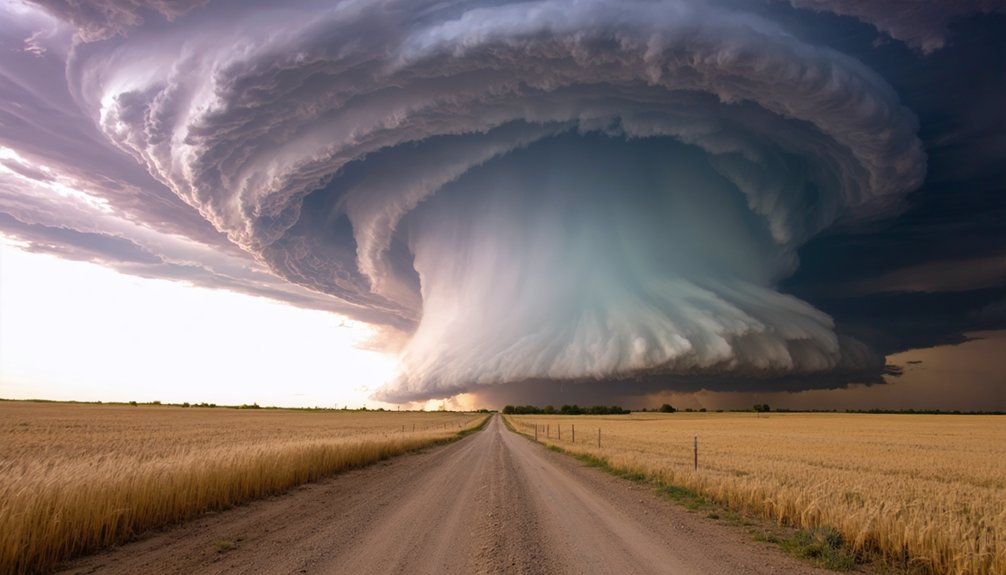
Flat, open terrain gives storm chasers a decisive tactical edge, and Oklahoma delivers that in abundance across its western and central regions. You can visually track supercell rotation from miles out, with minimal urban development or tree canopy obstructing your sightlines. That unobstructed visibility lets you read mesocyclone structure, monitor wall cloud descent, and reposition efficiently before a tornado touches down.
Interstates 35 and 40 function as your primary intercept corridors, cutting directly through prime tornado alley territory. The rural road grid supports rapid east-west or north-south adjustments as storms evolve.
Unlike chasing near cultural festivals or dense population centers, western Oklahoma’s sparse infrastructure keeps roads clear and decision-making clean. You’re not fighting traffic — you’re executing precise intercept strategies across terrain engineered by geography for exactly this pursuit.
Road Network Access Points
Beyond terrain visibility, road network efficiency determines whether you intercept a supercell or watch it escape. Interstates 35 and 40 give you high-speed repositioning corridors cutting directly through Oklahoma’s core tornado alley.
You’ll navigate section-line roads gridded at one-mile intervals across western and central Oklahoma, letting you adjust position precisely as storms shift. Monitor weather alerts continuously while driving these grids — conditions escalate faster than most chasers anticipate.
You’re also responsible for identifying your nearest storm shelter before committing to an intercept position. Some eastern Oklahoma sectors introduce hills and dense tree coverage, complicating sightlines and escape routes.
Prioritize road familiarity, keep fuel topped, and never block intersections. Oklahoma’s infrastructure gives you genuine freedom of movement — use it strategically, not recklessly.
The Road Networks That Give Chasers a Strategic Edge
Oklahoma’s proximity to Interstates 35 and 40 gives chasers a structural advantage that few other regions can match. These corridors cut through western and central Oklahoma, positioning you directly within local storm hotspots where historical storm patterns consistently produce supercell activity each spring. You can reposition rapidly, cutting across target zones without losing visual contact on rotating updrafts.
The grid-style road network across the plains gives you predictable intercept angles. You’re not guessing — you’re calculating. Rural highways run north-south and east-west with enough regularity that you can execute clean forward flanks or escape routes without dead ends trapping you.
Be aware, though — hilly terrain in eastern sectors introduces navigation friction. Stick to the western corridor, and Oklahoma’s infrastructure keeps you mobile, precise, and in control.
The Best Time of Year to Chase Storms in Oklahoma
Infrastructure puts you in position, but timing determines what you actually encounter. Your ideal window runs April through late July, with May delivering the highest concentration of supercell activity across western and central Oklahoma.
During this period, atmospheric instability peaks as Gulf moisture collides with dry continental air masses, creating conditions that reward precise storm prediction.
Early April can produce significant events, but storm mode becomes increasingly erratic by August as moisture profiles shift.
You’ll want your safety gear fully staged before May 1st — hail exceeding 2 inches diameter becomes routine, and tornado potential escalates rapidly.
June extends your opportunities while maintaining quality chase days.
Targeting this defined window maximizes your intercept probability without forcing marginal-weather gambles that compromise both safety and productivity.
Tornadoes, Giant Hail, and Lightning: Oklahoma’s Storm Variety
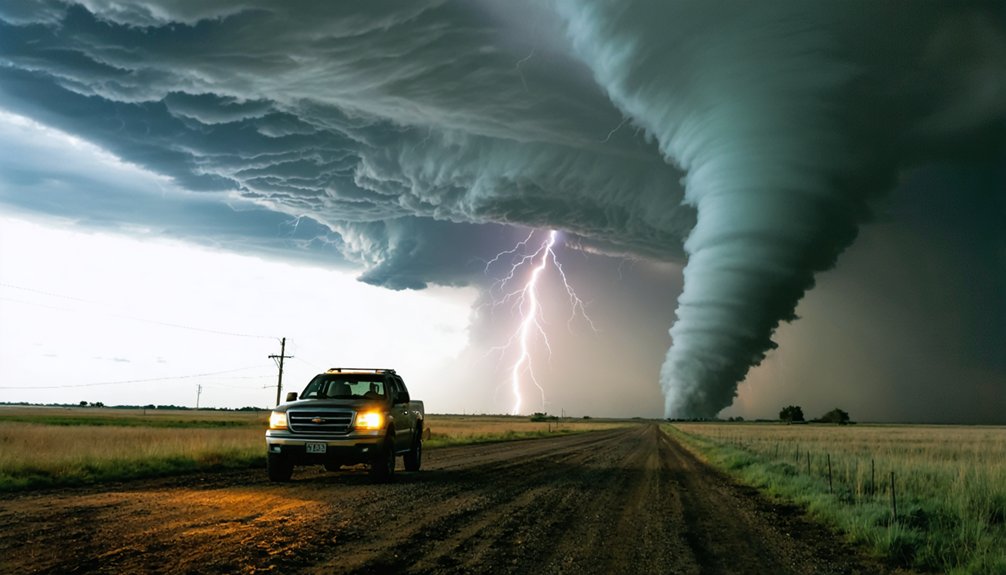
What makes Oklahoma uniquely demanding — and rewarding — is the sheer variety of severe weather you’ll encounter within a single chase season.
Historical storm patterns confirm Oklahoma leads the nation in supercell frequency, lightning activity, and large hail events.
Emergency preparedness isn’t optional here — it’s survival.
You’ll face three distinct threats every seasoned chaser respects:
- Tornadoes — Oklahoma’s western and central corridors produce violent, long-track tornadoes capable of EF4+ intensity
- Giant hail — Supercells routinely drop 2″+ hailstones, destroying equipment and vehicles within seconds
- Lightning — Oklahoma claimed the U.S. lightning capital title for 2025, overtaking Florida with staggering strike frequency
Each phenomenon demands separate tactics, separate gear, and absolute situational awareness.
Oklahoma doesn’t offer one threat — it delivers all three simultaneously.
How Oklahoma’s Radar Coverage and Research Tools Help Chasers
Few environments in the United States give chasers the research infrastructure Oklahoma delivers. Dense radar technology coverage lets you monitor storm tracking in near real-time, identifying rotation signatures, velocity differentials, and hail cores before you commit to an intercept position.
Oklahoma’s research institutions actively collect data on live supercells, meaning publicly available products reflect cutting-edge analysis rather than outdated models. You’ll also benefit from redundant communication layers — ham radio, satellite phone, and mobile internet — keeping your situational awareness sharp even in remote sectors.
One caveat: KFDR radar outages during active outbreaks can create coverage gaps in western Oklahoma, so cross-referencing multiple radar feeds isn’t optional — it’s essential. Oklahoma’s infrastructure doesn’t just support chasers; it actively sharpens your decision-making in rapidly evolving severe weather scenarios.
Storm Chasing Laws and Licensing in Oklahoma
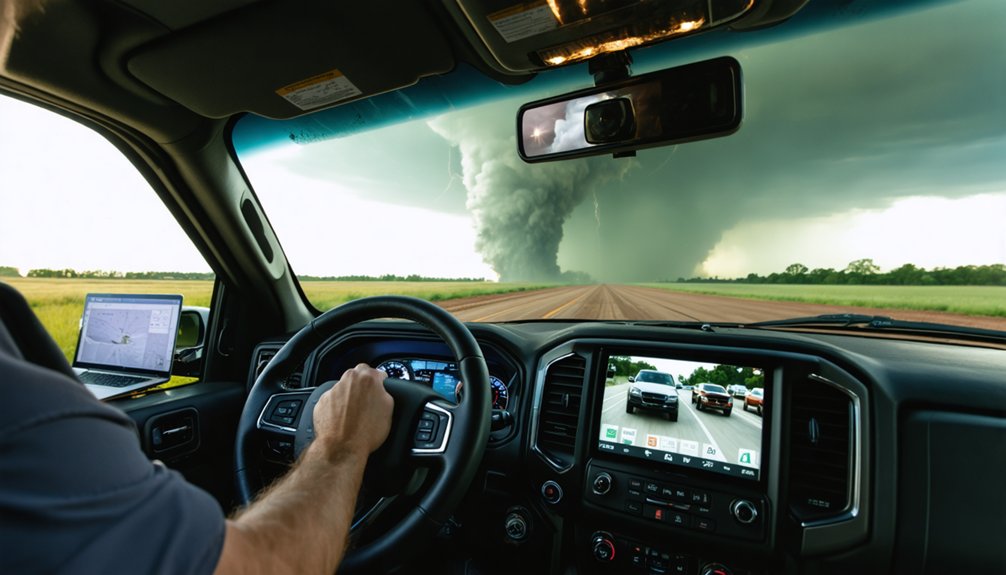
If you chase storms in Oklahoma, you’ll need to understand the legal framework that governs your activity on public roads.
Oklahoma House Bill 2426 proposes a two-tier classification system distinguishing professional from amateur chasers, with professionals potentially paying a $500 licensing fee to operate with emergency vehicle privileges.
You must follow all standard traffic laws regardless of classification, meaning blocking roads for photographs carries legal consequences.
Current Oklahoma Chasing Laws
Oklahoma’s storm chasing regulatory landscape is actively evolving. House Bill 2426 reshapes how the state defines storm chasers, splitting them into professional and amateur classifications. Understanding these legal regulations protects your freedom to chase while keeping roads clear for emergency responders.
Here’s what you need to know right now:
- Professional chasers can pay a $500 license fee, granting emergency vehicle status during active pursuits.
- Amateur chasers operate under standard traffic laws — blocking roads for photos is strictly prohibited.
- Storm safety remains non-negotiable; nearly half of indirect chasing deaths involve hydroplaning after storms pass.
These rules aren’t designed to restrict you — they’re designed to keep you alive. Know them, follow them, and you’ll chase smarter every season.
Professional Licensing Requirements
House Bill 2426 draws a clear line between professional and amateur chasers — and crossing into professional status comes with both privileges and costs. Under the proposed storm chasing regulations, professional chasers would pay a $500 licensing fee and gain the legal authority to operate as emergency vehicles. That’s a significant operational advantage, letting you position closer to active storm zones with fewer traffic restrictions slowing you down.
Amateur chasers, however, operate under standard traffic laws — no exemptions, no special access. The licensing requirements exist to separate trained operators from casual observers clogging evacuation routes.
If you’re chasing professionally, that $500 buys you legitimacy and access. If you’re not licensed, standard road rules apply, and blocking roads for documentation remains strictly prohibited regardless of your experience level.
Road Safety Legal Obligations
Beyond licensing status, road safety legal obligations apply to every chaser on Oklahoma’s highways. Whether you’re a weekend enthusiast or a seasoned professional, traffic laws aren’t optional during storm preparedness operations. Your freedom to chase depends on your discipline behind the wheel.
Oklahoma enforces strict rules that protect both chasers and civilians:
- Blocking roads for photographs is prohibited—your weather forecasting mission doesn’t override public safety
- Nearly half of indirect storm chasing deaths result from hydroplaning—speed management saves lives
- Traffic violations can end your chasing privileges entirely—one reckless decision costs your freedom in the field
You’ve invested in weather forecasting tools, storm preparedness gear, and route planning. Don’t surrender your ability to chase because you ignored a traffic statute. Respect the road. Protect your access.
Why Storm Chasers From Around the World Choose Oklahoma
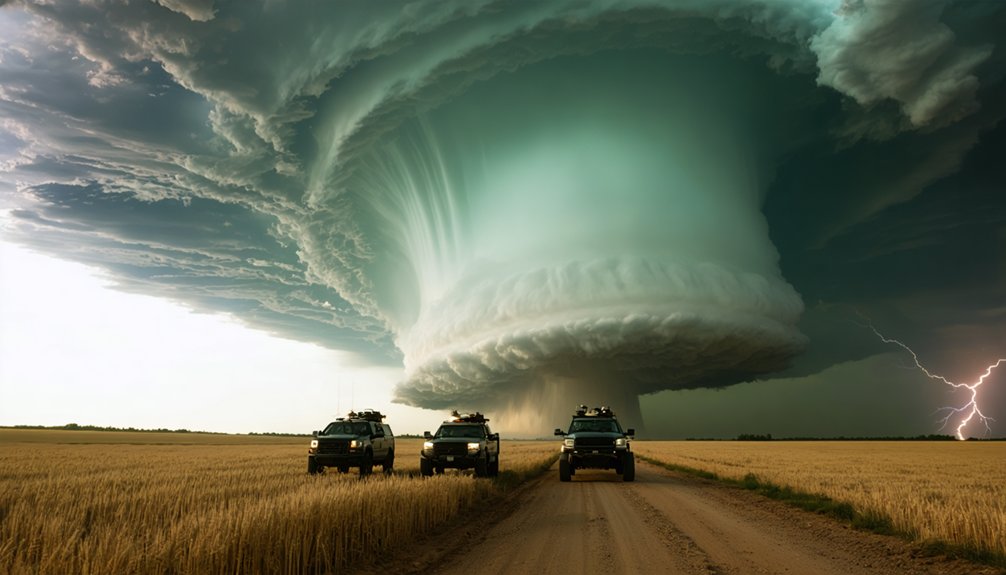
When it comes to storm chasing destinations, no state rivals Oklahoma‘s combination of storm frequency, terrain, infrastructure, and research support.
Historical storm data confirms Oklahoma leads the U.S. in supercell thunderstorms and tornado density, making every spring season statistically significant for intercept opportunities.
You’ll find flat, open terrain paired with Interstate 35 and 40 access, giving you maximum visibility and rapid repositioning capability.
Meteorological innovations developed through Oklahoma’s world-class research institutions provide you with precise, real-time data during active chase operations.
The state’s radar coverage, mobile internet infrastructure, and ham radio networks keep you connected and informed.
Add Oklahoma’s 2025 designation as the nation’s lightning capital, and you’ve got the most diverse, data-rich chasing environment on Earth.
Frequently Asked Questions
What Does a Storm Chasing Tour in Oklahoma Typically Cost?
You’ll typically spend $1,000–$3,000 per week on guided tours. Costs cover storm chasing gear, expert guidance, and safety precautions. Independent chasing cuts expenses but demands you’re equipped with professional-grade equipment and advanced meteorological knowledge.
Are Children Allowed to Participate in Storm Chasing Tours?
Many tours do allow children, but you’ll find strict storm safety policies vary by operator. Child supervision requirements are non-negotiable — most companies mandate parental consent, minimum age limits, and direct adult oversight throughout every chase.
What Should Beginners Pack for Their First Oklahoma Storm Chase?
For your first Oklahoma storm chase, you’ll need essential gear: a weather radio, mobile internet, ham radio, satellite phone, rain gear, and a first aid kit. Prioritize storm safety by packing hydroplaning-prevention supplies and navigation tools.
How Do Storm Chasers Find Accommodation During Active Chase Days?
You’ll book flexible, last-minute accommodations along I-35 or I-40 corridors, keeping your storm chasing gear ready. Prioritize motels near chase targets, maintain safety precautions, and you’ll adapt lodging dynamically based on real-time storm positioning data.
Can Storm Chasing Footage Be Sold to Media Outlets Legally?
Yes, you can legally sell your storm chasing footage to media outlets through proper media licensing agreements. Understand the legal considerations surrounding copyright ownership, contract terms, and usage rights before you negotiate any deal.
References
- https://www.tempesttours.com/storm-chasing-tours
- https://en.wikipedia.org/wiki/Storm_chasing
- https://www.youtube.com/watch?v=nukYjHliTDg
- https://www.youtube.com/watch?v=3z3dJvT4K0k
- https://extremesportsx.com/2024/03/07/the-best-states-to-visit-for-storm-chasing/
- https://www.bartlesvilleradio.com/pages/news/478952026/oklahoma-strikes-gold-as-nations-lightning-capital
- https://www.quincyvagell.com/guide-western-oklahoma/