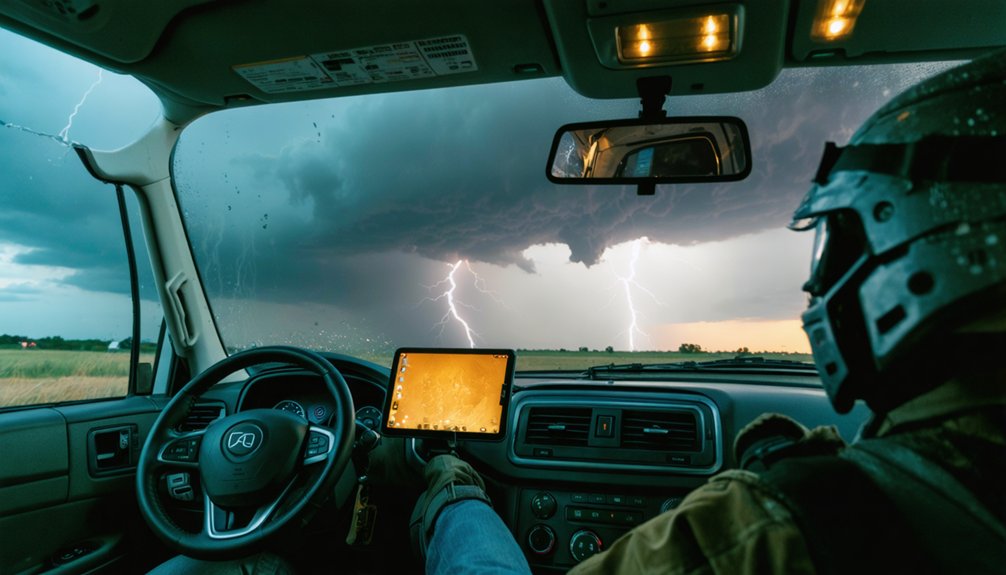
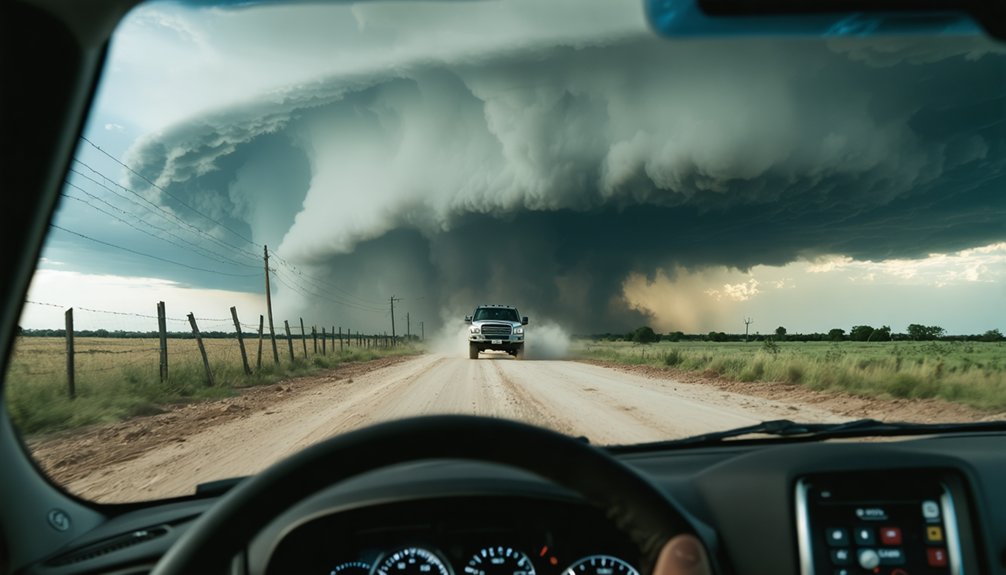
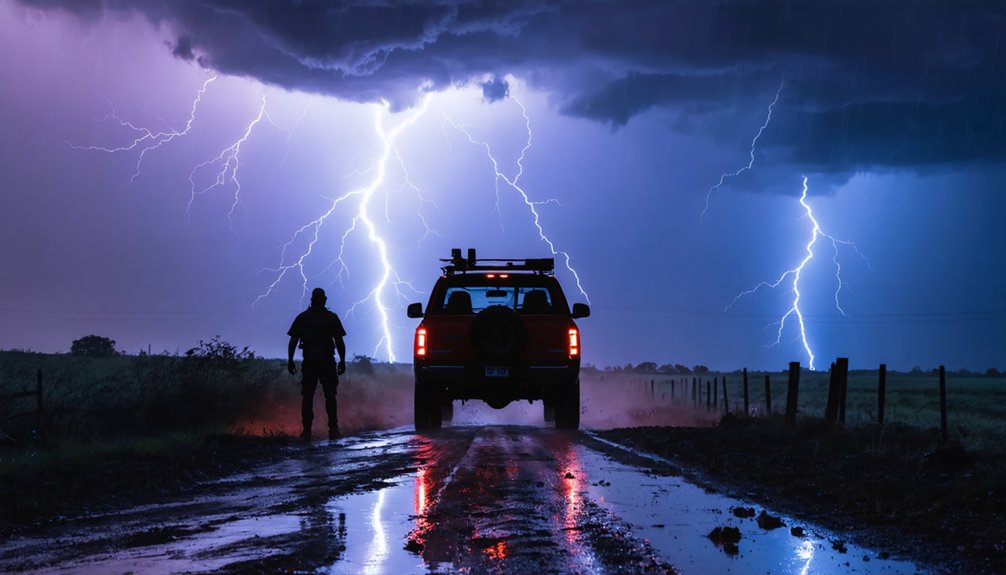
Storm chasing safety starts before you leave home. You’ll need a fully inspected vehicle, tested communications gear, and a route plan that includes alternate roads and verified escape routes. Know your abort triggers—flooded roads, nightfall, signal loss—and commit to them without exception. Approach storms from the south or west, maintain at least one mile from circulation, and always carry backup power. The measures ahead can mean the difference between a successful chase and a fatal one.
Key Takeaways
- Plan routes with verified escape paths and use NWS mesoscale discussions and Storm Prediction Center outlooks to confirm target areas beforehand.
- Establish firm abort triggers like flooded roads, nightfall, or signal loss, and commit to them before departure to avoid reactive decisions.
- Approach storms from the south or west to maintain clear sightlines, open escape routes, and avoid the storm’s forward-moving track.
- Inspect your vehicle thoroughly, keep fuel full, and carry backup power, first aid, and emergency supplies for remote operations.
- During emergencies, immediately call services with exact GPS coordinates, reporting tornado direction, movement, distance, injuries, and damage extent clearly.
Plan Your Route Before the Storm Hits
Before you enter the chase zone, you’ll need a detailed route plan that accounts for alternate roads, safe shelter options, and verified escape routes.
Before entering the chase zone, your route plan must include alternate roads, shelter options, and verified escape routes.
Start with weather pattern analysis using Storm Prediction Center outlooks and NWS mesoscale discussions to confirm your target area.
Cross-reference storm prediction models to anticipate storm motion, speed, and potential track shifts before departure.
Check state road conditions and identify network limitations that could restrict your movement.
You’ll also need to define your abort triggers in advance. These include flooded roads, nightfall, storm motion reversal, and loss of radar or GPS signal.
Knowing when to exit is as critical as knowing where to go.
Preparation before departure keeps your options open and your escape routes intact.
Check Your Vehicle for Storm Chasing Readiness
Your vehicle is your lifeline in the field, so inspect it thoroughly before departure. Vehicle maintenance isn’t optional — it’s a non-negotiable safety requirement. Check your tires, brakes, fluids, belts, hoses, wipers, headlights, and battery before every chase.
Keep your fuel tank full, and carry extra fuel when operating in remote areas.
Stock your vehicle with emergency supplies, first aid gear, and backup power systems to keep navigation and weather alerts running continuously. A dead phone or failed GPS during a fast-moving storm can cost you critical decision-making time.
Choose a vehicle capable of handling variable road surfaces and severe weather conditions. You’re operating in hostile environments where mechanical failure isn’t just inconvenient — it’s potentially fatal.
Prepare your vehicle like your escape depends on it, because it does.
Know Your Storm Chasing Abort Triggers Before You Leave
A mechanically sound vehicle gets you into the field — knowing when to leave it keeps you alive. Before departure, you must define your abort triggers — non-negotiable conditions that override curiosity, ambition, or sunk-cost thinking.
Establish specific thresholds tied to storm behavior and weather pattern shifts. Your triggers should include flooded roads, unexpected storm motion reversal, nightfall without adequate lighting equipment, and complete loss of radar or GPS signal.
If the weather pattern deteriorates faster than your route allows, you exit — no debate.
Write these triggers down and commit to them before the adrenaline hits. Freedom in the field depends on disciplined pre-planning, not reactive improvisation.
Chasers who define their limits in advance are the ones who return home and chase again.
Give Every Person in the Vehicle a Specific Job
When every person in the vehicle has a clearly defined role, your team operates with fewer errors and faster response times.
Assign one person to drive, one to monitor radar and navigation, one to communicate with outside contacts, and one to log data or film—without crossover.
Overlapping responsibilities create hesitation and confusion at the exact moments when clarity matters most.
Assign Clear Roles
Every person inside a chase vehicle should carry a defined role before the team enters the target area. Assign one person as the driver, keeping their focus solely on road conditions and vehicle control.
Designate a navigator to manage routing and storm structure understanding, ensuring the team maintains safe positioning relative to the circulation.
A communicator handles radio contact, relays emergency information, and monitors NWS updates.
A logger documents GPS coordinates, timestamps, and weather pattern analysis throughout the chase.
These defined responsibilities eliminate overlap, reduce confusion, and sharpen team response during rapidly evolving conditions.
When everyone operates within a specific function, you preserve decision-making efficiency and reduce dangerous hesitation.
Clear role assignment isn’t optional—it’s a fundamental operational discipline that directly protects every person in that vehicle.
Avoid Role Overlap
Role overlap kills response time. When two people reach for storm equipment simultaneously or wait for someone else to call out weather updates, you’ve created a gap that a fast-moving tornado exploits instantly. Every seat carries a defined function—no exceptions.
- Driver – Operates the vehicle and executes escape routes only.
- Navigator – Manages maps, GPS, and real-time weather updates continuously.
- Radar Operator – Monitors storm equipment, tracks rotation, and reports changes aloud.
- Communicator – Contacts emergency services, relays positions, and logs observations.
Own your role completely. Don’t drift into someone else’s lane because you think you can help. Redundancy in tasks creates hesitation, and hesitation during a rapidly intensifying storm costs lives. Lock your assignment down before wheels roll.
Test Your Radios and Carry Backup Power Before You Leave
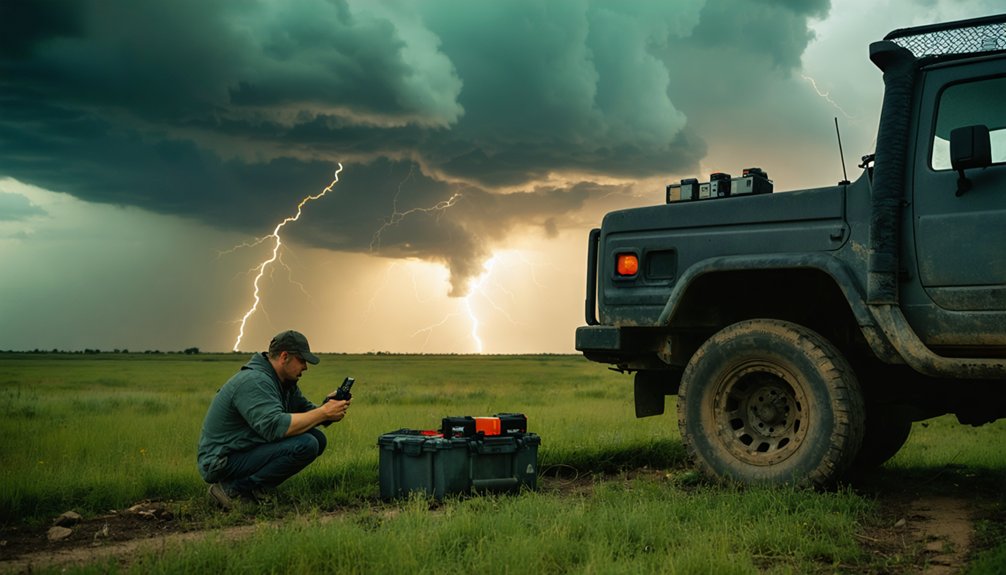
Before you enter the chase zone, test every radio, phone, and data device to confirm they’re transmitting and receiving clearly. Weak radio communication in the field isn’t a minor inconvenience—it’s a threat to your safety and your team’s coordination. Verify signal strength, channel assignments, and squelch settings before departure.
Backup power is equally non-negotiable. Carry fully charged power banks, a vehicle inverter, and spare charging cables for every critical device. Batteries drain faster under continuous GPS tracking, radar streaming, and radio use. You won’t have time to troubleshoot a dead device when a storm is moving toward you at 50 mph.
Redundant systems keep you informed and in control when primary equipment fails. Test everything before you leave—not after you’ve already committed to a target.
Slow Down, Lights On, and No Handheld Devices While Driving
Driving discipline breaks down fast when conditions deteriorate, and three rules keep you from compounding a dangerous situation: reduce speed, turn your headlights on, and put the phone down. Rain, dust, and debris shift road surface conditions instantly, and visibility conditions can collapse within seconds.
Follow these four disciplines without exception:
- Reduce speed immediately when rain intensifies or dust crosses the roadway.
- Activate headlights in any reduced-visibility conditions, regardless of time of day.
- Keep both hands on the wheel and eyes on the road surface ahead.
- Set devices down completely—no texting, no handheld radar checks, no exceptions while moving.
Your freedom to chase depends on staying mobile and alive. Distraction eliminates both.
Keep at Least One Mile From Tornado Circulation
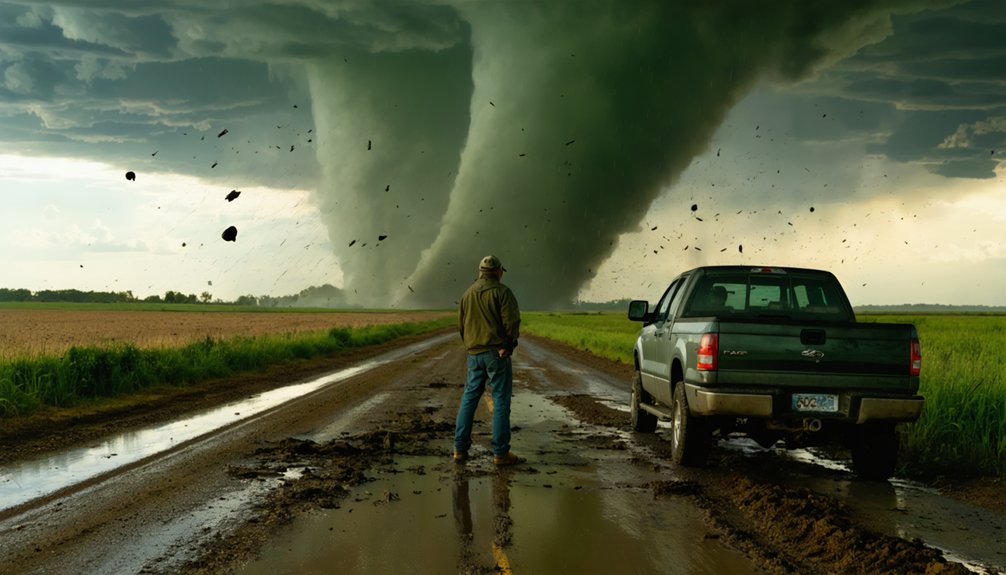
Keeping your hands on the wheel and your speed controlled gets you to the right position—but position itself is what keeps you alive near active tornado circulation. Maintain at least one to two miles from any confirmed tornado proximity. That margin gives you time to react if the storm accelerates, shifts direction, or produces a satellite tornado without warning.
Approach from the south, west, or east—never from the north, where storm motion works against your escape. Avoid driving beneath rotating wall clouds or into precipitation and hail cores.
Storm safety depends on discipline, not bravado. Never sacrifice distance for a better angle or photograph. The moment you compromise that buffer, you’ve handed control to the storm. Keep the margin. Keep your freedom to move.
Approach Storms From the South or West, Never the North
When you position yourself south or west of a supercell, you’re placing your vehicle in the storm’s inflow region, which offers cleaner visual sightlines to the wall cloud and mesocyclone while keeping you ahead of the most dangerous precipitation.
That positioning also gives you forward escape routes as the storm typically tracks northeast, letting you pace it safely without cutting across its path.
Approaching from the north, however, puts you directly in the storm’s forward-moving path, trapping you in the rain-wrapped core where tornado visibility collapses and escape routes vanish rapidly.
Southern Approach Benefits Explained
Where you position your vehicle relative to a storm isn’t just a tactical preference—it’s a fundamental safety decision. Storm path analysis consistently confirms that southern and western approaches give you the clearest southern approach advantages:
- Forward storm motion moves northeast, keeping you outside the primary danger zone.
- Visibility remains cleaner from the south, letting you observe structure without entering precipitation.
- Escape routes stay open since you’re not driving into the storm’s forward path.
- Northern positioning traps you directly in the storm’s projected track, eliminating exit options fast.
Approaching from the north removes your margin. The storm moves toward you, your exits close, and your reaction time collapses. Position yourself where the storm’s own motion works in your favor, not against you.
Northern Positioning Deadly Risks
Positioning north of a supercell doesn’t just reduce your margins—it eliminates them. Northern risks compound rapidly because storm motion typically tracks northeast, driving the entire destructive envelope directly toward your position. You’re surrendering every escape route the moment you commit to that angle.
The storm surge of rain, hail, and embedded circulation wraps around the northern flank, cutting visibility and blocking roads before you can react. You won’t outrun a northeast-tracking supercell from the north—storm speeds routinely exceed safe vehicular escape thresholds.
Approach from the west, southwest, or south, where forward storm motion works in your favor and escape routes remain open. Northern positioning isn’t aggressive chasing—it’s a fatal miscalculation that removes the freedom to make any corrective decision at all.
Abandon Your Vehicle and Find Low Ground If Escape Fails
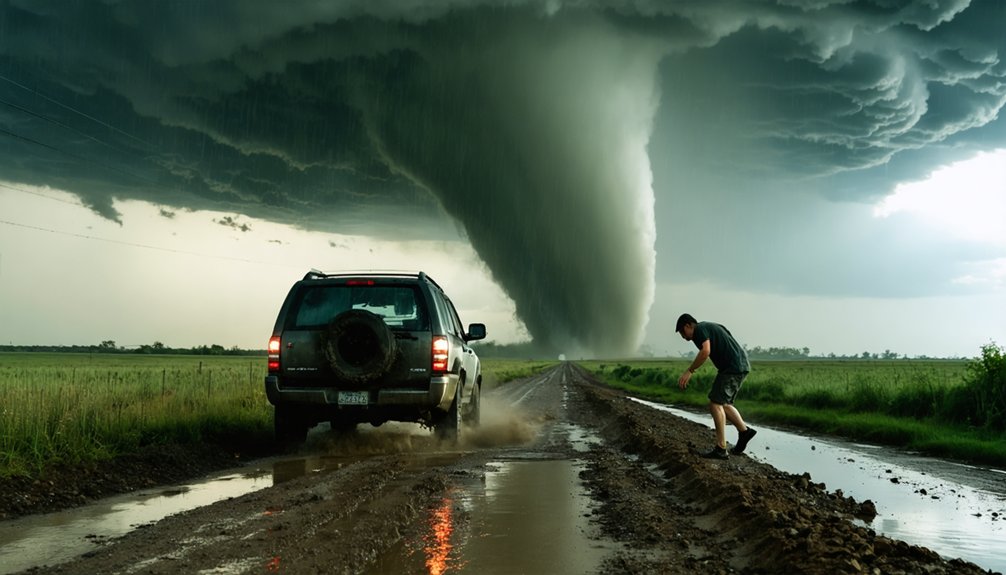
If vehicular escape is no longer viable, abandon the vehicle immediately and move to the nearest sturdy structure. Underground shelters provide maximum protection. If no structure exists, low ground remains your last resort.
Follow these critical steps:
- Exit the vehicle quickly and move perpendicular to the tornado’s path.
- Locate a ditch or ravine below road grade, avoiding floodplain safety hazards like rising water.
- Lie flat, face down, protecting your head with both arms.
- Stay away from trees, vehicles, and debris-prone open areas.
Never shelter under an overpass—it creates a wind tunnel effect, increasing debris impact velocity. You’re most vulnerable when stationary, so act decisively. Seconds determine survival outcomes when tornado proximity eliminates safe vehicular movement.
Report Injuries and Tornado Sightings With Exact GPS Coordinates
When you witness a tornado or encounter injuries in the field, call emergency services immediately and provide your exact GPS coordinates rather than a vague location description.
Your device’s coordinate readout—latitude and longitude to at least four decimal places—gives dispatchers and response teams a precise target, cutting response time considerably.
Coordinate your report with your team’s communicator so that all transmitted information is consistent, verified, and actionable.
Accurate GPS Reporting
Accurate GPS coordinates can mean the difference between a rapid emergency response and a delayed one. When you call emergency services, don’t guess your location—confirm it using your device’s exact coordinates.
Watch for GPS signal interference from dense storm clouds, and cross-reference with a secondary device to catch satellite navigation errors before transmitting.
Follow this reporting protocol:
- Read your latitude and longitude aloud directly from your GPS display.
- Confirm coordinates with a backup navigation app before calling dispatch.
- State tornado direction of travel and estimated distance from your position.
- Report injured party count and visible damage extent at your exact location.
Precise reporting accelerates response times and keeps rescue teams from searching unnecessarily—your accuracy directly protects lives in the field.
Emergency Services Coordination
Transmitting exact GPS coordinates is only half the task—knowing how to coordinate with emergency services once you’re on the line is what completes the loop. When you report injuries or tornado sightings, state your coordinates immediately, describe storm movement direction and speed, and confirm road accessibility for responders.
Your storm documentation becomes operationally critical here—dispatchers use your real-time observations to mobilize resources efficiently. Don’t editorialize; deliver facts. Specify whether the tornado is on the ground, aloft, or dissipating.
Reference your weather pattern analysis to anticipate where the storm tracks next, giving responders advance positioning intelligence. Keep the line open if requested.
Designate one crew member solely for emergency communication so your driver stays focused. Precision reporting isn’t optional—it directly determines how fast help reaches the right location.
Frequently Asked Questions
Can Solo Storm Chasers Ever Safely Operate Without a Dedicated Team?
You can operate solo, but you’ll face heightened risks without team coordination. Prioritize solo safety by sharing your GPS location, pre-planning escape routes, and maintaining redundant communication systems before entering any chase zone.
What Insurance Coverage Is Recommended Specifically for Storm Chasing Vehicles?
You’ll need extensive insurance policies that include hail, flood, and collision vehicle coverage. Confirm your insurer covers storm-chasing activities specifically, as standard policies often exclude professional or high-risk weather pursuit operations.
How Do Professional Chasers Handle Extreme Fatigue During Multi-Day Chase Trips?
You’ll combat fatigue management by rotating drivers, scheduling mandatory rest stops, and avoiding sleep deprivation through strict sleep schedules. Don’t push beyond your limits—exhausted decision-making kills chasers faster than storms do.
Are There Legal Restrictions on Where Storm Chasers Can Legally Drive or Park?
You’ll face legal restrictions on closed roads, private property, and disaster zones. Always obey parking regulations—never stop on highways or block emergency access. Local ordinances vary, so you must verify jurisdiction-specific rules before entering any chase area.
What Mental Health Risks Do Experienced Storm Chasers Commonly Face Over Time?
You’re carrying the weight of a thousand storms! Experienced chasers commonly develop PTSD, anxiety, and burnout. You’ll need active stress management routines and strong emotional resilience to prevent cumulative trauma from eroding your judgment and long-term mental wellbeing.
References
- https://www.atms.unca.edu/cgodfrey/courses/swfex/pdf/ChasingSafety.pdf
- https://crazystormchasers.com/best-practices-for-storm-chasing-safety-engagement/
- https://www.reddit.com/r/stormchasing/comments/k89wnc/safety_tips_for_storm_chasing/
- https://www.livingskytours.com/storm-chasing-101/
- https://stormchaser.com/Storm-Chasing-Safety.pdf
- https://midweststormchasers.org/safety-tips/
- https://crazystormchasers.com/essential-safety-checklist-for-storm-chasing-expeditions/
- https://crazystormchasers.com/essential-storm-chasing-safety-tips-and-guidelines/
- https://crazystormchasers.com/storm-chasing-safety-rules/
- http://www.stormeyes.org/tornado/chasing/FAQ/