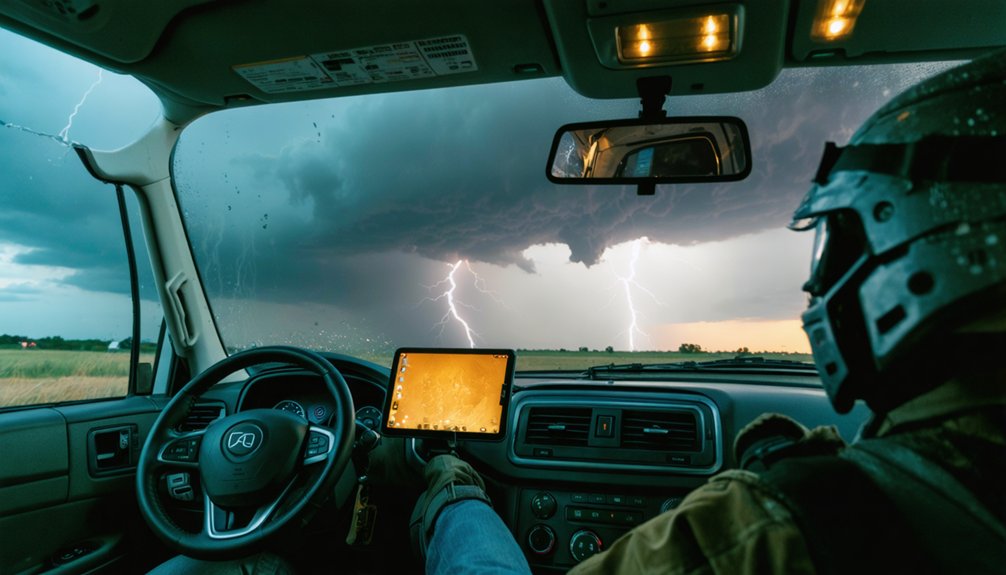
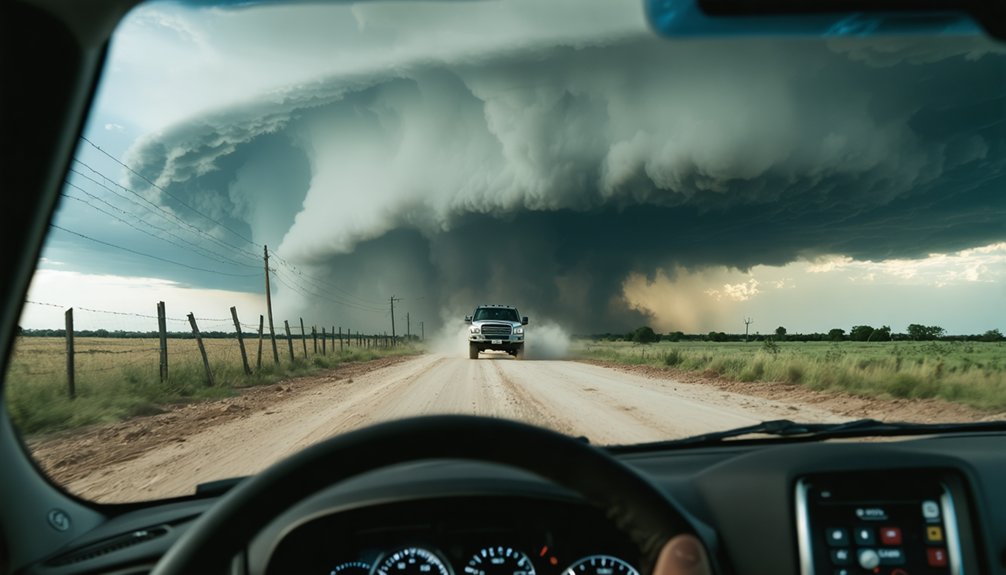
Effective storm chasing driving starts with targeting active boundaries, not just outlook categories. You’ll want your road network memorized before entering storm country, with parallel escape corridors already planned. Assign crew roles before departure—driver, navigator, and radar operator—so nobody’s confused mid-intercept. Follow traffic laws strictly, maintain constant escape route awareness, and never shelter under overpasses. The strategies ahead break down each phase of a chase in precise, actionable detail.
Key Takeaways
- Assign dedicated crew roles—driver, navigator, and radar monitor—before departure to prevent dangerous confusion during fast-moving storm situations.
- Always maintain at least two parallel escape corridors and never position yourself without a viable exit route available.
- Memorize road networks in advance, using interstates for rapid repositioning and secondary roads for precise storm intercept approaches.
- During hydroplaning or hail, slow down immediately, avoid hard braking, and trust physical cues over visual confirmation of traction loss.
- Never shelter under an overpass; prioritize movement over documentation, and treat retreat decisions as immediate and non-negotiable.
Choose Your Chase Target Based on Boundaries, Not Just Outlooks
When planning a chase, the SPC Convective Outlook gives you a starting point, but it shouldn’t be your finishing point.
Convective outlooks and weather models identify broad risk assessment zones, but effective target refinement demands sharper tools. Use radar analysis, surface charts, and satellite imagery to locate active boundaries — drylines, warm fronts, and outflow boundaries — because these features drive lift enhancement and accelerate storm evolution.
Pay particular attention to boundary intersections, where converging features concentrate shear and maximize convective potential.
Before you leave, forecast storm motion to optimize your intercept angle and avoid unnecessary repositioning.
Chasing boundaries rather than simply chasing outlook categories gives you a tactical edge, keeps you mobile, and preserves your freedom to reposition as conditions evolve throughout the day.
Map Your Road Network Before You Enter Storm Country
Pinning down your target is only half the job — getting there and staying mobile depends entirely on the road network you’ve committed to memory before storms fire.
Road network mapping isn’t optional; it’s foundational to every chase decision you’ll make once things accelerate. Study your storm route planning well before departure, identifying paved county roads, highway junctions, and grid patterns that allow east, south, and west movement simultaneously.
Flag dead-ends, dirt roads, and Interstate segments that’ll trap you during active interception. Identify two or three parallel escape corridors running perpendicular to anticipated storm motion.
When storms fire and the situation compresses your decision window, you won’t have time to discover your route options — you’ll only have time to execute them.
Assign Crew Roles Before the Chase Starts, Not Mid-Intercept
Once storms fire and intercept windows compress, there’s no margin to negotiate crew dynamics on the fly. Assign role assignments before you leave the staging area.
Designate one person as the full-time driver, responsible solely for vehicle control and road awareness. Assign a dedicated navigator to manage GPS routing, road surfaces, and repositioning options. A third crew member handles radar, satellite feeds, and storm-motion updates.
Each role stays fixed unless conditions force a deliberate handoff. You’ll eliminate mid-intercept confusion, reduce communication breakdowns, and keep decision-making clean under pressure.
Brief everyone on retreat triggers and exit priorities before departure. When a tornado closes distance fast, you want immediate coordinated action, not improvised debate. Pre-assigned roles deliver exactly that.
Storm Chasing Driving Rules That Keep You on the Road
When you’re behind the wheel in a storm environment, you must obey all traffic laws without exception, because reckless driving compounds the hazards the storm itself already creates.
You need to maintain a viable escape route at all times, keeping your vehicle positioned so that a sudden tornado approach doesn’t trap you on a dead-end road or in a blocked lane.
You also can’t afford distracted driving—hand off navigation, radar monitoring, and camera work to a dedicated co-chaser so your full attention stays on the road.
Obey Traffic Laws Always
Although adrenaline and urgency define storm chasing, traffic laws aren’t optional—they’re operational constraints that keep you mobile, safe, and legally protected.
Traffic law adherence isn’t bureaucratic compliance—it’s tactical discipline. Speeding invites traffic stops that eliminate your intercept window entirely. Reckless driving charges can end your legal storm chasing career permanently.
Obey posted speed limits, use turn signals before every pull-off or lane change, and stop fully at intersections even when roads appear clear.
Storm environments create unpredictable hazards—emergency vehicles, panicked civilians, debris—that demand predictable driving behavior from you.
Your vehicle is your most critical asset. A citation, collision, or license suspension removes that asset immediately.
Treat traffic laws as hard operational boundaries, not suggestions you override when the storm looks promising.
Maintain Safe Escape Routes
Every positioning decision you make near a storm should factor in how you’ll exit if conditions deteriorate faster than expected.
Escape route options aren’t optional—they’re operational requirements. Contingency planning before you approach keeps your freedom of movement intact when storms accelerate unexpectedly.
Apply these principles consistently:
- Avoid dead-end rural roads where a single blocked path eliminates all retreat options.
- Keep your vehicle pointed in the direction of intended escape, not just convenient observation.
- Monitor storm motion continuously so you’re never repositioning reactively under pressure.
- Avoid dirt roads before or during precipitation, since mud removes traction and mobility simultaneously.
Your ability to retreat depends entirely on decisions made before conditions force your hand.
Discipline your positioning early, and you’ll never chase yourself into a corner.
Avoid Distracted Driving Habits
Storm chasing generates a constant stream of incoming data—radar updates, GPS directions, radio traffic, camera angles—and every one of those inputs competes for attention you can’t afford to split while driving.
Effective attention management starts before you move. Pre-program navigation aids, assign a dedicated co-pilot for communication strategies, and establish clear roles that keep distraction triggers away from the driver.
Driving mindfulness means your eyes stay on road hazards, not screens. Use peripheral visual awareness to monitor storm structure without fixating on it. If you need to consult data, pull over safely.
Focus techniques like verbal callouts between crew members keep critical information flowing without forcing the driver to disengage from the road. Discipline here isn’t optional—it’s operational.
Handle Hydroplaning, Hail, and Dust the Moment They Hit
When your tires lose contact with the road surface, you’ll often feel the steering go light and notice spray kicking out from under the wheels — ease off the throttle immediately without braking hard or jerking the wheel.
You can’t maintain chase positioning if you’ve spun out or left the road, so recognizing that early loss-of-traction signal is what keeps you mobile.
Once hail begins striking the vehicle, slow down immediately, since large stones reduce visibility fast and strike the windshield at angles that can crack or compromise your forward sightlines.
Recognizing Hydroplaning Warning Signs
Hydroplaning can strip away steering and braking control before you’ve consciously registered the loss of traction, making early recognition the critical first line of defense.
Watch for these hydroplaning signs before grip fully disappears:
- Steering feels unusually light or unresponsive, indicating tires are riding over water accumulation rather than gripping pavement.
- Engine RPMs spike without acceleration, signaling driven wheels have lost surface contact.
- Spray pattern shifts under the vehicle, visible in mirrors as mist rather than defined tire tracks.
- Rear-end drift begins without steering input, confirming traction loss has already started.
You won’t always see standing water in time to react.
Trust these physical cues over visual confirmation. Recognizing hydroplaning signs early keeps your options open and your escape routes intact.
Slowing Down During Hail
Hail transforms road conditions faster than most drivers anticipate, compressing your reaction window to seconds. The moment hail impact begins, reduce speed immediately — don’t wait for conditions to deteriorate further. Hail accumulates like gravel, eliminating tire grip and triggering skids even at moderate speeds.
Visibility reduction compounds the danger. Bouncing ice obscures road edges, other vehicles, and obstacles simultaneously. You’ll need both headlights on and your speed dropped well below the posted limit to maintain any reasonable stopping distance.
Don’t accelerate trying to outrun a hail core — that decision routinely traps chasers inside worsening conditions. Instead, pull safely off the road if hail intensifies beyond manageable levels.
Protect your tires, your windshield, and your exit options by treating every hail encounter as a serious mechanical threat.
Reroute Your Storm Chase When Your Position Breaks Down
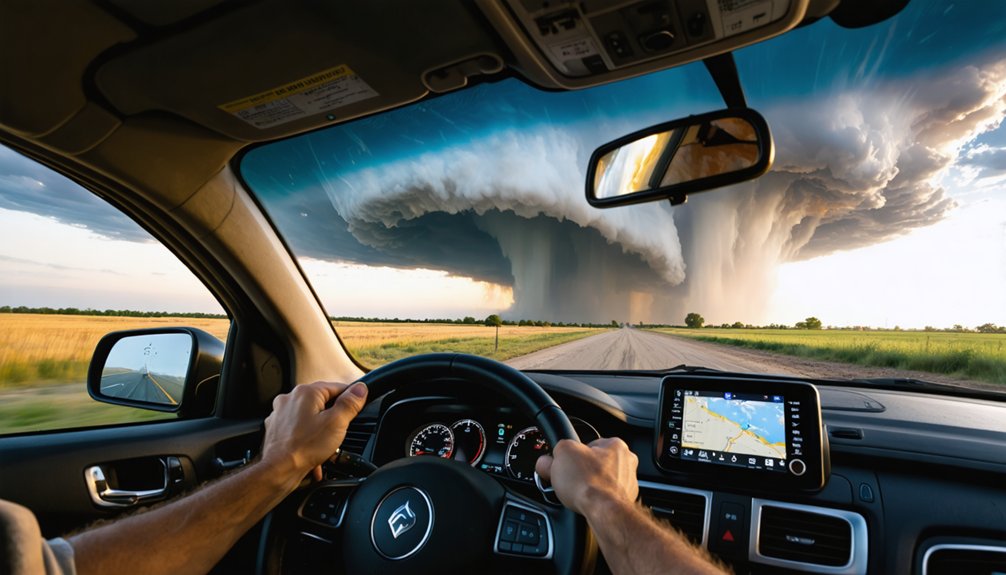
Even the most carefully planned chase position can break down when storms accelerate, jog, or outrun your route network. When that happens, execute reposition strategies quickly and deliberately rather than forcing a compromised intercept.
Apply these reposition strategies and communication protocols immediately:
- Reassess storm motion and identify the next viable intercept point before committing to a new route.
- Prioritize paved roads with multiple exit options over shortcuts that trap you.
- Communicate position changes clearly with your chase crew before moving.
- Use Interstates for rapid repositioning, then shift to secondary roads near the target.
Retreating early preserves your mobility and keeps options open. A broken position isn’t a failure — it’s data.
Adapt your route, maintain discipline, and you’ll stay in the game safely.
How Close Is Too Close During a Storm Chase?
Knowing when to stop closing distance on a storm separates disciplined chasers from reckless ones. Establish your tornado distance before you’re in the field, not while adrenaline is affecting your judgment.
For safe viewing, position yourself perpendicular to storm motion, ideally one to two miles from the mesocyclone, with a clear escape route behind you.
Watch for these signals that you’ve closed too far:
- The wall cloud fills your entire forward view
- Debris is visible at ground level
- Your retreat angle requires driving parallel to storm motion
Once a tornado begins tracking toward your vehicle, retreat immediately. Don’t negotiate that decision in the moment.
Your mobility is your only real protection out there, and a damaged or blocked vehicle ends your chase permanently.
Escape a Closing Tornado Before the Road Closes Behind You
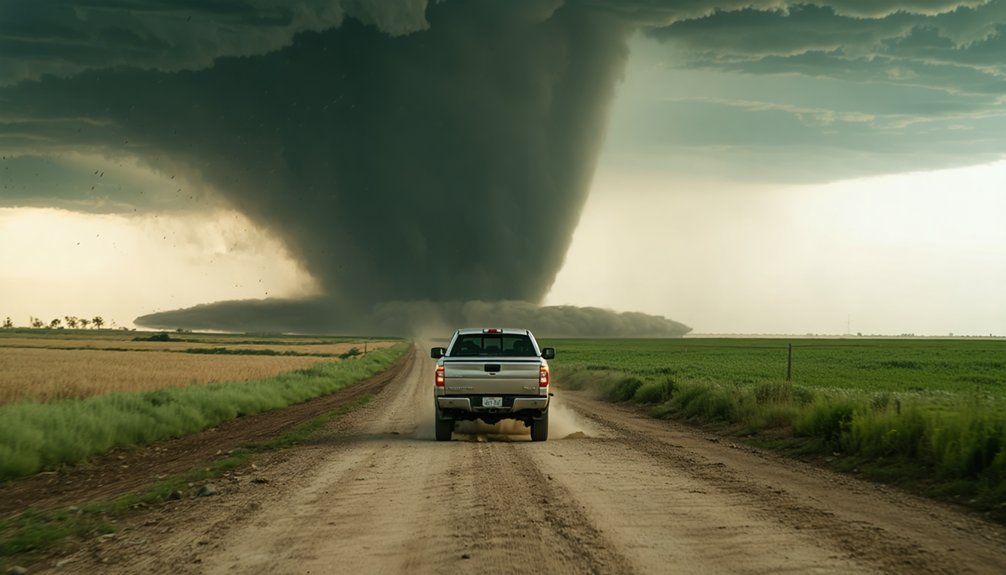
Once you’ve committed to retreating, the clock on that decision runs faster than most chasers expect. Tornado safety depends entirely on your ability to move before the circulation cuts off your route.
Execute your exit using these principles:
- Drive perpendicular to storm motion, not directly away from it
- Avoid core punching through precipitation just to reach open road
- Never shelter under an overpass; it eliminates your mobility entirely
- Maintain emergency communication with your team throughout the retreat
Your vehicle is your only asset. Once debris, flooding, or downed infrastructure blocks the road behind you, that asset becomes a liability.
Prioritize movement over documentation, stay off dirt roads, and treat every retreat decision as non-negotiable the moment you make it.
Frequently Asked Questions
Should Storm Chasers Carry Emergency Supplies Like Food and Water?
Yes, you should carry safety kits stocked with food, water, and medical supplies. Implement solid hydration strategies, since you’ll face long, unpredictable deployments where resupply isn’t guaranteed, keeping you operationally independent and ready.
What Insurance Coverage Do Storm Chasers Typically Need for Their Vehicles?
You’ll need extensive vehicle protection that covers hail, flood, and collision damage. Explore coverage options beyond standard policies, including specialized endorsements for high-risk environments, ensuring you’re financially protected when storm conditions compromise your vehicle’s safety.
Are There Legal Permits Required to Chase Storms Professionally?
You don’t need specific professional permits or storm chasing regulations to chase legally. However, you must obey all traffic laws, respect road closures, and carry proper vehicle credentials when operating in restricted jurisdictions.
How Do Storm Chasers Coordinate With Local Emergency Management Officials?
As the storm closes in, you’ll coordinate through established communication protocols: report storm data to local emergency managers via radio, share positional updates, and follow their safety measures to guarantee your movements don’t obstruct emergency response operations.
What Physical Fitness Considerations Matter for Long Storm Chasing Seasons?
You’ll need endurance training to sustain multi-day chases and sharp hydration techniques to counter fatigue. Prioritize cardiovascular conditioning, consistent sleep schedules, and electrolyte management so you’re physically capable of making precise, split-second driving decisions throughout demanding seasons.
References
- https://www.weathercentertx.com/weather-101-different-types-of-weather/storm-chasing-101/
- https://stormtrack.org/threads/basic-storm-chasing-process.29691/
- http://www.stormeyes.org/tornado/chasing/FAQ/
- https://www.flame.org/~cdoswell/chasesums/Chase_safety.html
- https://www.atms.unca.edu/cgodfrey/courses/swfex/pdf/ChasingSafety.pdf
- https://www.youtube.com/watch?v=dCGFK8JI-mU
- https://www.wikihow.com/Storm-Chase
- https://www.stormchase.us/Articles/VehiclePrep.html
- https://www.facebook.com/groups/6926972223/posts/10161041750897224/
- https://www.facebook.com/groups/1821133111780534/posts/2069603803600129/