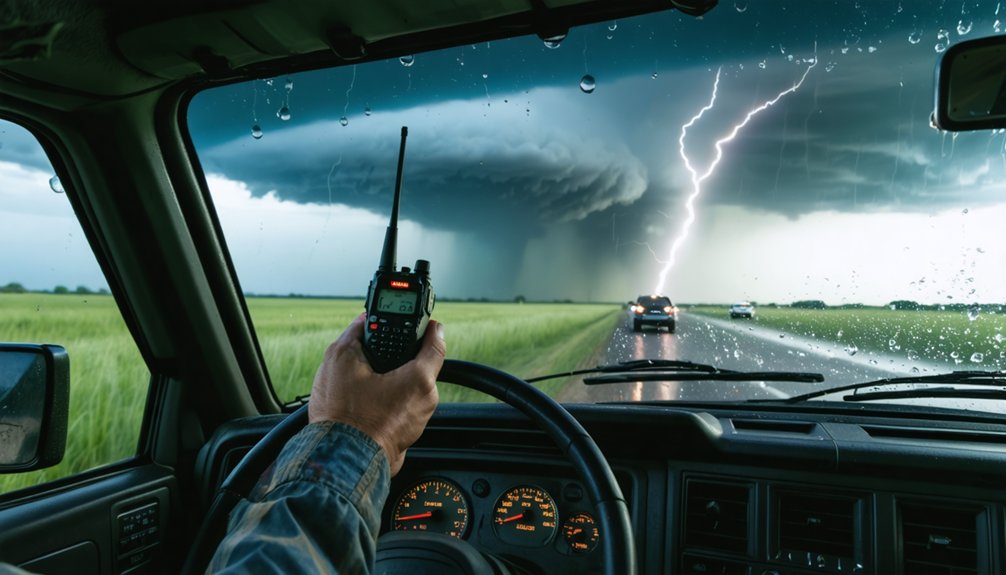
To set up emergency communication for storm chasing, you’ll need redundant systems across multiple technologies. Carry two phones on different carriers, a licensed ham radio operating on 2-meter frequencies like 146.580 MHz, GMRS/FRS handhelds for inter-vehicle coordination, and a satellite phone as your last resort. Back everything up with high-capacity power banks and solar chargers. The details behind building a truly resilient, field-tested system go much deeper than the basics.
Key Takeaways
- Carry at least two mobile phones on different carriers like Verizon and AT&T to ensure network diversity during storm chasing.
- Use ham radios on the 2-meter band with frequencies like 146.580 MHz, requiring an FCC license for legal operation.
- Deploy GMRS/FRS handhelds for immediate inter-vehicle communication and assign roles within groups for effective relay chains.
- Maintain backup power through high-capacity power banks, solar chargers, and portable generators to prevent device failures.
- Use satellite phones and emergency beacons as last-resort communication backups when all other systems fail.
Build Your Core Storm Chasing Communication Kit
Building a reliable storm chasing communication kit starts with redundancy—you can’t afford a single point of failure when you’re operating in severe weather.
Redundancy isn’t optional in storm chasing—one failed link in your communication chain can cost you everything.
Equip yourself with at least two mobile phones on different carriers, a ham radio capable of operating on the 2-meter band, and a weather radio for direct National Weather Service alerts.
Layer your backup systems deliberately. A satellite phone covers you when cellular infrastructure collapses entirely, while an emergency beacon becomes your last-resort lifeline if all other communication fails.
Add GMRS/FRS handhelds for inter-vehicle coordination and a scanner to monitor public safety frequencies simultaneously.
Power management is non-negotiable—carry power banks, car chargers, and a solar backup.
Each device must serve a distinct, mission-critical function within your overall communication architecture.
Which Radio Frequencies Do Storm Chasers Actually Use?
Once you’ve assembled your hardware, knowing which frequencies to monitor and transmit on determines whether your communication network actually functions under pressure. Frequency allocation separates functional chasers from silent ones.
For licensed operators, the 2-meter band (144–148 MHz FM) dominates storm spotting operations. Transmit on 146.580 as your default spotter frequency, or use 146.550 if you’re roaming without a permanent local group. Radio licensing through the FCC unlocks these ham bands, giving you legal access to the most reliable spotter networks.
Without a license, use MURS or GMRS/FRS frequencies for inter-vehicle coordination. Scan public safety channels simultaneously to track emergency responses near active storm cells. Layering your frequency awareness across multiple bands keeps your team informed when conditions deteriorate rapidly.
Set Up Multi-Carrier Coverage for Remote Areas
When chasing storms in remote areas, you’ll want to carry devices on at least two networks—Verizon and AT&T cover most rural corridors. But adding a regional carrier specific to your target area closes critical gaps.
Pair each device with an external antenna or cellular amplifier to push weak signals into usable range when you’re operating far from towers.
If cellular coverage fails entirely, fall back on a mobile hotspot running a satellite connection or a ruggedized data terminal to maintain real-time radar access and team coordination.
Carrier Selection Strategy
Chasing storms across remote stretches of the Great Plains or mountain corridors means you’ll frequently operate well outside any single carrier’s reliable coverage zone. Deploy at least two devices with different carriers—typically Verizon and AT&T—to maximize geographic coverage overlap.
Carrier compatibility matters considerably here; your devices must support regional network bands relevant to your specific chase territory. Research coverage maps before departure, not during the chase.
Signal prioritization becomes critical when multiple networks are detectable. Configure your devices to prefer the strongest available signal automatically, reducing manual intervention during high-pressure situations.
Supplement cellular coverage with a mobile hotspot on a third carrier when penetrating truly isolated terrain. This layered carrier strategy guarantees you’ll maintain data and voice connectivity when institutional infrastructure becomes unreliable or completely absent.
Signal Boosting Techniques
Even the strongest multi-carrier setup falters without adequate signal amplification when you’re operating in dead zones between towers. Mount external antennas on your vehicle’s roof to minimize signal attenuation caused by metal bodies blocking transmission paths. Match antenna polarization to your carrier’s tower orientation—vertical polarization dominates cellular networks, so deploying mismatched antennas kills your gain before amplification even begins.
Install a bidirectional amplifier between your external antenna and devices to boost both incoming and outgoing signals simultaneously. WeBoost and SureCall units handle multi-band amplification across Verizon and AT&T frequencies without requiring separate hardware per carrier.
Run low-loss coaxial cable to prevent signal degradation between components. Properly configured, this system transforms marginal one-bar coverage into reliable data connections, keeping your weather feeds and voice communications operational deep in remote terrain.
Backup Connectivity Options
Cellular dead zones don’t discriminate between critical moments and quiet stretches, so you need redundant carrier coverage before you’re deep in remote terrain. Carry devices on at least two separate carriers—Verizon and AT&T cover most rural corridors, but regional providers fill critical gaps in states like Colorado.
Add satellite messaging capability through a dedicated device like a Garmin inReach, giving you two-way communication completely independent of cellular infrastructure. When towers fail entirely, satellite messaging keeps your position and observations moving to meteorologists and emergency managers.
Pair every connectivity layer with dedicated backup power—power banks, solar panels, or vehicle-mounted chargers—because a dead device eliminates your redundancy instantly. Stack these systems deliberately, and you maintain operational freedom regardless of what the terrain does to your signal.
Coordinate Storm Chasing Communication Between Vehicles
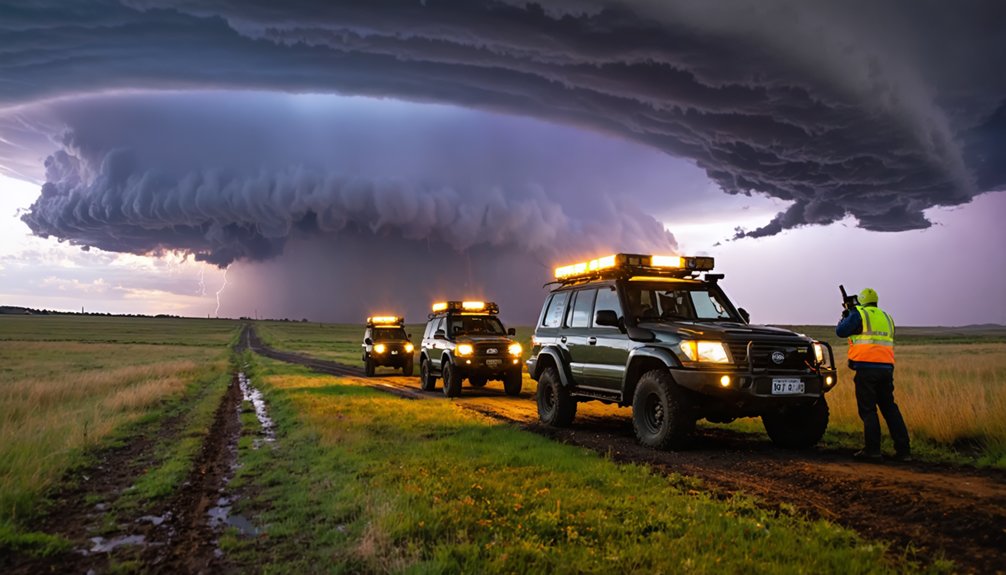
When coordinating communication between vehicles during a storm chase, you’ll want to layer multiple radio systems to maintain reliable contact. Deploy inexpensive GMRS/FRS handhelds for immediate inter-vehicle synchronization, while running a 2-meter ham radio setup simultaneously for broader network communication with Skywarn or Canwarn systems.
Assign each vehicle a designated role in your emergency relay chain before deployment. If one vehicle loses contact, the next unit in sequence assumes relay responsibilities, preventing communication gaps during critical moments.
Use 146.580 MHz as your default simplex frequency, shifting to pre-agreed alternates if interference occurs. Equip each vehicle with a scanner to monitor public safety channels simultaneously.
This layered approach ensures your team maintains operational coordination regardless of individual equipment failures or dead zones.
Pull Live Radar Data While You’re in the Field
When you’re in the field, specialized apps like RadarScope and GRELevel3 give you Super-Resolution Level II radar data with real-time storm tracking and escape route analysis.
You’ll need reliable connectivity to run these tools, so pair your devices with mobile hotspots from multiple carriers to maintain access in areas with weak or inconsistent coverage.
Carrying hotspots on both Verizon and AT&T considerably reduces the risk of losing your data feed at a crucial moment.
Mobile Radar App Options
Several mobile radar apps give storm chasers direct access to live radar data, transforming a smartphone or tablet into a field-ready situational awareness tool. Apps like RadarScope and GR2Analyst deliver Super-Resolution Level II data, letting you track storm structure, rotation, and intensity with professional-grade precision.
You’ll want satellite integration to overlay infrared and visible imagery, sharpening your situational picture when radar gaps exist. Pair your app with a mobile hotspot across multiple carriers to maintain uptime in low-coverage zones.
Frequency management matters here too—prioritizing data connections across Verizon, AT&T, or regional providers keeps your feed live when one network drops. Select apps that support real-time GPS overlays so you can plot escape routes while actively monitoring developing storm cells.
Hotspots Ensure Remote Access
Mobile radar apps are only as good as the data connection feeding them, and that’s where a dedicated mobile hotspot becomes a non-negotiable part of your kit. Wi-Fi hotspots decouple your radar data stream from a single carrier’s coverage gaps, keeping Super-Resolution Level II feeds live when cell signals fade.
Maximize your remote connectivity with these three strategies:
- Run dual-carrier Wi-Fi hotspots simultaneously to maintain redundant data paths across Verizon and AT&T networks.
- Integrate satellite connectivity as a failover layer when terrestrial carriers drop completely in isolated terrain.
- Connect all chase vehicle devices—laptops, tablets, mobile data terminals—through one ruggedized hotspot to centralize your network.
You stay operational, informed, and mobile when your data infrastructure is built for independence, not convenience.
Keep Your Gear Powered Through Long Chase Days
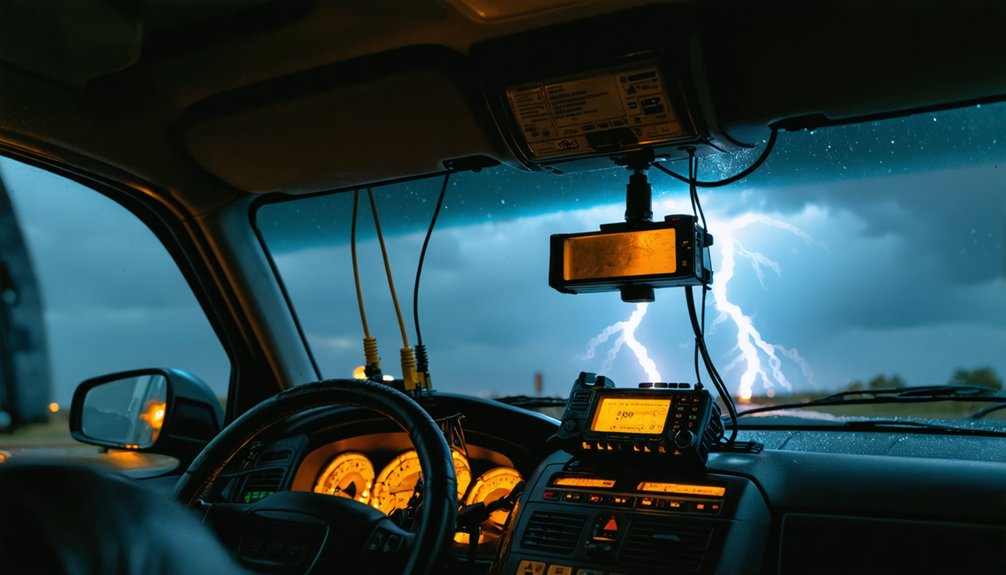
Power management is a critical operational priority on long chase days, and you’ll need a layered approach to keep your gear running. Start with high-capacity power banks as your primary backup, then integrate solar chargers or portable generators for extended operations.
Power management demands a layered strategy—pair high-capacity power banks with solar chargers to sustain gear through long chase days.
Proper battery maintenance prevents unexpected failures—monitor charge levels consistently and rotate units before depletion hits critical thresholds.
Structured power distribution across your vehicle ensures every device receives adequate current without overloading circuits. Use dedicated car chargers and portable solar panels to sustain radios, mobile data terminals, and GPS units simultaneously.
When traditional power infrastructure fails completely, emergency beacons provide your final failsafe.
Waterproof walkie-talkies add resilience in extreme conditions where standard equipment becomes vulnerable.
Build redundancy into every layer of your power strategy.
Back Up Your Communication When Signal Fails
Keeping your gear powered means nothing if your signal drops at the wrong moment—so redundancy in communication infrastructure is just as important as power management. Build your emergency signal strategy around layered backups so no single failure leaves you isolated.
Prioritize these three redundancy planning essentials:
- Carrier diversity – Carry two mobile phones on separate networks like Verizon and AT&T to maximize coverage across dead zones.
- Ham radio – Operate on the 2-meter band (146.580 MHz) for direct spotter-to-spotter communication when cellular grids collapse.
- Satellite phone – Deploy one as your last-resort lifeline in areas where no terrestrial signal exists.
Cross these systems strategically, and you’ll maintain operational communication regardless of which infrastructure fails first.
Frequently Asked Questions
Do Storm Chasers Need a License to Operate Ham Radio Equipment?
Yes, you’ll need a valid amateur radio license for ham radio operation. Radio licensing guarantees you’re certified for Equipment certification standards, letting you freely communicate on the 2-meter band during storm chasing operations.
How Do Storm Chasing Communication Systems Differ Internationally From US Setups?
You’ll find international standards dramatically reshape everything! Equipment differences are vast—you’ll swap 146.580 MHz for region-specific frequencies, adapt to local licensing laws, and replace US-centric carriers with country-specific networks serving your chase operations abroad.
What Legal Regulations Govern Storm Chasers Using Emergency Communication Frequencies?
You must obtain proper emergency frequency licensing to legally operate on restricted bands. Follow radio frequency compliance rules by adhering to FCC regulations, ensuring your ham license covers your transmitting frequencies during storm chasing operations.
Can Storm Chasing Communication Equipment Be Claimed as a Tax Deduction?
You can claim tax deductions on storm chasing communication equipment if you’re operating professionally. Document all equipment claims meticulously, ensuring purchases directly support income-generating activities. Consult a tax professional to maximize legitimate deductions while maintaining compliance.
How Do Storm Chasing Teams Handle Communication During Simultaneous Multi-Cell Events?
Like juggling tornadoes blindfolded, you’ll split frequencies across dedicated channels. Assign teams satellite messaging with data encryption, use dual-band ham radios, and coordinate simplex frequencies per cell—ensuring you’ve got synchronized, secure coverage during chaotic multi-cell events.
References
- https://www.stormtours.com/information/storm-chasing-technology/
- https://www.civicplus.com/blog/ps/keep-citizens-informed-of-tornado-threats/
- https://en.wikipedia.org/wiki/Storm_chasing
- http://forums.radioreference.com/threads/storm-chasers-radio-use.267590/
- https://www.youtube.com/watch?v=AswKDts1i0o
- https://crazystormchasers.com/communication-devices-for-storm-chasers/
- https://www.youtube.com/watch?v=yVkPOUHgYiM