Surviving storm chasing demands preparation, discipline, and split-second decision-making. You’ll need a solid plan locked in before conditions escalate, a trained partner with assigned roles, and the right gear on hand. Maintain at least 1–2 miles from tornado circulation, avoid dangerous positions like overpasses and inflow regions, and drive defensively when visibility drops. Know when to disengage before your escape routes disappear. The seven tips ahead break down exactly what keeps chasers alive.
Key Takeaways
- Plan your route before departure, using weather models and Storm Prediction Center outlooks to lock in target areas early.
- Always chase with a trained partner, assigning distinct roles for driving, navigation, and radar monitoring.
- Maintain 1–2 miles from tornado circulation, positioning ahead of storm movement to keep escape routes open.
- Carry GPS, offline maps, radar apps, protective gear, and a fully stocked vehicle emergency kit.
- Disengage immediately when visibility drops, routes become blocked, or darkness prevents visual tracking of circulation.
Plan Your Storm Chase Before Conditions Intensify
Before you leave your driveway, you need a concrete plan. Forecast accuracy determines whether you’ll chase productively or waste hours repositioning. Check Storm Prediction Center outlooks and reliable weather models early, and lock in your target area before conditions escalate.
Route flexibility is equally critical. Build your plan around multiple road options, including alternates that keep escape routes open as storms evolve. Identify nearby sturdy shelter locations along your intended path.
Avoid last-minute decisions made under pressure; those choices carry the highest risk.
You’re chasing because you want freedom of movement and control over your situation. A pre-built plan gives you exactly that. Without it, you’re reacting instead of leading, and in severe weather, reaction time is rarely enough to keep you safe.
Always Chase With a Partner and Assigned Roles
Chasing alone reduces your situational awareness and leaves no backup if conditions deteriorate fast, so always bring a trained partner.
Assign roles before departure — one person drives while the other navigates, monitors radar, and tracks escape routes — so neither task competes for attention.
Confirm your communication methods in advance, keep mobile weather apps active, and establish check-in protocols so your team stays coordinated throughout the chase.
Partner Benefits and Roles
Storm chasing alone puts you at serious risk, so you should always bring a trained partner on every chase. Team coordination directly improves your situational awareness and sharpens decision-making when conditions deteriorate fast. You can’t effectively monitor radar, navigate roads, and watch storm movement simultaneously without help.
Role clarity is equally critical. Assign one person as the driver and the other as the navigator before you leave. The driver focuses entirely on road conditions and vehicle control. The navigator manages maps, weather apps, and real-time updates. This division keeps both of you sharper and prevents dangerous distractions at critical moments.
Confirm your communication methods before departure, and keep mobile weather tools active throughout the chase. A disciplined two-person team dramatically reduces your exposure to preventable mistakes.
Communication Plan Essentials
Having assigned roles keeps your team organized, but those roles only function under pressure if your communication plan is already locked in before you leave.
Establish radio protocols and confirm signal clarity on every device before departure.
Your pre-chase communication checklist should cover:
- Primary and backup channels: Agree on specific radio frequencies and confirm your mobile apps are pulling live data.
- Check-in intervals: Set timed position updates so both team members always know current status without asking.
- Failure protocols: Define exactly what each person does if data service drops or radio contact breaks.
Don’t assume you’ll figure it out mid-chase. Weak signal clarity or undefined radio protocols during a fast-moving storm creates dangerous hesitation.
Lock in your plan before the engine starts.
Essential Gear Every Storm Chaser Should Carry
Your gear loadout directly determines whether you can navigate, communicate, and survive when conditions deteriorate fast.
You’ll need navigation and communication tools like a portable weather radio and paper maps as backups when data service fails.
Plus, protective clothing and equipment such as a helmet, goggles, gloves, and sturdy footwear.
Round out your setup with a vehicle emergency supply kit that includes a first aid kit, extra fuel, and a reliable weather information device so you’re never caught underprepared.
Navigation And Communication Tools
When you’re moving fast and conditions are deteriorating, reliable navigation and communication tools can be the difference between a controlled chase and a dangerous situation. Your GPS navigation system should provide real-time routing with offline capability, ensuring you’re never dependent on spotty data coverage.
Pair it with active weather apps to monitor storm movement, rotation, and shifting escape corridors.
Carry these core communication and navigation essentials:
- A dedicated GPS device with preloaded maps independent of cellular service
- Weather apps like RadarScope for live storm tracking and positioning
- A portable weather radio for NWS alerts when data signals fail
Don’t rely on a single system. Redundancy keeps you mobile and informed when conditions tighten fast and every second demands a precise decision.
Protective Clothing And Equipment
Storm chasing exposes you to flying debris, hail, broken glass, and sudden structural hazards, so your clothing and equipment must provide real physical protection, not just comfort. Select storm resistant clothing that includes reinforced layers, long sleeves, and durable pants that resist abrasion and puncture. Avoid loose fabrics that wind can weaponize against you.
Your core safety gear should include a certified helmet, impact-resistant goggles, sturdy leather or composite-toe boots, and cut-resistant gloves. These items protect your most vulnerable points during rapid exposure to debris fields or shattered vehicle glass.
Pack a compact first aid kit within arm’s reach, not buried in cargo. Every piece of protective equipment you carry preserves your ability to operate independently, make clear decisions, and exit dangerous situations on your own terms.
Vehicle Emergency Supply Kit
A well-stocked vehicle emergency supply kit can determine whether you walk away from a deteriorating situation or become another statistic. Vehicle maintenance supplies and emergency communication tools aren’t optional—they’re operational necessities. Keep your fuel tank full and inspect your vehicle before every chase.
Your kit must include:
- Emergency communication devices: a portable weather radio and charged backup phone for when data networks fail
- Navigation and medical supplies: paper maps, a first aid kit, and protective gear including helmet, goggles, and gloves
- Vehicle maintenance essentials: jumper cables, a tire repair kit, and extra fuel when venturing into remote areas
Don’t cut corners on preparation. Your independence in the field depends entirely on your self-sufficiency when conditions deteriorate rapidly.
Keep Your Distance From Tornado Circulation
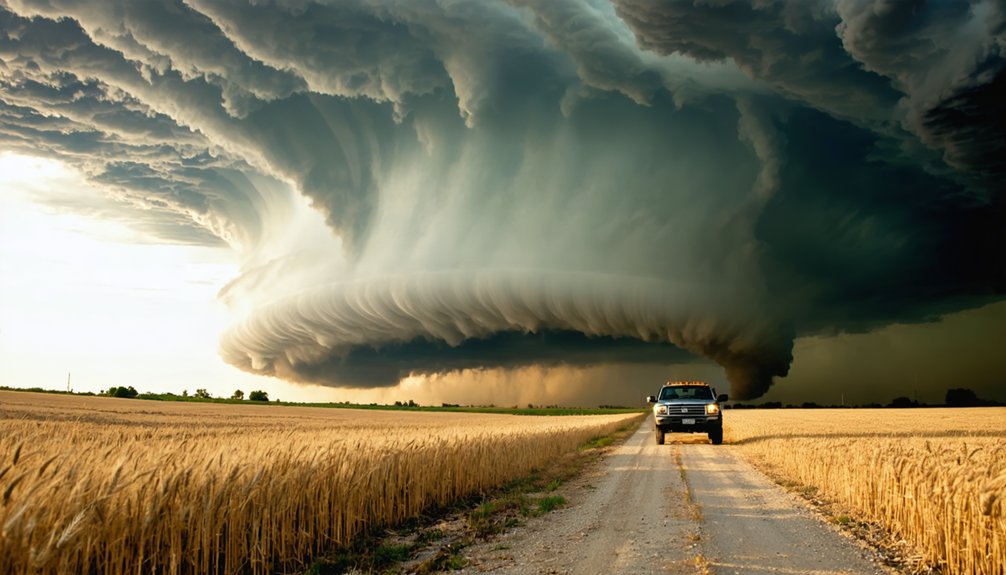
Maintaining a minimum distance of 1–2 miles from a tornado’s circulation is one of the most critical decisions you’ll make during a chase. Tornado proximity directly determines your survival margin, and underestimating it costs lives.
Maintain safe distance by positioning yourself ahead of the storm’s forward motion, never beside or behind it.
Avoid core punching entirely. Driving through a storm’s heavy precipitation core eliminates visual contact and traps you inside dangerous conditions without warning.
Don’t position beneath rotating wall clouds or active inflow regions either.
Adjust your location early. Waiting until escape routes close forces reactive decisions under maximum stress. You’ll have fewer options and less time.
Move proactively, keep your exit clear, and never let a tornado dictate your positioning.
Avoid These High-Risk Positions During a Chase
Certain positions during a chase carry disproportionate risk and can eliminate your margin for survival faster than you’d expect. High risk positioning often feels calculated in the moment but quickly becomes a fatal miscalculation. Storm proximity alone doesn’t define danger—your location relative to the storm’s structure does.
Avoid these positions without exception:
- Beneath rotating wall clouds or inflow bands, where debris and sudden circulation changes offer zero reaction time.
- Inside the precipitation core, known as core punching, where visibility collapses and hail strikes without warning.
- Blocked escape routes, including dead-end roads or congested intersections where repositioning becomes impossible.
Adjust your position early and deliberately. Waiting until conditions force a decision removes your freedom to act on your own terms.
Drive Defensively When Storm Conditions Hit
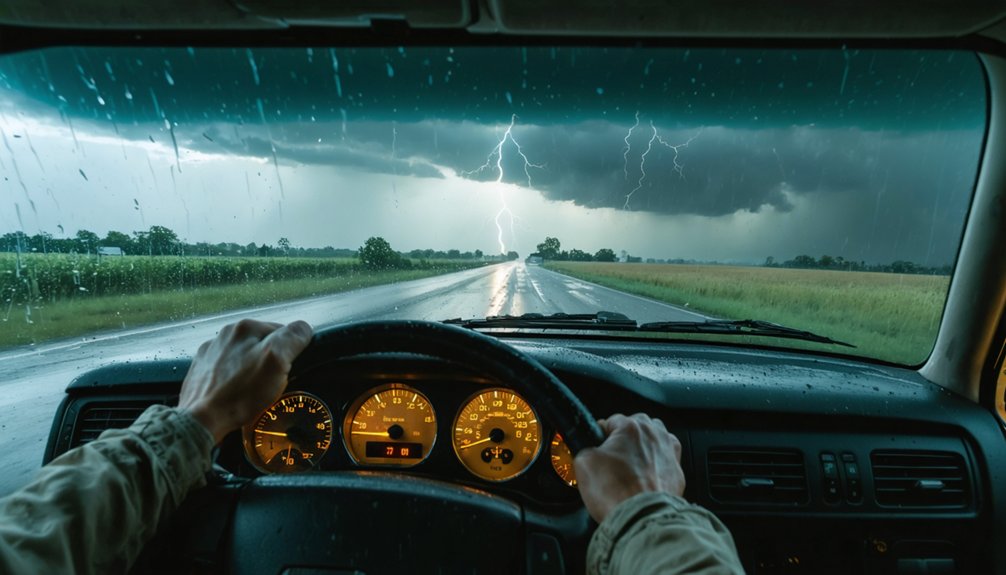
Storm conditions degrade your vehicle’s performance and your own reaction time simultaneously, so you’ll need to adapt your driving behavior the moment conditions shift.
Heavy rain and blowing dust diminish tire traction markedly, demanding immediate speed reductions. Watch for standing water; hydroplaning can eliminate steering control within seconds.
Activate your headlights when visibility drops to ensure other drivers see your vehicle. Monitor road signage carefully, since debris and reduced visibility can obscure critical turn warnings.
Avoid unpaved roads once rain begins, as softened surfaces trap vehicles and eliminate your exit options.
Stay out of urban areas whenever possible. Traffic congestion and physical obstacles restrict your maneuvering options precisely when rapid repositioning matters most.
Position yourself early, and never wait until your escape route is already compromised.
Signs It’s Time to Stop Storm Chasing and Shelter
Recognizing when to abort a chase is as critical as any positioning decision you’ll make in the field. When conditions shift against you, act immediately—not after escape routes close.
Disengage and seek emergency shelter when you encounter:
- Failing visibility from rain, dust, or debris that prevents accurate storm assessment
- Blocked escape routes due to traffic, flooding, or rapid storm movement toward your position
- After-dark conditions that eliminate your ability to visually track circulation
Monitor weather alerts continuously; they’ll signal deteriorating conditions before you see them. Never shelter under overpasses—they create deadly wind tunnels during tornado passage.
Instead, locate a sturdy building or, as a last resort, a low ground depression away from flood-prone drainage. Your freedom depends on knowing when to stop.
Frequently Asked Questions
Do I Need a License or Certification to Storm Chase Legally?
You don’t need a license to storm chase legally, as no formal storm chase regulations exist in the U.S. However, you should pursue safety training to chase responsibly and protect yourself and others.
How Do I Handle Emotional Stress After Witnessing a Violent Tornado?
Ironically, the storm that tests your courage also tests your mind. You’ll need post trauma coping strategies and emotional resilience—talk to peers, debrief experiences, and seek professional mental health support to process what you’ve witnessed effectively.
What Insurance Coverage Should Storm Chasers Carry for Their Vehicles?
You’ll need extensive vehicle coverage that includes collision, hail, and flood damage. Insurance requirements for storm chasers should also cover liability and equipment loss, ensuring you’re financially protected when pursuing extreme weather conditions.
Are There Legal Liabilities if My Chase Vehicle Causes an Accident?
Yes, you bear full accident liability if your chase vehicle causes a collision. Your legal responsibilities include negligence claims, property damage, and injury costs, so you’ll need adequate liability insurance coverage to protect your freedom.
How Do I Find and Join an Established Storm Chasing Group?
Like a compass finding true north, search Spotter Network and local NWS skywarn programs to connect with vetted chasers. You’ll gain storm chase safety protocols, structured group communication, and mentorship that’ll sharpen your skills fast.
References
- https://www.livingskytours.com/storm-chasing-101/
- https://www.atms.unca.edu/cgodfrey/courses/swfex/pdf/ChasingSafety.pdf
- https://www.reddit.com/r/stormchasing/comments/k89wnc/safety_tips_for_storm_chasing/
- https://www.flame.org/~cdoswell/chasesums/Chase_safety.html
- https://crazystormchasers.com/essential-storm-chasing-safety-tips-and-guidelines/
- https://www.wiu.edu/SevereWeather/images/presentations/How_to_Effectively_Storm_Chase.pdf
- https://crazystormchasers.com/storm-chasing-safety-rules/
- https://www.reddit.com/r/stormchasing/comments/1jgc295/a_beginners_guide_to_storm_chasing/
- https://stormchaserlog.com/post/surviving-the-close-pass-tactical-tornado-safety-for-serious-storm-chasers
- https://www.reddit.com/r/stormchasing/comments/1ditn4z/if_there_was_one_tip_you_could_give_about_storm/