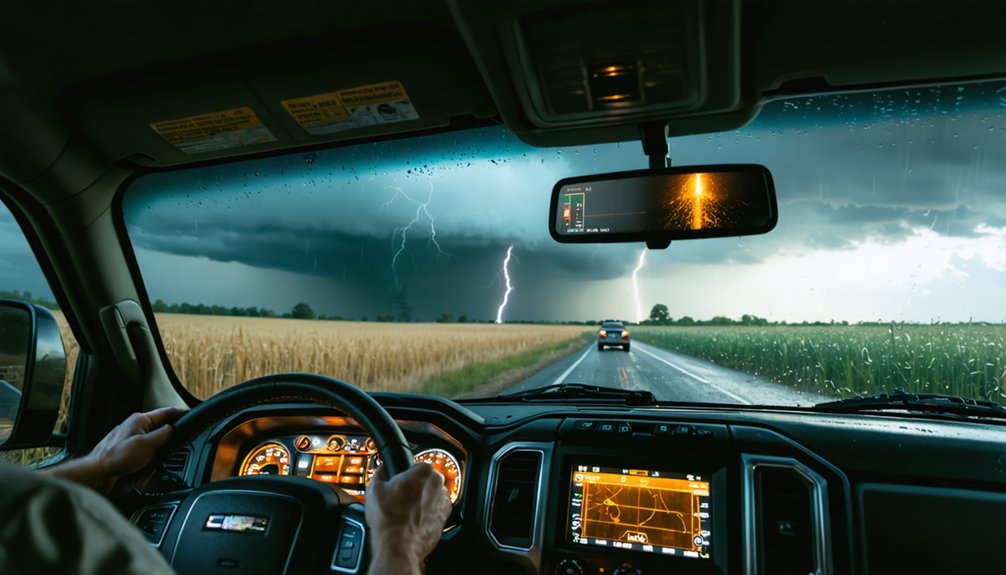
To chase waterspouts successfully, you’ll need Doppler radar, satellite imagery, and stacked models like GFS, NAM, and HRRR to confirm atmospheric instability before leaving shore. Target hotspots like the Florida Keys between 12 PM and 5 PM, maintain a half-mile buffer, and pre-plan escape routes before deploying equipment. Log wind speed, humidity, and temperature data from safe distances. Keep your engines ready and your gear maintained—there’s far more to master before your first chase.
Key Takeaways
- Use Doppler radar, satellite imagery, and stacked weather models to assess atmospheric conditions and position yourself before waterspout activity develops.
- Target peak activity hours between 12 PM and 5 PM at known hotspots like the Florida Keys or Great Lakes.
- Maintain at least a half-mile buffer, move perpendicular to the waterspout’s path, and pre-plan escape routes before deploying equipment.
- Differentiate fair-weather waterspouts from tornadic ones, as winds can exceed 100 mph with rapid intensification occurring within minutes.
- Log wind speed, temperature, and humidity data while keeping cameras stabilized and all gear maintained to ensure quality documentation.
Read the Weather Before You Leave Shore
Before you ever cast off, you’ll want to pull Doppler radar, satellite imagery, and weather model data to map out atmospheric conditions in your target area. Identify temperature gradients, humidity levels, and pressure systems that signal waterspout development.
Wind shear data tells you how air layers interact vertically, which directly influences rotation potential and cloud formation intensity.
Target known hotspots like the Florida Keys or Great Lakes during May through September, concentrating your window between 12 PM and 5 PM when activity peaks.
Elevated, land-based vantage points give you early visual confirmation of dark-spot formations and spiral structures before committing to water.
Reading conditions accurately before departure keeps you in control of your chase and preserves your freedom to reposition or abort safely.
Pick the Right Time and Place to Chase Waterspouts
You’ll find the highest waterspout activity between May and September.
With peak formation clustering between 12 PM and 5 PM when surface heating maximizes instability.
Target known hotspots like the Florida Keys and Great Lakes, where warm water, humidity, and temperature gradients consistently produce favorable conditions.
Use Doppler radar, satellite imagery, and mesoscale weather models to position yourself ahead of developing activity rather than reacting to it after formation.
Peak Waterspout Activity Windows
Knowing when and where waterspouts peak gives you a measurable edge before you ever launch a vessel or set up a shore-based vantage point. Concentrate your chase windows between 12 PM and 5 PM, May through September, when thermal instability and surface moisture combine to produce the highest formation rates.
Hotspots like the Florida Keys and Great Lakes deliver disproportionate annual activity, making them priority targets for efficient marine navigation planning.
Before departure, cross-reference Doppler radar, satellite imagery, and atmospheric data — temperature gradients, humidity levels, and wind shear — to confirm favorable conditions.
Build your emergency protocols around these peak windows by pre-positioning escape routes and confirming communication gear while conditions remain stable.
Precision timing reduces exposure risk and maximizes productive observation opportunities.
Known Hotspot Locations
Targeting the right geography cuts your setup time and increases productive observation windows considerably. The Florida Keys rank as the world’s most active waterspout corridor, generating hundreds of documented events annually. Historical sightings concentrate between Key West and Marathon during June through September, giving you dense, reliable data for route planning.
The Great Lakes produce significant tornadic waterspout activity, particularly Lake Michigan and Lake Superior, where sharp temperature gradients accelerate formation. These zones also support rich marine biology ecosystems, making dual-purpose scientific documentation viable.
The Adriatic Sea and Australian coastlines offer additional high-frequency targets if you’re operating internationally. Cross-reference historical sightings databases against current Doppler radar outputs before committing to a location.
Positioning yourself within established hotspots dramatically compresses waiting time between productive observation opportunities.
Forecasting Tools For Positioning
Once you’ve locked in a hotspot, the next step is timing your arrival using the right forecasting stack. Pull Doppler radar loops and satellite analysis to identify developing convective cells and boundary interactions before you launch.
Cross-reference atmospheric profiling data—specifically temperature gradients, humidity levels, and wind shear layers—to confirm instability aligns with your target window.
Your peak chase window runs 12 PM–5 PM, May through September. Outside that window, your odds drop sharply.
Monitor WSR-88D spectrum-width products for early rotation signatures and track pressure systems that could accelerate or suppress development.
Don’t rely on a single model. Stack GFS, NAM, and HRRR outputs against real-time satellite feeds to sharpen your positioning. Precision forecasting gives you freedom to move confidently and early.
Know the Difference Between Waterspout Types
When chasing waterspouts, you’ll need to distinguish between fair-weather and tornadic types, since each carries a substantially different risk level.
Fair-weather waterspouts form under relatively calm conditions along converging wind boundaries.
Tornadic waterspouts descend from supercell or strong convective storms and carry far greater destructive potential.
Watch for cloud rotation, dark-spot formation on the water’s surface, and a visible spiral structure as key visual warning signs that signal a more dangerous event.
Fair-Weather Vs. Tornadic
Not all waterspouts carry the same risk, and misidentifying the type you’re tracking can lead to a critical safety failure. Fair-weather waterspouts form under relatively calm cumulus clouds, develop from the water surface upward, and typically produce winds under 70 mph. They’re common during May–September and dissipate quickly on land.
Tornadic waterspouts are an entirely different threat. They descend from supercell or severe thunderstorm systems, display distinct cloud rotation, and generate winds exceeding 100 mph. Their radar signatures appear on WSR-88D systems as tight rotational couplets with elevated spectrum-width values—clear indicators of organized, dangerous circulation.
Never assume visual weakness means low risk. Rapid intensification happens fast. Classify accurately, maintain your half-mile minimum, and adjust your escape route the moment tornadic characteristics emerge.
Visual Warning Signs
Distinguishing waterspout types visually starts before the funnel ever forms. Watch the cloud base for cloud rotation and dark-spot development at the water’s surface — these precursor signatures indicate tornadic potential rather than fair-weather activity.
Fair-weather waterspouts typically display smooth, columnar structures with clearly defined spiral patterns and form under relatively calm cumulus clouds.
Tornadic waterspouts, by contrast, emerge from organized convective systems with rotating wall clouds, visible rear-flank downdrafts, and turbulent inflow bands.
Track spectrum-width products on WSR-88D radar to detect angular velocity gradients before visual confirmation is even possible.
Never treat a weak appearance as a reliable safety indicator — rapid intensification can occur within minutes.
Visual identification gives you the margin needed to reposition decisively.
How Far Should You Stay From a Waterspout?
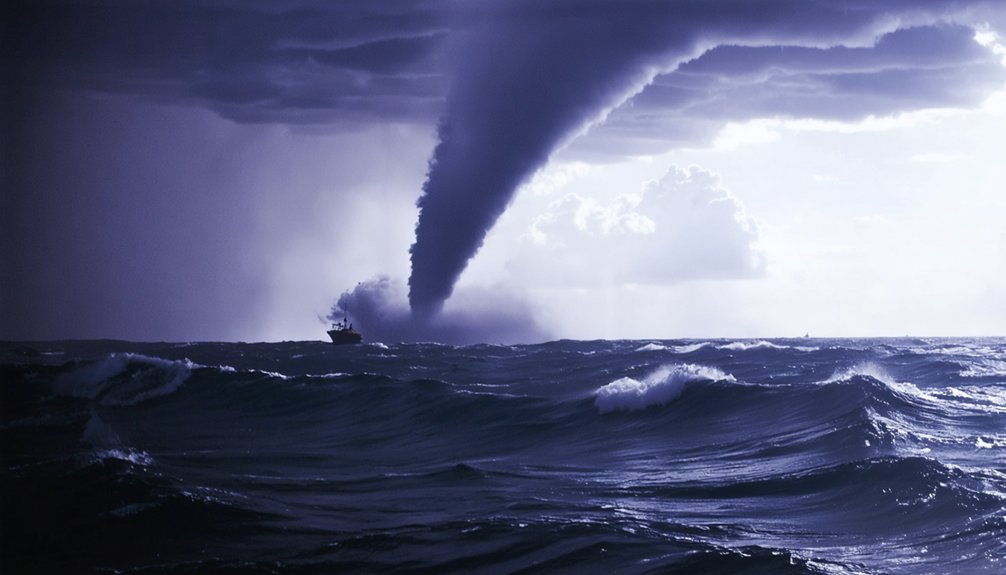
How far you stay from a waterspout directly determines your reaction time and survival margin. Atmospheric conditions shift fast, and waterspout formation can accelerate without warning. Maintain at least a half-mile buffer at all times.
Distance from a waterspout isn’t preference—it’s survival margin. That half-mile buffer is your decision window.
- Keep a minimum 0.5-mile distance to preserve reaction time during sudden track changes.
- Move perpendicular to the waterspout’s path, never parallel.
- Identify your escape route before repositioning, not after conditions shift.
- Return to shore immediately when wind shear or intensity increases.
- Never close the gap based on a waterspout appearing weak—rapid intensification is real.
That half-mile isn’t arbitrary—it’s your decision window. The moment you compress that buffer, you’re surrendering control to the storm.
Keep your distance, keep your options open.
Plan Your Waterspout Escape Route Before You Need It
Before a waterspout closes your options, you need a pre-planned escape route locked in. Don’t wait until the funnel tightens—identify your exit corridor before you deploy any observation equipment or reposition your vessel.
Move perpendicular to the waterspout’s projected track, never parallel. Parallel movement keeps you inside the threat zone longer and limits your reaction window.
Chart two exit vectors in advance: a primary route and a contingency if conditions shift unexpectedly.
Keep your engines running and ready for immediate vessel maneuvering the moment the situation changes.
Simultaneously, activate emergency communication with the coast guard, transmitting your coordinates and intended heading.
A clear escape plan isn’t cautious—it’s what keeps you operational, free to chase another day without compromising your crew or equipment.
Gear Up With the Right Safety Equipment for Water Chasing
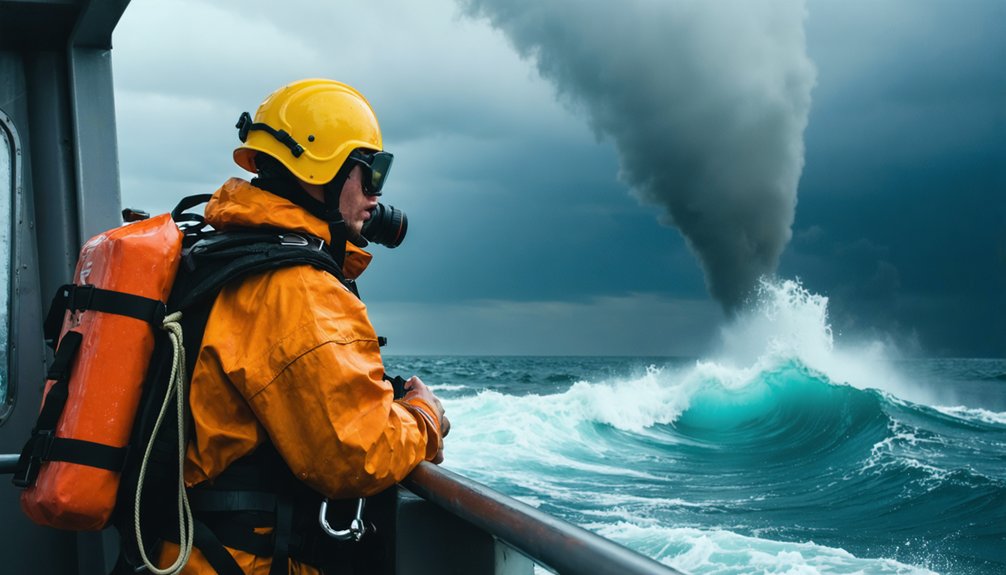
Your escape route is only as reliable as the gear keeping you operational when conditions deteriorate fast. Equipment maintenance isn’t optional — it’s what separates a controlled retreat from a crisis. Before every chase, verify all systems and protect your crew communication channels against weather interference.
- Wear life jackets/PFDs at all times on open water
- Use waterproof clothing, helmets, and puncture-resistant boots
- Keep engines serviced and fuel reserves topped before departure
- Carry multi-frequency marine radios as your primary crew communication tool
- Reduce sail area immediately on sailboats to maintain directional control
Treat every piece of equipment as mission-critical. A single failure — a dead radio, a fouled engine — eliminates your options when a waterspout shifts track unexpectedly. Maintain everything before you launch.
Document Every Waterspout Chase Without Risking Your Safety
Capturing clean, usable documentation from a waterspout chase demands discipline — you’re balancing scientific value against real-time risk. Log wind speed, temperature, and humidity for every encounter, building a dataset that strengthens historical case studies and improves future forecasting models.
Disciplined documentation transforms every waterspout chase into data — each logged variable sharpening forecasts and deepening our collective scientific record.
Mount stabilized, weather-protected cameras before deployment — equipment maintenance directly affects footage quality and instrument reliability under marine conditions. Saltwater exposure degrades sensors fast, so inspect and clean gear after each chase.
Record observations strictly from safe distances; compromised positioning produces unusable data anyway. After dissipation, stay alert — residual debris, wave surges, and secondary circulations remain active threats.
Continue monitoring NOAA broadcasts until navigation conditions normalize. Your documentation has long-term scientific value only if you’re operational for the next chase.
Frequently Asked Questions
How Do I Coordinate With My Chase Team During Fast-Moving Storms?
Use multi-frequency radios and NOAA weather radio to maintain real-time contact. Assign clear roles, conduct equipment checks before deployment, and establish storm safety protocols ensuring you’ve got continuous coordination throughout rapidly evolving conditions.
Should I Report Waterspout Sightings to the Coast Guard Immediately?
Coincidentally, just as wildlife interactions demand immediate reporting, so do waterspouts—you must report sightings to the coast guard instantly. Legal considerations require it. Transmit exact coordinates via marine radio, ensuring compliance and protecting fellow mariners from rapidly intensifying threats.
What Communication Devices Are Essential for Waterspout Chasing on Water?
You’ll need marine radio for multi-frequency coordination and real-time NOAA alerts, plus an emergency beacon for distress signaling. Keep cell service active as backup, ensuring you’ve got continuous, reliable communication during rapidly evolving waterspout encounters.
How Do I Stay Informed About Rapid Forecast Changes While Chasing?
Like a telegraph operator on duty, you’ve got to tune into NOAA weather radio constantly. Monitor weather radar updates and maintain storm tracking via multi-frequency radios, ensuring you’re receiving real-time forecast changes during rapidly evolving waterspout conditions.
What Hazards Remain After a Waterspout Fully Dissipates Over Water?
After dissipation, you’ll still face residual debris, wave surges, and rapid storm safety threats from new developments. Monitor water rescue risks closely, stay alert for secondary circulations, and confirm a safe navigation window before resuming any movement.
References
- https://open.spotify.com/track/1ESmMKaASDxFICpa5eyqzo
- https://crazystormchasers.com/chasing-waterspouts-responsibly-and-safely/
- https://crazystormchasers.com/the-science-behind-chasing-waterspouts/
- https://crazystormchasers.com/best-strategies-for-chasing-waterspouts/
- https://crazystormchasers.com/best-tips-for-staying-safe-around-waterspouts/
- https://www.youtube.com/watch?v=fABwvj0rP_A