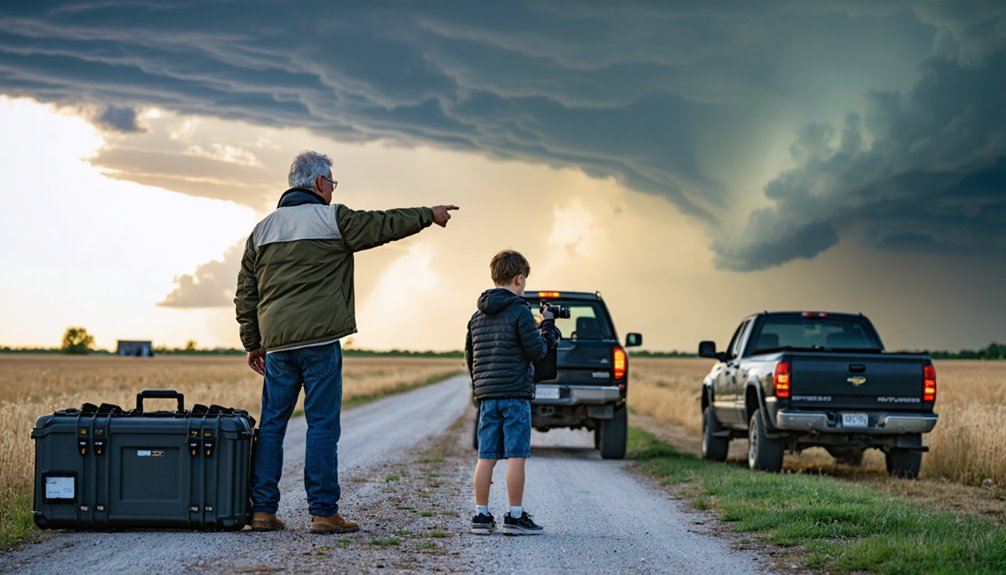
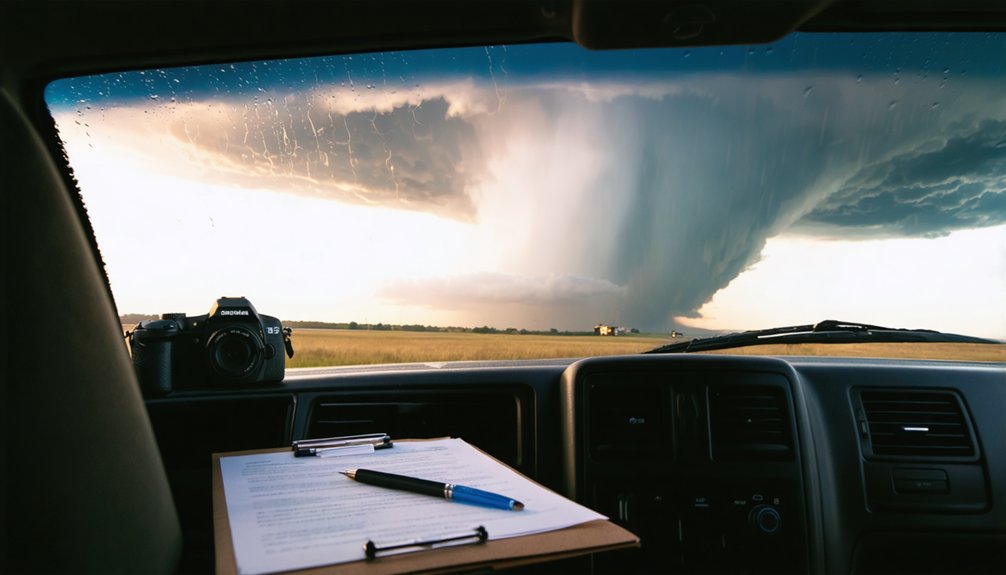
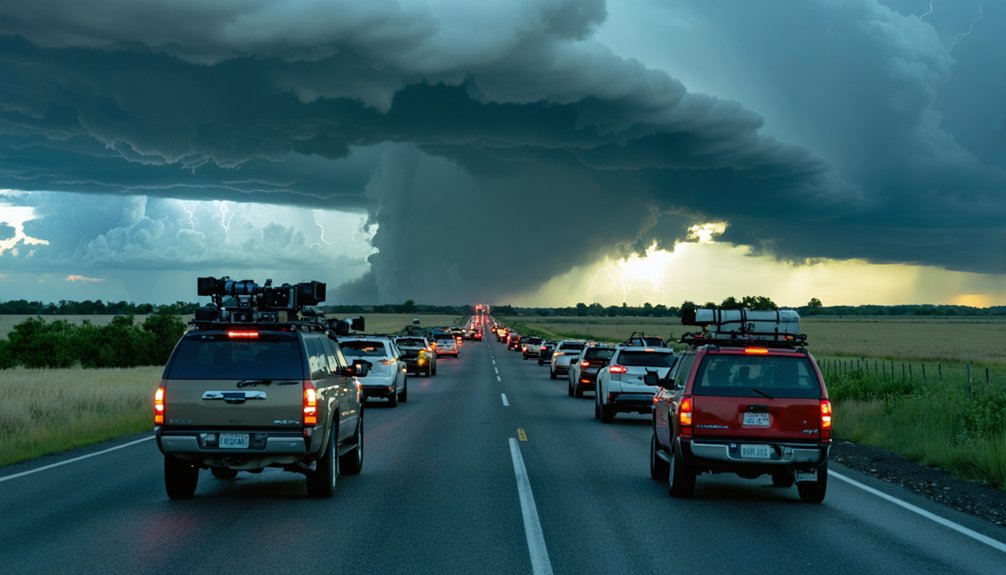
Mastering storm chasing competitions means replacing instinct-driven decisions with a structured scoring system. You’re balancing three variables simultaneously: forecasting precision, strategic positioning, and safety compliance. Cross-reference HRRR and GFS models early, stage your gear before initiation, and treat every intercept as a calculated risk-reward equation. Reckless proximity destroys scores; disciplined repositioning builds them. Safety isn’t just survival—it’s your operational infrastructure. The strategies that separate competitive chasers from the rest go much deeper.
Key Takeaways
- Treat every intercept decision as a scoring calculation that balances proximity, safety compliance, and documentation quality simultaneously.
- Disciplined, data-driven forecasting using SPC outlooks and HRRR models builds a consistent competitive edge over intuition-based approaches.
- Prioritize pre-planned perpendicular escape routes before every intercept to maintain maneuverability and avoid costly repositioning penalties.
- Safety compliance functions as operational infrastructure, directly supporting documentation quality and preventing performance-destroying penalties.
- Staying mobile and adaptable is your strongest competitive advantage, especially when rain-wrapped circulations or erratic storm behavior emerge.
Understand What Competitive Storm Chasing Actually Scores
Competitive storm chasing rewards precision across three measurable dimensions: documentation quality, storm proximity, and safety compliance. You’re not judged on boldness alone. Timestamped footage of mesocyclones, wall clouds, and tornado formation zones carries direct scoring weight, so technical camera stability and fast autofocus aren’t optional upgrades.
Competitive storm chasing scores documentation quality, proximity, and safety — boldness alone won’t move the needle.
Weather pattern analysis determines whether your positioning reflects skill or luck, and judges can distinguish between the two through historical case studies of comparable chase days. Proximity matters, but reckless intercepts work against you.
Safety compliance isn’t a background requirement; it’s an active scoring variable. Understanding this structure reshapes how you approach every decision, from initial target selection to final documentation review.
Treat each dimension as a performance category, not an afterthought, and your competitive framework immediately becomes more disciplined.
Build Your Forecasting Edge Before Chase Day
Your forecasting edge starts with disciplined tool selection—pull SPC Convective Outlooks early to frame the day’s risk, then cross-reference HRRR and GFS model data to refine initiation timing and target placement.
You’re looking for convergence zones where dewpoints exceed 60°F and CAPE climbs above 2,000 J/kg, since those thresholds signal the highest-probability environments for significant convection.
Once you’ve identified candidate zones, monitor dryline position and CIN suppression closely, because the difference between a productive chase and a busted target often comes down to when and where the cap breaks.
Master Key Forecasting Tools
Before you intercept a single storm, your forecasting edge is built at the desk. Master the SPC Convective Outlooks, HRRR, and GFS models before wheels ever roll. These tools aren’t suggestions—they’re your competitive framework for identifying viable target zones.
Track dewpoints above 60°F and CAPE values exceeding 2,000 J/kg to isolate high-probability intercept windows. Monitor dryline positioning and CIN suppression to pinpoint initiation timing with precision.
Don’t let meteorological myths drive your decisions—gut instincts without data cost you positioning and points. Instead, study historical case studies to recognize recurring atmospheric setups that produce tornadic supercells.
Real-time radar velocity products sharpen your tactical adjustments once you’re mobile. Build that analytical foundation first, and you’ll chase smarter, not just faster.
Identify High-Priority Target Zones
Three atmospheric variables separate a high-probability target zone from wasted mileage: dewpoint concentrations above 60°F, CAPE values exceeding 2,000 J/kg, and dryline positioning relative to CIN suppression. When these three signals converge geographically, you’ve identified your primary target corridor.
Cross-reference SPC Convective Outlooks with HRRR model runs to confirm initiation timing. Don’t commit your route until CIN suppression shows signs of breaking down in your target window. Weather alerts from the SPC can validate or invalidate your morning analysis, so monitor them continuously.
Have your storm chasing gear staged and accessible before you reach the target zone. Repositioning costs time, and time costs intercept quality.
Precision targeting isn’t luck—it’s disciplined pattern recognition executed before the first storm fires.
Pick Targets the Way Competitive Chasers Actually Do
Competitive chasers don’t wander into a setup hoping for the best—they run a systematic target selection process anchored in measurable atmospheric variables.
You need to read the weather pattern the same way, filtering noise and committing to data. Storm longevity depends on selecting environments with sustained energy, not isolated pockets of instability.
Prioritize these three variables before locking your target:
- Dewpoints above 60°F — confirms sufficient moisture for deep convection
- CAPE above 2,000 J/kg — indicates explosive instability supporting organized updrafts
- Dryline or CIN suppression zones — signals where initiation timing concentrates storm development
Cross-reference SPC Convective Outlooks with HRRR model runs, then identify your intercept window. You’re building a case, not gambling. Commit only when the evidence converges.
Position Relative to Storm Motion and Protect Your Exit
Once you’ve locked your target, storm motion becomes the primary variable governing every positioning decision you make. Most supercells track northeast, meaning your storm positioning advantage sits southeast of the mesocyclone — close enough for documentation, far enough for reaction time.
You’re not just chasing the storm; you’re anticipating where it’s going before it gets there.
Your exit strategy isn’t optional — it’s built before you commit to any intercept. Identify perpendicular escape routes that move you away from storm motion, not parallel to it.
Avoid dead-end roads, low-water crossings, and narrow rural paths with no turnaround options. Rain-wrapped circulation collapses your decision margin fast.
Maintain at least one mile from active rotation as your baseline. Freedom in chasing means controlling your options, not surrendering them.
Document Mesocyclones and Tornadoes in Ways That Win Points
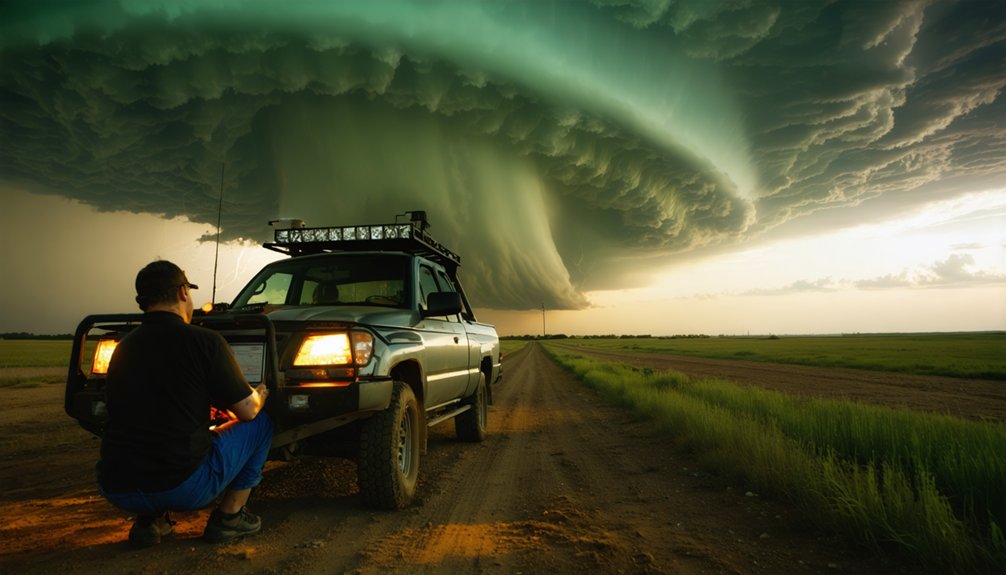
Score-maximizing documentation follows three principles:
Score-maximizing documentation follows three principles: timestamp everything, hold steady, and capture full formation sequences.
- Timestamp everything — judges verify proximity claims against timestamped footage, so gaps hurt credibility.
- Hold steady on rotation signatures — shaky footage obscures mesocyclone structure and reduces assessed quality.
- Capture formation sequences — documenting tornado development from wall cloud to touchdown demonstrates forecasting accuracy and positioning discipline.
Your footage is evidence. Treat it with the same analytical rigor you apply to radar interpretation.
Make Safety Decisions That Protect Your Score, Not Just Your Life
Safety isn’t separate from your competitive performance—it’s embedded in your score. Reckless intercepts that ignore escape routes or push you into rain-wrapped or nighttime tornado scenarios collapse your decision-making margins and cost you positioning advantages you can’t recover.
You protect your score the same way you protect yourself: by treating escape route integrity as a non-negotiable tactical priority before the storm ever enters your radar frame.
Safety Boosts Score
Why do the strongest competitors treat safety as a scoring variable rather than a separate obligation? Because reckless intercepts don’t just endanger you—they collapse your documentation window and disqualify positioning advantages you’ve already earned.
Storm fatigue degrades judgment. Gear reliability determines whether you capture usable footage when it counts. Both feed directly into your score.
Treat each safety decision as a tactical calculation:
- Maintain escape routes — Limited road options force reactive choices that cost positioning time.
- Monitor gear reliability — Failing equipment during intercept means lost timestamped documentation and dropped scoring opportunities.
- Manage storm fatigue actively — Rest before high-probability chase days to preserve the decision-making precision that separates competitive outcomes.
Safety compliance isn’t a constraint on performance. It’s the infrastructure that makes strong performance possible.
Reckless Intercepts Backfire
Reckless intercepts don’t just threaten survival—they destroy the scoring structure you’ve spent hours building. When storm fatigue clouds your judgment, you start trading strategic positioning for proximity that penalty systems actively punish.
Competition formats reward documentation quality and safety compliance simultaneously, meaning a blown escape route costs you on multiple scoring dimensions at once.
Effective risk management means treating every intercept decision as a scoring calculation, not just a survival calculation. If road options narrow, visibility drops, or storm motion becomes erratic, your best competitive move is repositioning—not pressing forward.
Rain-wrapped circulations and nighttime approaches collapse your decision margins fast. The chasers who consistently score highest aren’t the closest ones. They’re the ones who stay autonomous, disciplined, and operationally sharp when pressure peaks.
Escape Routes Win
Every escape route you plan before intercept is a scoring asset, not just a safety measure. Blocked exits collapse your decision-making margin and force reactive choices that cost positioning and documentation quality. Cross-reference weather data sources against road grids before committing to any approach vector.
Treat escape planning as a three-step tactical process:
- Identify two exit routes perpendicular to storm motion before intercept begins.
- Monitor emergency communication channels for rapid storm structure updates that may require immediate repositioning.
- Reassess exit viability every five minutes using real-time radar velocity products.
Rain-wrapped circulation and deteriorating road conditions eliminate options fast. Chasers who maintain exit flexibility stay mobile, document longer, and avoid penalty-triggering reckless intercepts.
Your freedom to reposition is your strongest competitive advantage.
Frequently Asked Questions
How Do You Mentally Recover After a Failed Chase Day?
You rebuild emotional resilience by reviewing your forecast data analytically, identifying tactical errors without self-judgment. Then you use mental visualization to rehearse corrected decisions, so you’re mentally sharpened and strategically free for your next chase opportunity.
What Sleep and Rest Habits Do Top Competitive Chasers Follow?
Like Edison’s disciplined rest fueling breakthroughs, you’ll prioritize consistent sleep cycles for storm preparation. You optimize gear optimization efficiency by resting before high-risk chase windows, ensuring your decision-making stays sharp, analytical, and free from fatigue-driven errors.
How Do Chasers Manage Team Disagreements During High-Pressure Pursuit Decisions?
You’ll resolve team disagreements by pre-assigning a lead decision-maker before pursuit begins. Under decision making pressure, clear storm communication protocols override debate, letting your team act fast, stay unified, and maintain strategic positioning without hesitation.
Does Previous Competitive Experience Affect How Judges Evaluate Your Documentation?
Your previous competitive experience doesn’t directly shift judgment criteria — your documentation quality stands alone. However, experience influence shows in your timestamped footage precision, positioning decisions, and mesocyclone capture clarity, which judges analytically evaluate on its own merit.
How Do You Stay Motivated During Long Drives With No Storm Activity?
You stay sharp by running storm visualization drills on forecast data and using downtime for equipment preparation checks. You’re treating dead miles as tactical rehearsal, not wasted time, so you’ll arrive operationally ready.
References
- https://en.wikipedia.org/wiki/Storm_chasing
- https://will.illinois.edu/weatherrealness/episode/storm-chasing-can-be-deadly-heres-how-to-stay-safe
- https://extremetornadotours.com/
- https://crazystormchasers.com/top-tips-for-chasing-storms-in-races/
- https://crazystormchasers.com/insider-tips-for-storm-chasing-competitions/
- https://crazystormchasers.com/best-tips-for-storm-chasing-competitions-success/
- https://crazystormchasers.com/exploring-evolution-of-storm-chasing-competitions/