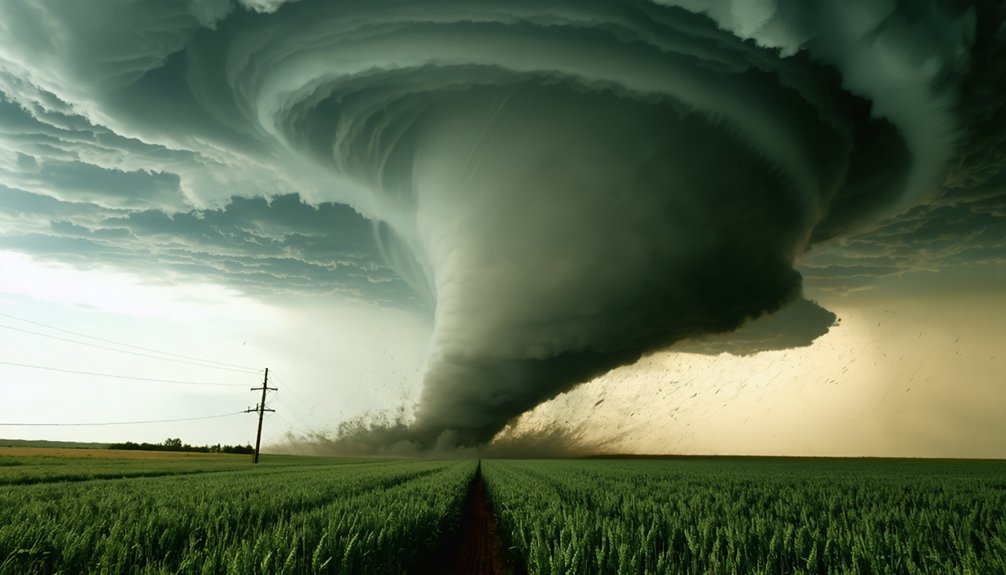
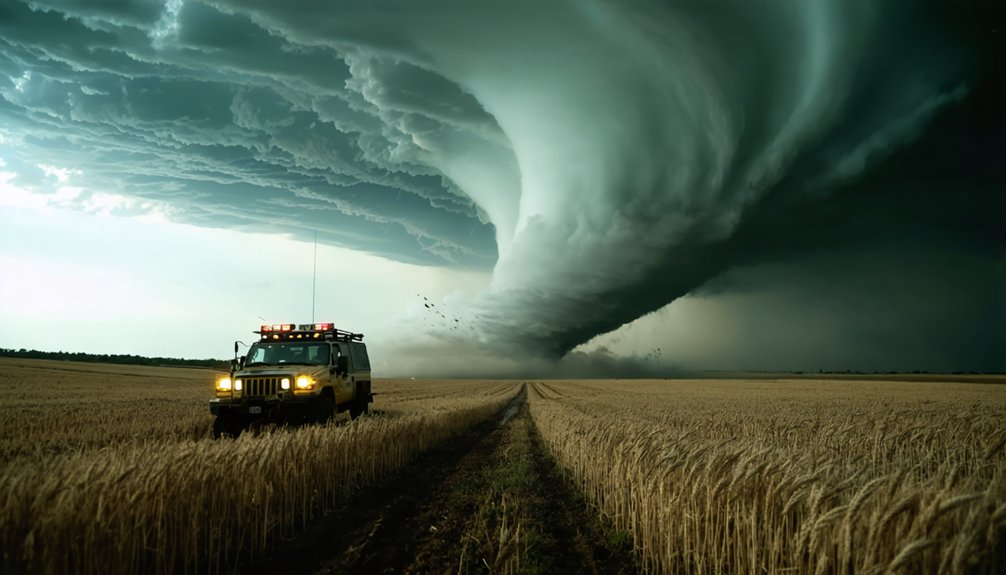
When a tornado touches down, your body releases epinephrine within seconds, spiking your heart rate past 160 BPM and compressing your sensory focus to a single point on the horizon. Your brain’s dopamine system then reinforces the experience through variable reward patterns similar to gambling, creating neuroplastic changes that make each chase feel increasingly necessary. It’s a measurable physiological cycle, not just excitement, and the deeper mechanics reveal exactly why it’s so difficult to stop.
Key Takeaways
- Tornadoes trigger rapid epinephrine release, spiking heart rate and sharpening senses, creating an intense physiological rush unique to high-threat environments.
- Dopamine-driven reinforcement from unpredictable storm encounters mirrors gambling behavior, making each chase neurologically rewarding and habit-forming.
- Hours of anticipation before tornado formation amplify arousal, making the moment of emergence an acute, overwhelming sensory experience.
- Experienced chasers manage calculated risks using radar and escape routes, sustaining the adrenaline cycle without reckless endangerment.
- Community validation and shared identity reinforce storm chasing behavior, motivating continued pursuit beyond individual physiological rewards alone.
The Adrenaline Hit That Makes Storm Chasing Physically Addictive
When a tornado drops from the clouds without warning, your adrenal glands flood your bloodstream with epinephrine within seconds, spiking heart rate and compressing your attention onto the storm’s core. These physiological triggers aren’t incidental — they’re the body’s acute stress architecture operating exactly as designed under high-threat conditions.
The emotional intensity peaks hardest after long stretches of empty skies, when uncertainty finally collapses into something violent and real. That contrast sharpens the neurological response considerably. Your senses narrow, reaction time accelerates, and broader judgment can simultaneously compress — a tradeoff worth understanding.
This isn’t simply excitement. It’s a measurable biological state that reinforces the behavior. Each close encounter conditions your nervous system to associate storm proximity with acute arousal, making the next chase harder to skip.
Why Storm Chasing Rewires Your Brain’s Reward System?
Beyond the adrenal spike, storm chasing targets a deeper and more durable system: dopamine-driven reinforcement. When you chase unpredictable storms, your brain doesn’t receive consistent rewards — it receives variable ones. That intermittent payoff structure is neurologically more reinforcing than predictable outcomes, activating the same reward circuitry linked to gambling behavior.
Each empty sky followed by a violent supercell strengthens your neural pathways through neuroplasticity, literally reshaping how your brain assigns value to the pursuit. Repeated exposure accelerates habit formation, conditioning you to return regardless of outcome.
You’re not just chasing storms — you’re chasing the next hit of dopamine uncertainty. Over time, this cycle becomes self-sustaining, making the pull feel less like a choice and more like a deeply embedded behavioral drive you’ve built yourself.
How Storm Chasers Manage Real Risk Without Losing the Rush?
That dopamine loop only stays intact if you survive the chase — which means risk management isn’t optional, it’s what keeps the cycle running.
Survival isn’t a side effect of the chase — it’s the condition that makes the next one possible.
Historical safety data shows experienced chasers rely on layered decision-making: real-time radar, dual-polarization data, and escape route mapping before positioning near a storm core.
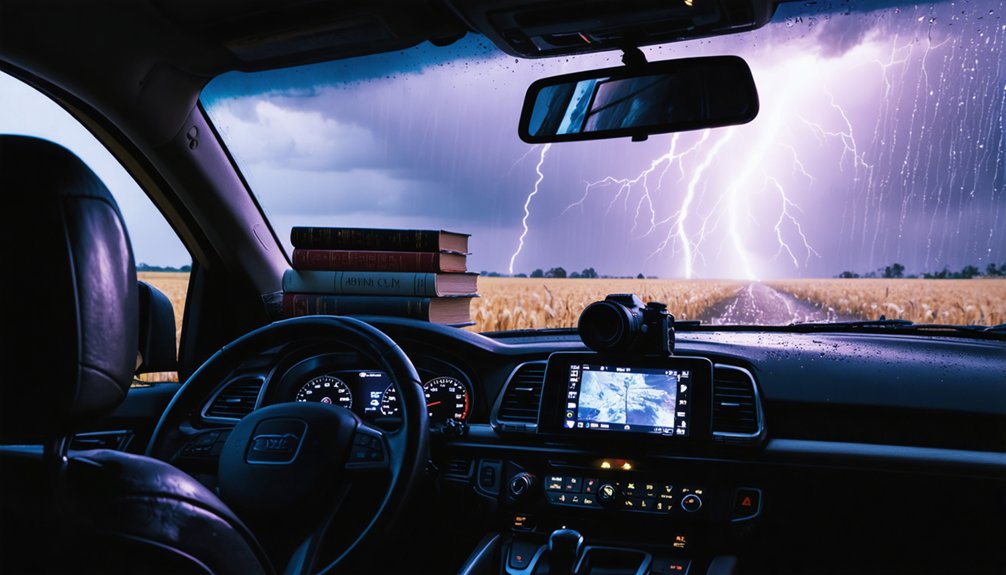
Gear optimization matters just as much. High-resolution GPS, dashcam systems, and live spotter networks let you stay close without surrendering situational awareness. You’re not eliminating danger — you’re engineering a precise margin around it.
That margin is where the rush lives. When you’ve read the mesocyclone correctly, chosen the right intercept angle, and held your position just outside the inflow notch, the intensity is earned.
Calculated risk keeps the reward system firing without crossing into recklessness.
What Storm Chasers Actually Feel When a Tornado Drops?
All the preparation collapses into a single moment the instant a funnel extends from the wall cloud — and your nervous system responds before your conscious mind catches up. Epinephrine floods your bloodstream, spiking your heart rate and sharpening your sensory intake. Storm anticipation built over hours of positioning suddenly discharges into acute arousal.
What you’re experiencing isn’t panic — it’s a calibrated stress response compressing your attention onto the storm core. Tornado awe operates alongside this biology, producing a paradox: you’re simultaneously threat-assessing and aesthetically overwhelmed. The visual scale of a condensing vortex triggers genuine awe responses documented in psychological literature.
Dopamine reinforces the entire sequence. Your brain logs this payoff against every empty chase day, strengthening the behavioral loop that’ll pull you back onto the plains next season.
Why Community and Identity Keep Storm Chasers Returning Each Season?
Once the biological rush fades, what keeps you loading gear into a vehicle every spring is something more structural: community. Storm chasing camaraderie operates through shared risk, technical language, and collective pattern recognition — creating reinforcement loops that extend well beyond any single intercept.
Storm chasing endures not on adrenaline alone, but on the reinforcement loops built through shared risk and collective pattern recognition.
Within these networks, personal identity forms around accumulated field experience, forecast accuracy, and storm documentation. Your chase history becomes a credential. A single violent supercell encounter can anchor a multi-year identity shift, reorienting how you spend time, money, and attention.
These communities also normalize ambitious targeting, raising individual risk thresholds through peer validation. Variable reward cycles become socially embedded — others returning each season confirms the behavior as rational.
That social scaffolding, combined with purpose-driven data collection, keeps you returning independent of what last season’s storms actually delivered.
Frequently Asked Questions
Does Storm Chasing Experience Change How Chasers Perceive Everyday Risk?
Yes, repeated adrenaline response from chasing recalibrates your risk perception. You’ll find ordinary dangers feel less intense, as your baseline shifts toward high-stakes environments, making everyday risks seem statistically insignificant by comparison.
What Role Does Awe Play in Attracting Storm Chasers to Severe Weather?
Awe’s your core draw—towering supercells trigger a powerful emotional response that’s hard to replicate. You’re witnessing natural wonder at its rawest, and that rare, unrepeatable spectacle keeps pulling you back into severe weather’s path.
How Does Meteorological Knowledge Deepen the Personal Appeal of Storm Chasing?
You’re not just chasing storms—you’re outsmarting them. Mastering weather prediction and storm behavior transforms every chase into a high-stakes analytical challenge, where your meteorological knowledge lets you intercept, decode, and conquer nature’s most violent spectacles on your terms.
Can a Single Storm Encounter Permanently Shape a Chaser’s Long-Term Identity?
Yes, one intense encounter can trigger identity transformation. You’ve rewired your reward pathways, and that emotional resilience you built surviving the storm’s chaos permanently anchors storm chasing as your core pursuit, not just a hobby.
How Does Unpredictable Storm Uncertainty Compare to Gambling-Like Reward Patterns?
You’re triggering dopamine-driven variable reward loops identical to gambling patterns. Unpredictable storm encounters reinforce thrill-seeking through intermittent payoffs, making your risk assessment sharper each chase, conditioning you to return despite—or because of—the outcome’s uncertainty.
References
- https://crazystormchasers.com/what-drives-adrenaline-junkies-to-chase-tornadoes/
- https://en.wikipedia.org/wiki/Storm_chasing
- https://roadtrippers.com/magazine/american-storm-chasing/
- https://newsinteractives.cbc.ca/longform/prairie-storm-chasers/
- https://www.reddit.com/r/stormchasing/comments/1dtva79/why_do_you_chase/
- https://www.facebook.com/groups/LowellSkywarn/posts/4318711441699950/
- https://crazystormchasers.com/what-motivates-storm-chasers-in-extreme-weather/
- https://crazystormchasers.com/what-drives-storm-chasers-to-risk-it-all/
- https://alllivingisstormchasing.substack.com/p/004-danger-and-dopamine-the-neurobiology
- https://crazystormchasers.com/the-psychology-of-storm-chasing/