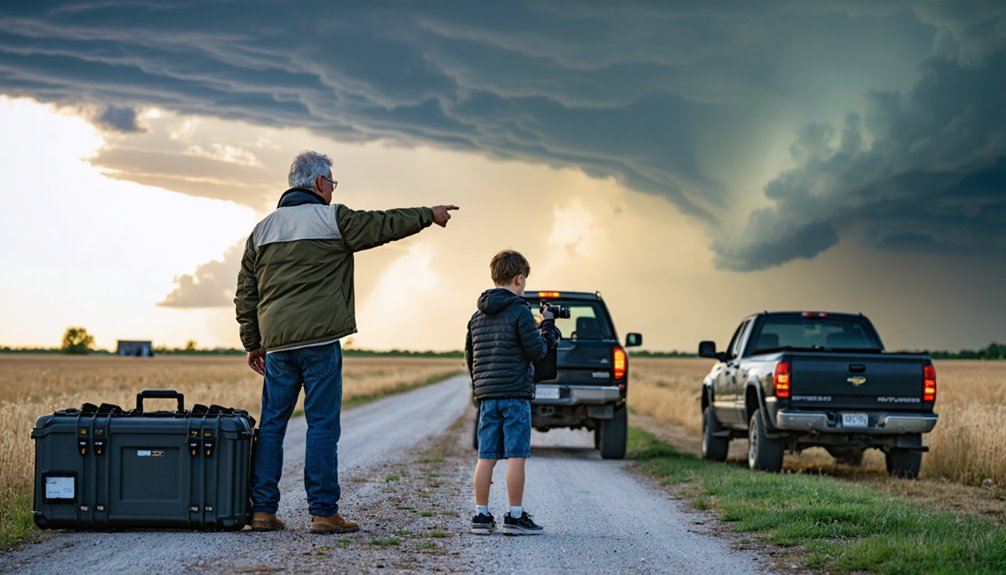
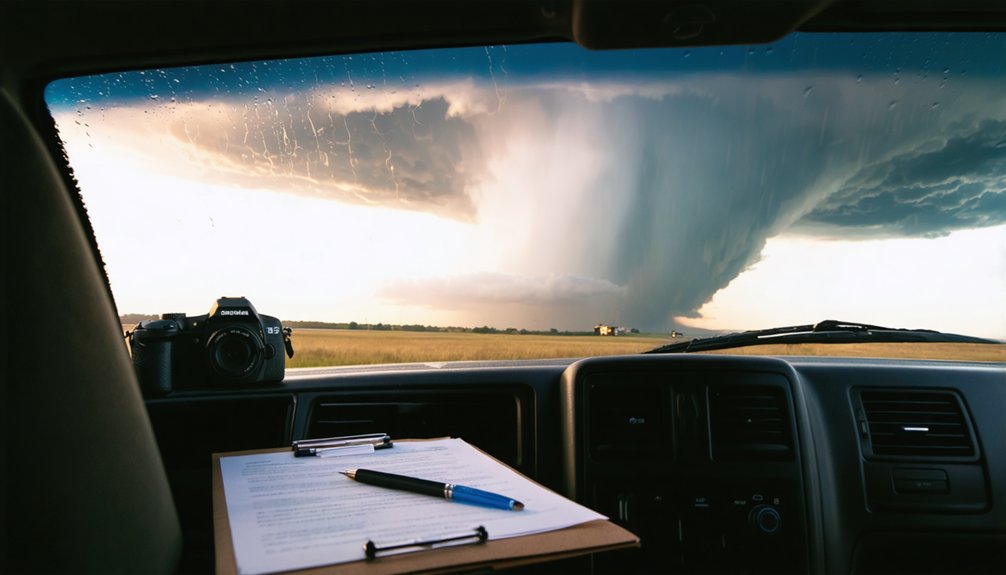
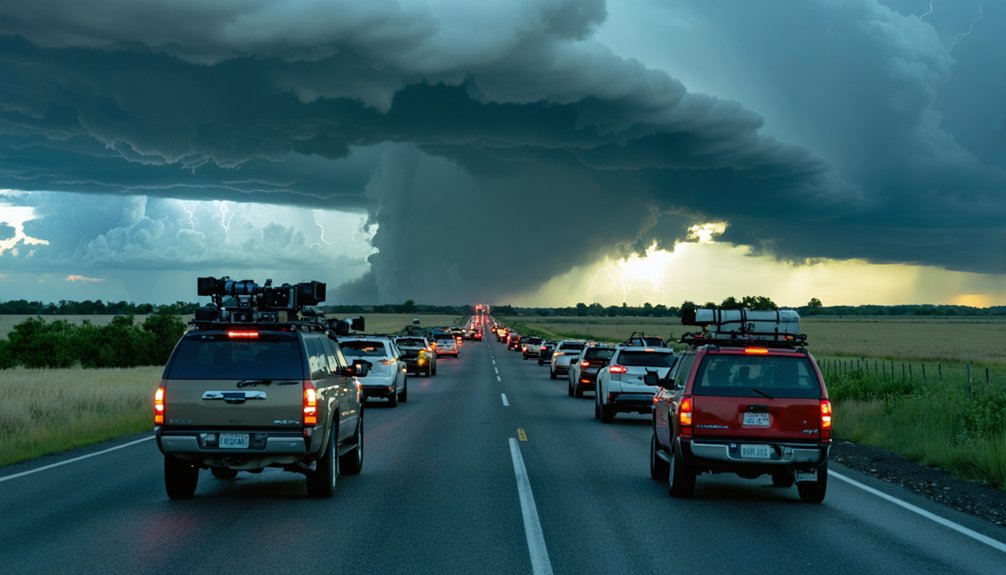
To compete successfully in storm chasing, you’ll need calibrated forecasting skills, reliable radar tools, and a structured safety framework. Start by analyzing SPC Convective Outlooks and cross-referencing GFS, NAM, and HRRR models the night before deployment. Equip your vehicle with redundant GPS units, stabilized HD cameras, and directional microphones. Maintain at least one mile from active circulation and pre-map multiple escape routes. Master these fundamentals, and the scoring criteria, documentation strategies, and positioning tactics ahead will sharpen your competitive edge markedly.
Key Takeaways
- Mount redundant GPS units, preload offline maps, and use RadarScope for real-time 90-second radar refresh cycles during chases.
- Use stabilized, high-definition cameras with directional microphones and continuous timestamps to maximize documentation scoring potential.
- Cross-reference GFS, NAM, and HRRR models nightly to identify primary targets and critical storm severity indicators before dawn.
- Maintain at least one mile from active tornadoes and pre-map multiple paved escape routes before storm intensification begins.
- Conduct post-chase review within 24 hours, analyzing forecast accuracy, intercept timing, positioning, and documentation clarity for future improvement.
What Storm Chasing Competitions Actually Score
Storm chasing competitions don’t reward the chasers who get closest to a tornado—they reward the ones who forecast accurately, position strategically, and document clearly.
Storm chasing competitions don’t crown the closest—they crown the smartest forecasters, strategists, and documentarians.
Scoring systems prioritize your ability to identify high-probability storm zones through weather pattern analysis, then execute a safe, calculated intercept. Reckless proximity earns you nothing.
You’re judged on forecast precision, mesocyclone documentation quality, and timestamped visual evidence of wall clouds and tornado formation zones.
Historical storm events inform how judges evaluate target selection—did you anticipate the right corridor, or did you chase noise?
Stabilized footage, clean radar reads, and well-reasoned positioning decisions carry more weight than dramatic close calls.
Understand what’s actually scored, and you’ll chase smarter, safer, and with a legitimate shot at winning.
Read the Forecast Before Everyone Else Does
Winning a storm chasing competition starts the night before, when most competitors are still sleeping. Pull up the SPC Convective Outlook and map boundary positions while others wait for morning briefings. You’re analyzing weather pattern evolution hours ahead, identifying where wind shear and moisture convergence will collide. That’s your edge.
Cross-reference model guidance against observed surface data. Don’t trust a single model run — compare GFS, NAM, and HRRR outputs to spot consensus zones. Early identification of storm severity indicators like CAPE values, helicity, and capping strength tells you where supercell development is most probable.
Mark your primary and secondary target corridors before dawn. Competitors who react to storms lose. You want to already be positioned, watching the first updraft tower while they’re still driving.
Build Your Storm Chasing Kit Before You Deploy
Before you deploy, your kit must cover two non-negotiable categories: documentation gear and real-time navigation tools.
You’ll want a stabilized camera capable of timestamped footage to capture mesocyclone structure and tornado formation zones with precision judges can evaluate.
Pair that with RadarScope on a redundant device and a reliable GPS unit backed by strong cell coverage, and you’ve built a functional competitive advantage into your setup before the storm even fires.
Essential Documentation And Recording Gear
Whether you’re chasing for competition points or raw documentation value, your gear loadout directly determines the quality of evidence you bring back. Mount a high-definition camera on a dedicated camera stabilization rig to eliminate vibration artifacts during rapid repositioning. Judges evaluate footage clarity, so shaky, unusable clips cost you scoring potential.
Pair your video setup with a directional microphone for clean audio recording of inflow, circulation, and environmental cues. Timestamped footage syncs your visual documentation with radar data during post-event review.
Carry redundant storage — dual SD cards minimum — and waterproof your entire kit. Power banks rated for extended field deployment keep everything running when you’re hours from a charging source. Every component you neglect becomes a liability when conditions escalate fast.
Reliable Navigation And Radar Tools
Your navigation and radar stack determines whether you intercept the storm or watch it from the wrong county. Mount a redundant GPS system and confirm strong cell coverage across your projected chase corridor before you deploy. Don’t rely on a single data source when conditions shift fast.
Run RadarScope for real-time velocity products, targeting rotation signatures within 90-second refresh cycles. Pair radar with satellite imagery to track storm pattern analysis and identify boundary intersections driving supercell development. This combination lets you anticipate storm motion rather than react to it.
Pre-load offline maps covering your primary and secondary routes. Cell towers fail in severe weather cores, and losing navigation mid-chase costs you positioning points. Redundancy isn’t optional—it’s your operational foundation for competitive success.
Use Radar Tools That Keep Pace With the Storm
During an active chase, radar fluency isn’t just helpful—it’s a direct competitive advantage. You need storm radar that refreshes every 90 seconds or less, keeping your situational awareness sharp as conditions shift.
RadarScope delivers the velocity products and tilt control that let you isolate rotation signatures before they’re obvious on standard displays.
Don’t rely on a single data source. Cross-referencing multiple radar feeds improves data calibration, reducing the lag between storm evolution and your positioning decisions.
Velocity couplets, hook echoes, and debris signatures all demand fast interpretation—hesitation costs points and creates risk.
Set your radar to automatically cycle through relevant tilts during active phases. You’re chasing precision, not just proximity.
The faster you read the storm, the better your intercept angles and documentation timing become.
Safety Rules That Govern Every Positioning Decision
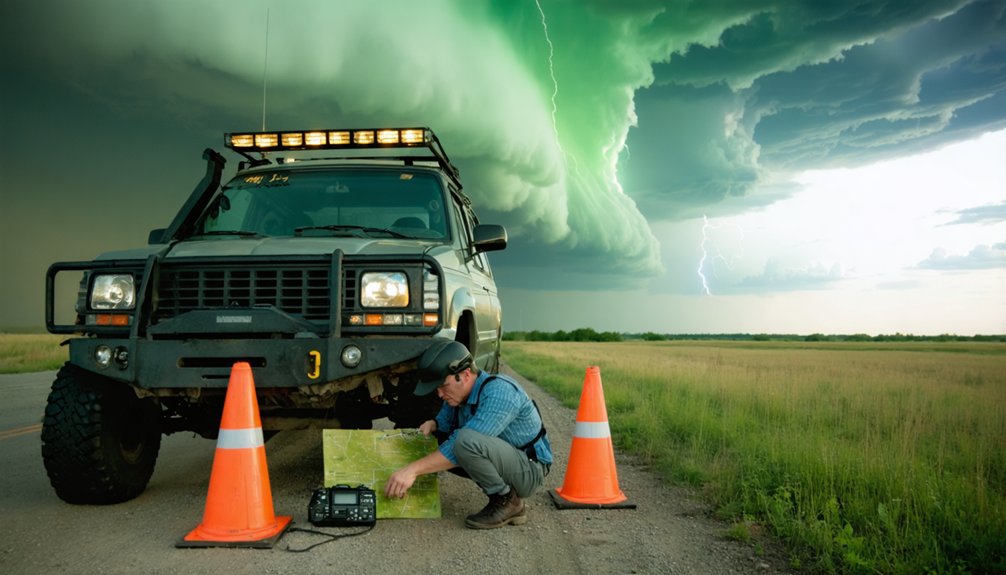
When positioning your vehicle, you must maintain at least one mile from active tornado circulation as your baseline safety threshold—getting closer doesn’t increase your score enough to justify the risk.
Before storms develop, you’ll want to map multiple unobstructed escape routes and identify sturdy shelter locations, because rapid storm movement can eliminate your options within minutes.
Rain-wrapped tornadoes, nighttime intercepts, and hail-core penetrations represent high-risk conditions where reduced visibility and compromised traction can quickly neutralize your situational awareness advantage.
Minimum Safe Distance Standards
Every positioning decision you make in a storm-chasing competition is governed by a non-negotiable baseline: maintain at least one mile of separation from an active tornado’s circulation. This storm proximity standard isn’t arbitrary—it accounts for rapid track shifts, debris fields, and visibility collapse that can eliminate your escape window within seconds.
Your safety buffer must factor in road geometry, storm forward speed, and real-time radar data. A tornado moving at 50 mph northeast while you’re positioned one mile south with a single paved exit isn’t a safe setup—it’s a trap.
Pre-map multiple unobstructed routes before storms develop. Avoid dirt roads during precipitation; traction failure eliminates your repositioning options entirely.
Distance compliance protects your life and keeps you scoring, not sidelined.
Escape Route Pre-Planning
Before a single storm fires, your escape routes need to be locked in—not improvised under pressure. Map multiple unobstructed corridors away from projected storm tracks before convection initiates. Identify road surfaces carefully—dirt and muddy routes fail under precipitation, even with 4WD engaged.
Integrate storm shelter considerations into your pre-chase mapping. Mark sturdy structures along each corridor so you’re never scrambling blind if your primary escape becomes compromised. Rapid storm movement can cut off options within minutes, so redundancy isn’t optional—it’s structural.
Establish communication protocols before you deploy. Confirm who receives your position updates, at what intervals, and through which channels if cell coverage degrades. Your escape plan and your communication plan are inseparable systems. Lock both down before the first storm cell develops.
High-Risk Intercept Conditions
Certain intercept conditions carry compounding risk profiles that override proximity scoring entirely—and recognizing them early determines whether your positioning decisions remain competitive or become dangerous.
Rain-wrapped tornadoes, nighttime intercepts, storm surge flooding, and lightning safety failures consistently eliminate chasers from contention—not through penalty, but through forced retreat or worse.
Treat these conditions as automatic repositioning triggers:
- Rain-wrapped tornadoes eliminate visual confirmation and compress your reaction window dangerously
- Nighttime intercepts degrade spatial awareness and obscure escape corridor visibility
- Storm surge zones near flood-prone terrain create rapid road-loss scenarios with no recovery
- Lightning exposure during stationary documentation increases strike probability markedly
You can’t score from a compromised position. Identify these variables before they compound, then reposition aggressively without hesitation.
Position Your Vehicle for Points and Clean Exits
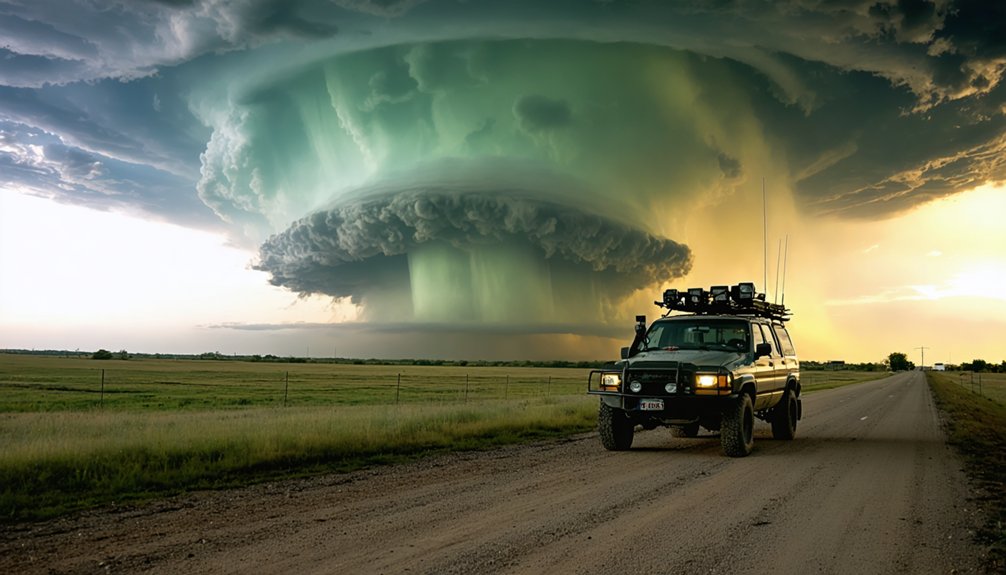
Positioning your vehicle well can make or break your score—judges reward strategic proximity, not recklessness. Before any weather pattern intensifies, you’ll want your vehicle maintenance completed—tires, brakes, and fuel checked—so mechanical failure doesn’t force a dangerous improvised exit.
Target positions at least one mile from active tornado circulation, maintaining clear visual angles on mesocyclone structure. Map multiple paved escape routes in advance; dirt roads become traps when precipitation saturates the ground. Avoid road networks that funnel you perpendicular to a storm’s forward track.
Cross-reference your position against radar refresh cycles every 90 seconds during active intercept. If your exits narrow, reposition immediately—points lost from distance are recoverable; a compromised escape route isn’t. Strategic discipline separates competitive chasers from reckless ones.
Document Storm Chasing Footage the Way Judges Score It
Once your vehicle is locked into a strategic position, documentation quality becomes the next scoring variable you can directly control. Judges reward strategic proximity and structured evidence, not chaos. Your footage must reflect disciplined execution against a complex weather pattern.
Once position is secured, documentation quality becomes your most controllable scoring variable — judges reward structured evidence, not chaos.
Prioritize these documentation fundamentals:
- Stabilize every shot — shaky footage loses credibility regardless of storm intensity
- Timestamp continuously — judges cross-reference your position against storm prediction timelines
- Frame mesocyclones and wall clouds — these structures carry the highest scoring weight
- Capture formation zones — tornado development sequences outperform static wide shots
Review your footage post-chase to identify targeting gaps and calibrate future decisions. Treat every clip as data. Clean, timestamped, structurally-focused documentation separates calculated competitors from thrill-seekers and directly controls how judges assess your performance.
Review Your Chase Data to Sharpen the Next Run
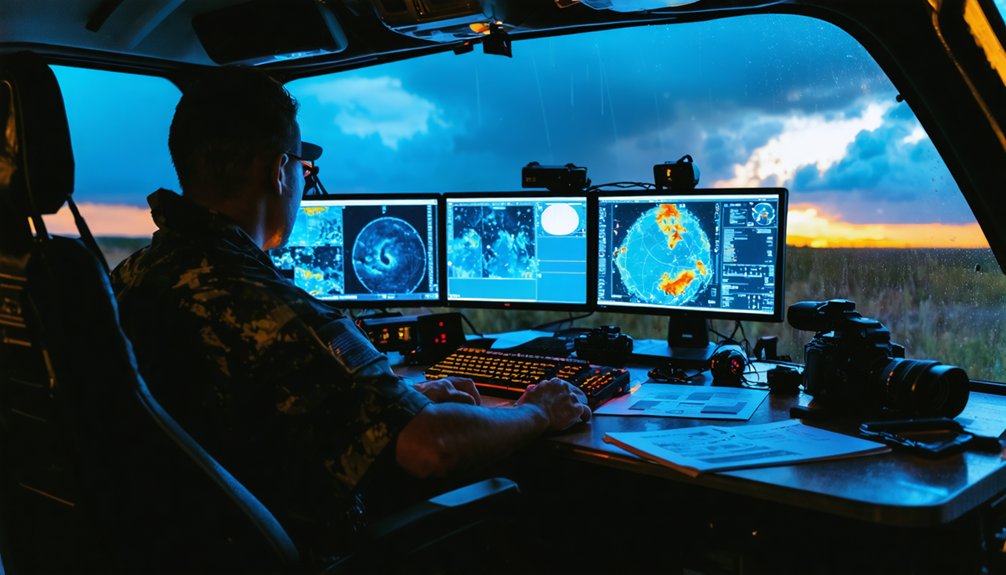
After the chase ends, your post-event data review becomes the highest-leverage activity for improving competitive performance. Compare your forecast against actual storm evolution to identify where your target selection drifted.
Pull your timestamped footage and GPS logs together, then map your positioning relative to mesocyclone zones and escape corridors you chose.
Your data analysis should isolate three core performance metrics: forecast deviation, intercept timing, and documentation clarity. Where did your radar reads lag behind storm movement? Where did route decisions cost you proximity points? Each gap is a calibration opportunity.
Run this review within 24 hours while situational memory remains sharp. Log your findings systematically so pattern recognition builds across multiple chase events.
You’re not just reviewing one run—you’re engineering the next one.
Frequently Asked Questions
How Do Storm Chasing Competitions Handle Participant Disqualification Mid-Event?
If you violate disqualification protocols—like breaching safety rules or ignoring conduct standards—you’re removed immediately. Judges monitor participant conduct in real time, pulling you from competition when unsafe positioning or documentation fraud’s confirmed mid-event.
Are Storm Chasing Competitions Insured Against Vehicle Damage or Injury?
Most competitions don’t provide insurance coverage for vehicle damage or injury. You’ll typically sign liability waivers transferring risk to yourself, so securing your own independent coverage before competing is essential for protecting your freedom and assets.
Can Beginners Enter Elite Storm Chasing Competitions Without Prior Experience?
Most elite storm chasing competitions are invite-only—you can’t simply sign up. With only top forecasters qualifying, beginner preparation and storm chasing safety training through NWS spotter programs must come first before you’ll ever earn consideration.
How Are Competition Winners Officially Notified After a Storm Chasing Event?
The knowledge doesn’t specify how you’re officially notified after winning. Focus on mastering weather prediction and safety protocols — organizers typically contact you directly once they’ve reviewed your timestamped documentation and scored your performance data.
Do Storm Chasing Competitions Require Participants to Carry Medical Emergency Equipment?
The knowledge base doesn’t explicitly confirm requirements, but storm safety demands you don’t overlook medical preparedness. You’ll strengthen your competitive readiness by carrying emergency supplies, aligning with protocols that tie safety compliance directly to performance.
References
- https://extremetornadotours.com/
- https://www.facebook.com/melaniemetzstormchasing/posts/great-list-of-storm-chasers-here/1165437485585140/
- https://en.wikipedia.org/wiki/Storm_chasing
- https://crazystormchasers.com/best-tips-for-storm-chasing-competitions-success/
- https://crazystormchasers.com/insider-tips-for-storm-chasing-competitions/
- https://www.youtube.com/watch?v=4GhvqEM7tX8
- https://www.youtube.com/watch?v=bJDejARiuJM
- https://de.wikipedia.org/wiki/Red_Bull_Storm_Chase