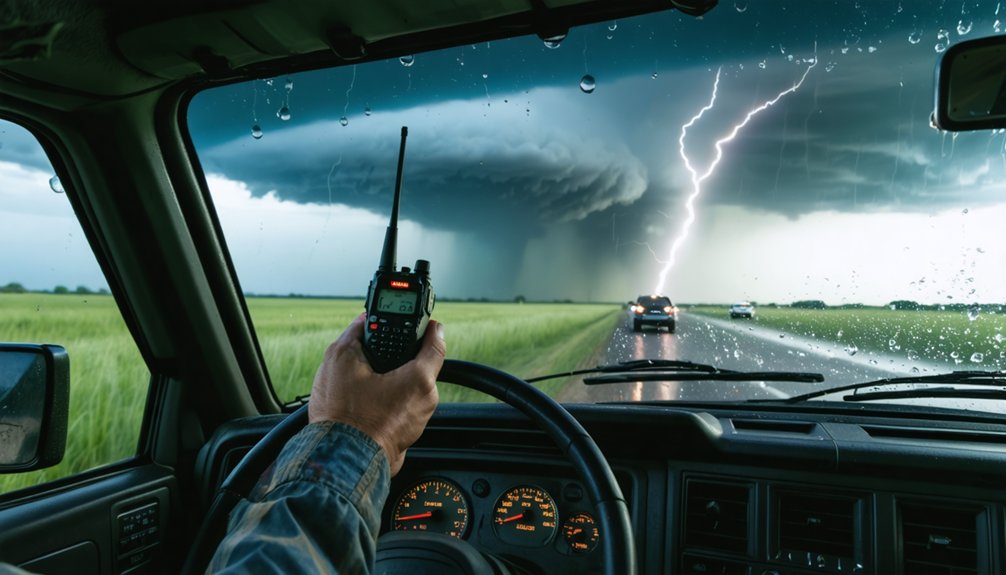
Clear communication is the single variable that most often separates a safe repositioning from a life-threatening trap. When a tornado shifts suddenly, you need to relay precise location, storm motion, and hazard data instantly—delays cost lives. Redundant channels like HAM radio, satellite phones, and personal locator beacons keep your team connected when primary systems fail. Stick around, and you’ll discover exactly how to build the protocols that keep your whole team aligned when it matters most.
Key Takeaways
- Clear communication enables immediate relay of critical weather data, helping teams reposition safely when tornadoes shift unexpectedly.
- Redundant communication channels prevent loss of situational awareness, ensuring continuous information flow if primary systems fail.
- Precise, timely ground-truth reports shorten the gap between hazard detection and public warnings, potentially saving lives.
- Structured team communication eliminates dangerous assumptions, ensuring coordinated vehicle movements and synchronized escape route decisions.
- Fast, accurate reporting distinguishes between safe repositioning and life-threatening danger during rapidly evolving storm conditions.
Why Clear Communication Can Mean Life or Death in Storm Chasing
When a tornado shifts direction in seconds, clear communication isn’t a courtesy—it’s the mechanism that keeps you alive. Unpredictable weather patterns demand that you relay critical information immediately—before roads flood, signals drop, or visibility collapses.
Communication barriers cost time you don’t have. If you’re spotting for the National Weather Service, delayed reports mean delayed warnings, and delayed warnings mean people don’t move. You’re expected to contact the forecast office directly for life-threatening threats, not after the fact.
Delayed reports mean delayed warnings. In severe weather, that gap doesn’t just cost time—it costs lives.
In the field, every second of hesitation compounds risk. Radar runs behind real-time conditions, so your verbal reports become the ground truth that guides emergency response.
Accurate, fast communication isn’t protocol for its own sake—it’s the difference between your team repositioning safely and driving into a tornado’s path.
How to Build a Storm Chasing Communication Plan Before You Leave
Before you leave the staging area, assign every team member a fixed role—driver, navigator, communicator, or logger—so no task falls through during fast-moving conditions.
You should then test every communication channel in your kit, including HAM radio, two-way radios, and satellite backup, confirming each one transmits and receives clearly.
Don’t assume your primary cellular network will hold; network outages are common enough in severe weather zones that untested backups become liabilities rather than safety nets.
Assign Roles Before Deploying
How roles get assigned before a chase begins determines whether your team communicates clearly under pressure or breaks down when conditions deteriorate. Designate a driver, navigator, communicator, and logger before deployment. Each role carries specific responsibilities that shouldn’t overlap during active storm operations.
Run team briefings before every chase to confirm role assignments, communication protocols, and fallback procedures. Verbal confirmation of each member’s duties removes ambiguity when radar updates demand fast decisions.
Your communicator handles spotter reports and radio traffic. Your navigator tracks escape routes and storm motion. Your logger timestamps observations for post-chase analysis.
Predefined roles prevent conflicting instructions when visibility drops or roads close. Teams that skip this step risk hesitation at exactly the wrong moment, putting everyone directly in the storm’s path.
Test All Backup Channels
Roles mean nothing if your team can’t communicate when cell networks fail. Before any storm prediction drives you into the field, test every backup channel you’re carrying. That means powering on your HAM radio, NOAA Weather Radio, and two-way radios under real conditions, not just at home.
Verify that satellite phones connect and that emergency beacons transmit confirmed signals. Run your inverters and portable chargers to confirm they hold load during extended operation.
Document which frequencies your team monitors and share that list before departure. Weather patterns shift faster than carriers restore signal coverage, so redundancy isn’t optional.
If one system fails mid-chase, you need another already active. Test everything before you leave, because discovering a dead radio during a closing tornado is a fatal delay.
What Storm Chasers Must Report and When to Call the NWS Directly
When you spot a tornado, large hail, or flash flooding, you must report it to the National Weather Service immediately—don’t wait for conditions to stabilize or for someone else to make the call.
Your ground-truth observations help forecasters verify radar data and issue timely public warnings, so accuracy and speed both matter.
If the threat is life-threatening and imminent, bypass standard channels and contact your local NWS forecast office directly, even if you’ve already posted to social media or sent an email.
Essential Reports For Spotters
Knowing what to report and when to call can determine whether a warning reaches the public in time. Weather variability moves faster than most communication barriers allow, so you must prioritize direct contact with your local National Weather Service forecast office for life-threatening, imminent threats. Don’t wait for email or social media to deliver critical data.
Your essential reports should include confirmed tornado development, hail size with diameter measurements, estimated wind speeds, flash flood onset, and structural damage. Include your exact coordinates, observation time, and storm motion direction. Keep transmissions brief and precise.
If roads, visibility, or signal coverage collapse around you, switch immediately to HAM radio or NOAA Weather Radio. Redundancy isn’t optional — it’s your operational foundation when networks fail mid-storm.
When To Call NWS
Calling the National Weather Service directly isn’t a backup option — it’s your primary channel when life-threatening conditions are imminent. Don’t wait for email or social media to process your observation. When you spot a tornado, large hail, damaging winds, or flash flooding, contact your regional forecast office immediately.
Avoid common communication pitfalls like vague location descriptions or delayed reports. Precision matters — give your GPS coordinates, storm motion, and observable damage without unnecessary detail.
Proper reporting etiquette means staying brief, factual, and sequential: location first, hazard second, movement third.
If people or property are in immediate danger, call 911 alongside your NWS report. Redundant reporting in life-threatening scenarios isn’t overkill — it’s protocol. Every second between your observation and official confirmation affects warning lead time.
How Team Roles and Protocols Prevent Dangerous Mistakes
Storm chasing teams that assign roles before deployment make fewer critical errors during fast-moving conditions. When you designate a driver, navigator, communicator, and logger in advance, you eliminate communication barriers that form under pressure. Each person executes a defined function without waiting for direction, which keeps decision-making fast and accurate.
Hierarchical clarity matters most when conditions deteriorate rapidly. You should verbally confirm repositioning decisions, hazard assessments, and escape routes before your vehicle moves. Standardized protocols prevent dangerous assumptions that form when visibility drops or signals fail.
If multiple vehicles are operating in the same storm environment, coordination becomes even more critical. Conflicting decisions or unconfirmed movements can block your only exit. Clear internal communication isn’t optional—it’s the operational standard that keeps your team out of a tornado’s path.
The Backup Communication Gear Every Storm Chaser Should Carry
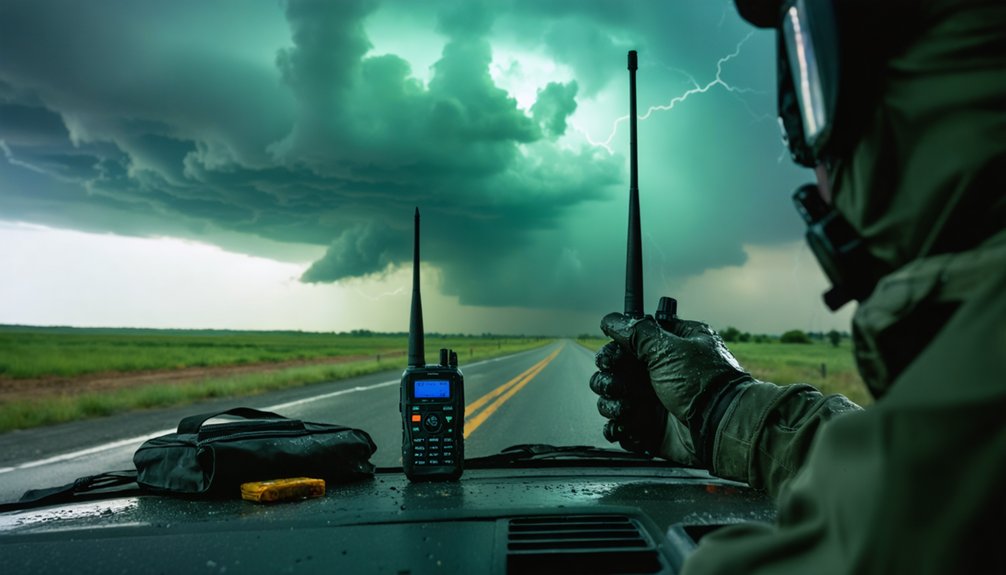
Even the clearest team protocols break down when your primary communication network goes offline. Cellular outages hit frequently in severe weather zones, so your emergency preparedness kit must include NOAA Weather Radio, HAM radio, and two-way radios as non-negotiable backups.
Satellite phones and personal locator beacons add another redundancy layer when mobile data drops entirely. Your communication protocols should designate which backup channel activates first and when to escalate to the next.
Test every device before deployment, not during the chase. Power inverters and portable chargers keep your gear operational across extended operations.
When one system fails, you shift immediately to the next without hesitation. Redundant channels aren’t optional equipment. They’re the difference between maintaining team contact and losing situational awareness at the worst possible moment.
How Spotter Reports Help the NWS Warn the Public in Real Time
When you radio a confirmed tornado or report quarter-inch hail directly to your local forecast office, that data moves faster than any radar scan can verify. Your ground-truth observation closes the gap between what algorithms estimate and what’s actually happening.
NWS forecasters use your input to validate weather patterns, refine polygon boundaries, and issue warnings with tighter lead times.
Data accuracy matters here because a vague or delayed report forces forecasters to work with incomplete information, weakening the quality of public alerts. When you transmit exact coordinates, event type, and time, you’re directly shortening the gap between hazard detection and protective action.
That means more people receive warnings early enough to act. Your clear, timely report isn’t supplemental—it’s operationally critical.
How to Recognize Abort Signs Before Your Exit Closes
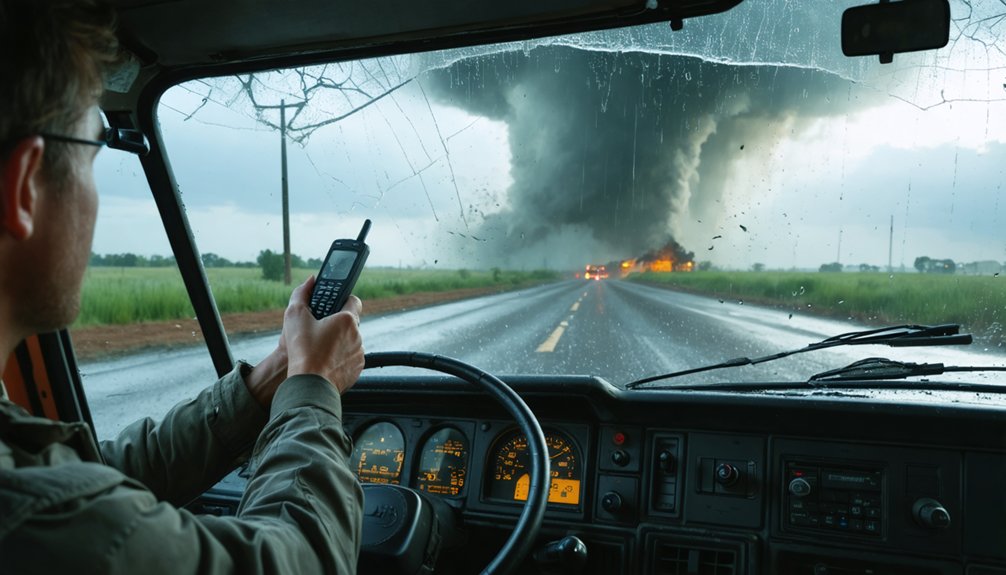
Recognizing abort signs early is what keeps a chase survivable, because once your exit closes, you’re reacting instead of deciding. Watch for three converging indicators: radar showing rapid inflow tightening, visible wall cloud rotation accelerating, and your designated emergency exit becoming visually obscured or road-blocked.
Any single sign warrants reassessment. Two signs mean you move immediately.
Communication failure compounds every abort decision. If your radio drops, GPS freezes, or mobile data cuts out simultaneously during a chase, treat it as a structural abort trigger, not a temporary inconvenience. These failures remove your situational awareness precisely when you need it most.
Verbally confirm your repositioning route with your team before moving. Hesitation after an exit closes isn’t caution, it’s entrapment. Decide early, communicate clearly, and move before conditions force your hand.
How Real-Time Ground Reports Keep Your Whole Team Aligned
Real-time ground reports are the connective tissue that stops your team from acting on conflicting pictures of the same storm. Radar lags. Your eyes don’t. When you verbally confirm tornado development, hail diameter, or road closures the moment you observe them, every team member recalibrates instantly.
Build your communication hierarchy before deployment. Designate who speaks first, who logs, and who drives. Signal prioritization determines which channel carries life-critical updates versus routine repositioning calls. HAM radio takes precedence when cellular drops. Satellite messaging handles non-urgent coordination.
Without structured reporting, one vehicle repositions based on outdated data while another holds position on a closing escape route. Ground truth, transmitted clearly and immediately, collapses that gap. Your team moves as one unit because everyone’s working from the same verified reality.
Frequently Asked Questions
How Do Storm Chasers Legally Access Restricted Areas During Active Emergencies?
⚠ Access isn’t automatic — you earn it through credentials. You’ll follow emergency protocols by coordinating with law enforcement, presenting official spotter identification, and maintaining storm safety standards that grant you legitimate field access during active emergencies.
What Certifications or Training Programs Are Required Before Becoming an Official Storm Spotter?
You don’t need mandatory certifications, but you’ll want to complete SKYWARN’s free weather training program. It equips you with storm spotting fundamentals, letting you report verified data directly to the National Weather Service independently.
How Do Storm Chasers Handle Mental Health Stress After Witnessing Extreme Destruction?
You build emotional resilience by debriefing with trusted peers after intense deployments. Lean on peer support networks, document your experiences analytically, and seek professional counseling when destruction’s psychological weight compromises your operational clarity and decision-making capacity.
What Insurance Coverage Do Professional Storm Chasers Typically Carry for Their Vehicles?
You’ll need specialized insurance requirements beyond standard policies. Vehicle coverage for storm chasers typically includes all-encompassing, collision, and high-risk endorsements. Carriers like State Farm or specialty insurers offer policies tailored to your extreme-use field operations.
How Do Storm Chasers Fund Their Expeditions and Cover Operational Costs?
Funding fuels your storm chase logistics through sponsorships, grants, media contracts, and crowdfunding. You’ll also leverage university research budgets, documentary deals, and merchandise sales as key funding sources to cover equipment, fuel, and operational costs efficiently.
References
- https://www.weather.gov/bou/spotters
- https://www.atms.unca.edu/cgodfrey/courses/swfex/pdf/ChasingSafety.pdf
- https://crazystormchasers.com/best-practices-for-storm-chasing-safety-engagement/
- https://crazystormchasers.com/storm-chasing-safety-rules/
- https://crazystormchasers.com/what-safety-precautions-should-storm-chasers-follow/
- https://crazystormchasers.com/why-is-coordination-crucial-between-storm-chasing-teams/
- https://noaa-mirror.org/www.weather.gov/gid/spotterinformation
- https://crazystormchasers.com/creating-emergency-communication-plans-for-storm-chaser-teams/
- https://midweststormchasers.org/safety-tips/
- https://crazystormchasers.com/why-is-teamwork-essential-in-storm-chasing-championships/